Massachusetts's official state bird is the Black-capped Chickadee (Poecile atricapillus, historically listed in the statutes as Penthestes atricapillus). The designation is codified in Massachusetts General Laws, Part I, Title I, Chapter 2, Section 9, which names 'the chickadee' as the 'bird or bird emblem of the commonwealth.' It has held that title since March 21, 1941, making it one of the earlier state bird designations in New England.
What Is the State Bird for Massachusetts? Identification Guide

Marcus Webb
21 Apr 2026
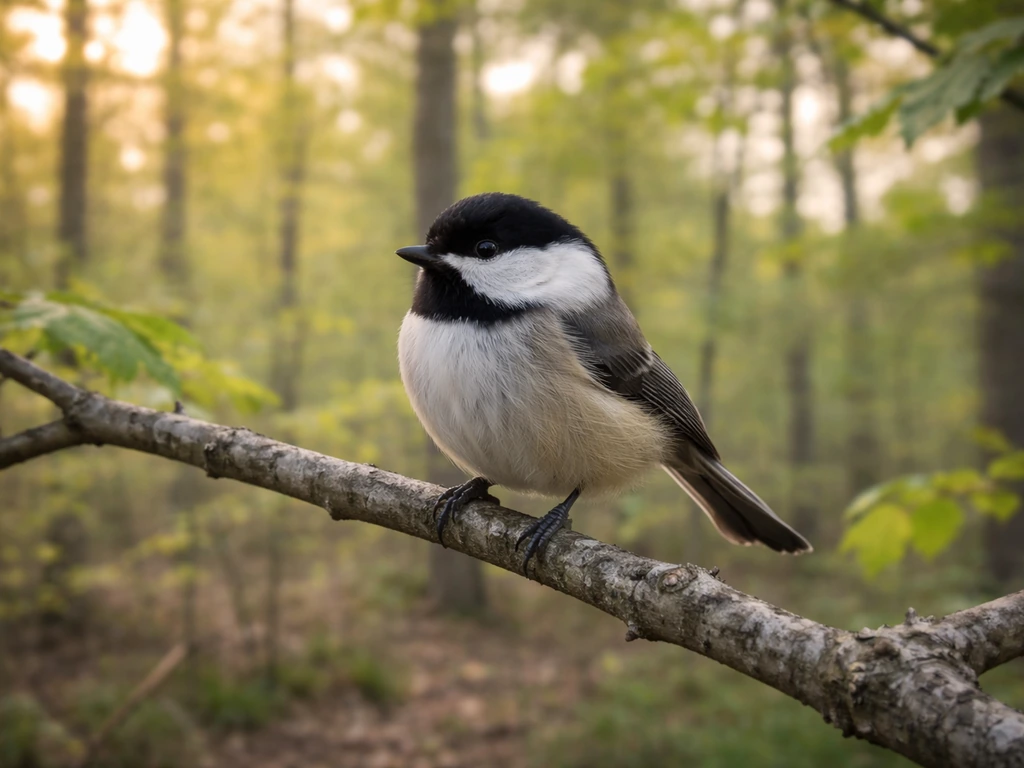
How to identify the Black-capped Chickadee
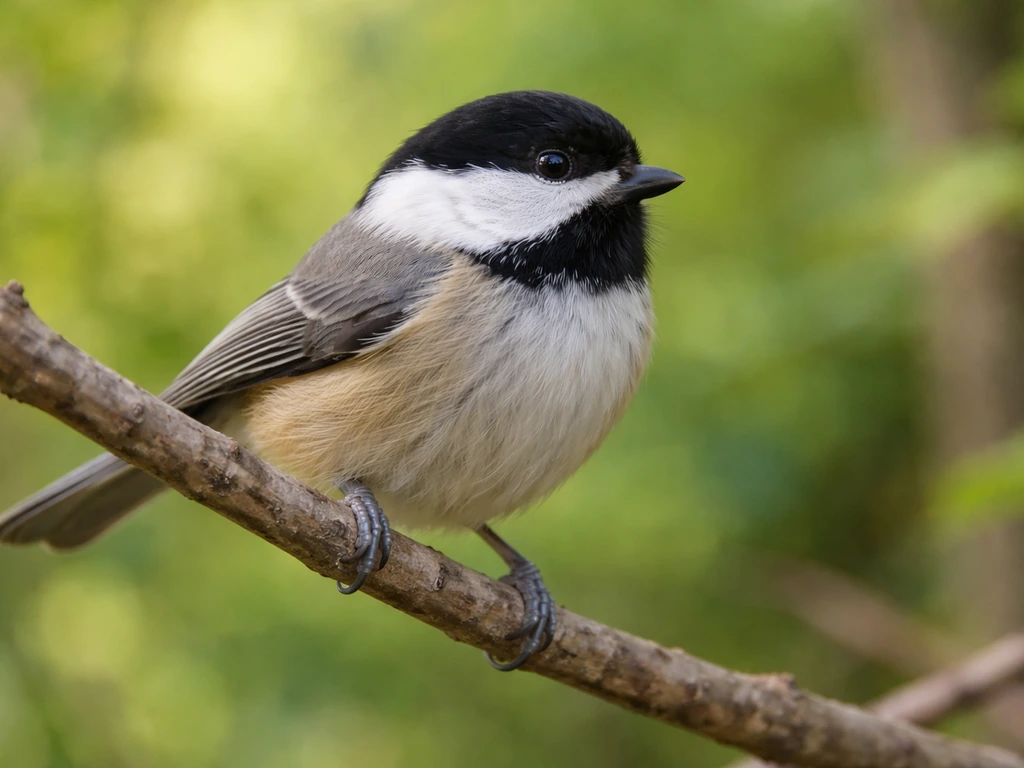
The Black-capped Chickadee is a small, compact bird that most people recognize instantly once they've seen it a couple of times. It measures 5 to 6 inches long (12 to 15 cm), has a wingspan of 6 to 8 inches (15 to 20 cm), and weighs just 0.3 to 0.5 oz (9 to 14 g). It's genuinely tiny, about the size of a large walnut.
Key field marks at a glance
- Solid black cap covering the top of the head down to eye level
- Matching black bib under the chin and throat
- Bright white cheeks that contrast sharply with the black cap and bib
- Gray back and wings with no bold wing bars
- Buff or pale orange-buff wash along the sides and flanks
- Small, stubby bill suited for picking insects and seeds
Calls and songs that confirm the ID
If you're ever unsure by sight, the sound clinches it. The species name is literally in its most famous call: a clear, buzzy 'chick-a-dee-dee-dee' that the bird uses as a contact and all-clear signal. The more 'dee' notes added to the end, the higher the alarm level. Its song is a simple, pure whistled 'fee-bee' or 'hey sweetie,' just two or three notes in a descending pitch, delivered slowly and cleanly. You'll also hear a thin, high-pitched 'see' used as a sharper alarm note. These sounds are easy to learn and worth knowing because they'll put you onto chickadees in the field faster than scanning the branches.
Watch out for the Carolina Chickadee look-alike
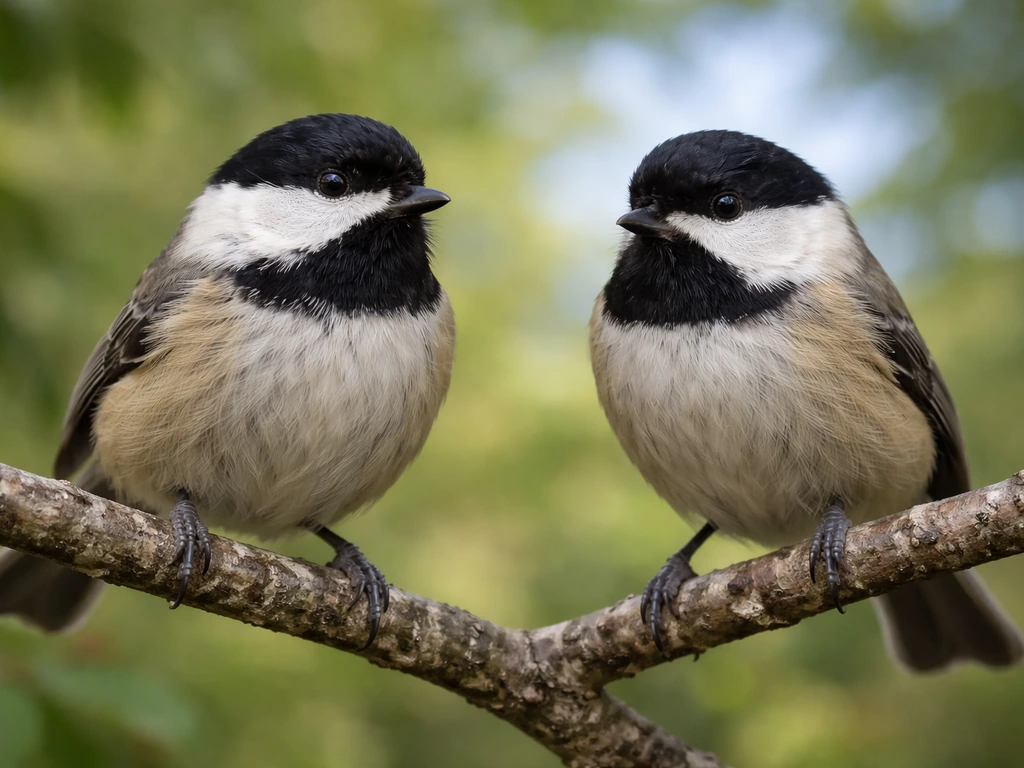
The one real identification challenge is separating the Black-capped Chickadee from the Carolina Chickadee. Audubon’s Field Guide includes identification guidance and notes on Black-capped Chickadee calls and songs, including how to distinguish them from Carolina Chickadee where their ranges overlap distinguishing the Black-capped Chickadee from the Carolina Chickadee. Both species share the same black cap, black bib, and white cheek pattern. In Massachusetts, this is rarely a practical problem because the Carolina Chickadee's range sits well to the south, but along a narrow hybrid zone in the mid-Atlantic and Appalachian states, the two species can intergrade and become genuinely difficult to assign. If you're in Massachusetts, the bird you're looking at is almost certainly a Black-capped. The most reliable separation, when needed, comes down to the song: the Black-capped's 'fee-bee' is a clean two-note whistle, while the Carolina's song is a faster four-note pattern.
Where to find it in Massachusetts
One of the strongest arguments for choosing this bird as the state symbol is how thoroughly it covers the state. Mass Audubon puts it plainly: Black-capped Chickadees can be found in all corners of the Commonwealth wherever there are at least a few trees. That's not an exaggeration. You'll encounter them in deep mixed forest, along the edges of deciduous woodlands, in willow and alder thickets near wetlands, in suburban parks, and reliably at backyard feeders from Cape Cod to the Berkshires.
The species favors open woods and forest edge habitat over dense, closed-canopy forest, and it especially gravitates toward birches and alders when available. It avoids purely coniferous stands, so a spruce plantation isn't where you'll find it. Chickadees are year-round residents, so there's no seasonal window to worry about. If you want a reliable sighting, set up a feeder with sunflower seeds or suet in a yard near any deciduous trees and you'll typically see them within days, if not hours.
One thing worth knowing for deeper birding: chickadees are cavity nesters, meaning they depend on dead or decaying trees for nesting sites. Healthy chickadee populations are a sign that a woodland still has enough structural diversity, including standing dead wood, to support the full range of cavity-dependent wildlife.
Why Massachusetts chose the chickadee
The selection makes a lot of intuitive sense when you think about what Massachusetts actually looks like on the ground. The state is not a single type of landscape. It mixes dense deciduous forest, old agricultural land, suburban neighborhoods, coastal areas, and urban pockets, sometimes within a few miles of each other. The Black-capped Chickadee is one of the very few species genuinely at home in all of those settings. Mass Audubon describes it as an 'apt choice' precisely because of its comfort in that mix of forest, farmland, and suburban development that defines the Commonwealth.
There's also a personality element that makes the chickadee feel right for the role. It's a familiar, approachable bird. It doesn't flush when you walk toward it. It will visit feeders confidently, occasionally land on an outstretched hand, and fill a quiet winter forest with sound. It's the kind of bird that even non-birders recognize and have a fondness for.
The history behind the 1941 designation
The Massachusetts Legislature officially adopted the Black-capped Chickadee as the state bird on March 21, 1941. The act was recorded as Chapter 121 of 1941, titled 'An Act Designating The Chickadee As The State Bird And The American Elm As The State Tree.' That pairing is worth noting: the Legislature chose to establish both a state bird and a state tree in the same act, treating the two designations as companion symbols of the Commonwealth's natural character.
The legal language in the current statute (Chapter 2, Section 9) uses the older scientific name Penthestes atricapillus, which was the accepted taxonomy at the time of designation. Modern taxonomy places the species in the genus Poecile, so you'll see it listed as Poecile atricapillus in current field guides. The bird itself hasn't changed; only the genus name was revised as ornithologists refined the classification of tit and chickadee species.
Which other states share the chickadee as their state bird
Massachusetts is not the only state to claim the chickadee. Maine's official statutes (Title 1, Section 209) also designate the chickadee as the state bird, making Maine and Massachusetts the two states that share this species as their official bird. If you are wondering what Maine's state bird is, it is the chickadee as well. Interestingly, Maine's designation is slightly less specific in wording, listing simply 'the chickadee' rather than explicitly naming the Black-capped Chickadee, though Black-capped is the species present in Maine. If you've been looking into Maine's state bird alongside Massachusetts, you'll notice the same bird at the center of both answers.
| State | Official Bird | Year Designated | Statute Reference |
|---|---|---|---|
| Massachusetts | Black-capped Chickadee | 1941 | Chapter 2, Section 9 |
| Maine | Chickadee (Black-capped) | Not specified in research | Title 1, Section 209 |
Where to go from here
If this lookup was for a school project, a trivia question, or simple curiosity, you now have the direct answer: Massachusetts's state bird is the Black-capped Chickadee, adopted in 1941 under Chapter 2, Section 9 of the Massachusetts General Laws. Now that you know the Massachusetts state bird is the Black-capped Chickadee, you can follow this guide on how to draw massachusetts state bird. If you want to dig further into why the chickadee specifically was chosen over other candidates, the reasoning behind that 1941 decision is worth exploring in more depth. And if you're building out knowledge of state birds across New England or the full 50 states, comparing Massachusetts and Maine is a natural starting point given that both share the same species. Oregon's state bird, the Western Meadowlark, offers an interesting contrast as a wide-open grassland species chosen by a state with a very different landscape and bird community than the forested Northeast. If you are curious about Oregon’s pick, the Western Meadowlark is officially recognized as the state bird Oregon's state bird. The bird on the Oregon driver’s license is the same state bird, the Western Meadowlark Oregon's state bird.
FAQ
Is the Black-capped Chickadee definitely the state bird of Massachusetts, or could it be another chickadee species?
Massachusetts names the chickadee in the statute, and the species present throughout the Commonwealth is the Black-capped Chickadee. The Carolina Chickadee is the main look-alike, but Massachusetts records are overwhelmingly Black-capped, especially outside the narrow intergrade areas in the broader region.
What should I answer if my teacher wants the “name of the state bird,” not the scientific name?
Use “Black-capped Chickadee.” The statute’s phrasing is “the chickadee,” but the identification guide context for Massachusetts points to the Black-capped species as the correct match for the state.
If I hear “chick-a-dee” calls, does that always mean I’m hearing a Black-capped Chickadee in Massachusetts?
Not always, chickadees are vocal across species, and you can also hear similar alarm notes in other woodland birds. To be confident, pair the call with at least one additional clue, like the two-note “fee-bee” whistle song pattern described for Black-capped Chickadee.
How can I distinguish Black-capped from Carolina Chickadee when I’m unsure in the field?
The most reliable separation in practice is the song timing and note count. Black-capped tends to give a clean two-note “fee-bee,” while Carolina more often sounds like a faster four-note whistle pattern. Visual markings can overlap heavily.
Do chickadees in Massachusetts leave during winter, or are they present year-round?
They are year-round residents, so you can expect the species in Massachusetts in every season. If you’re trying to see one, your best chance is not a migration window but reliable habitat plus feeders, especially near deciduous trees.
What feeder foods actually work if I’m trying to get a Black-capped Chickadee to visit?
Sunflower seeds or suet are the most practical options. Place feeders near cover, like deciduous edges, so the birds feel safe to approach, since they rely on nearby trees for quick retreat.
Is there any habitat I should avoid if my goal is to see the state bird?
Yes, avoid areas that are mostly conifer stands with little deciduous or mixed structure. Black-capped Chickadees strongly prefer open woods and forest edges and often associate with birch and alder rather than purely coniferous plantations.
Do chickadees need dead trees for anything besides nesting, and is that relevant to their conservation in Massachusetts?
They rely on cavities made by dead or decaying trees for nesting. That means “dead wood” is not just cleanup waste in the chickadee story, it supports cavity-dependent wildlife and can be a useful indicator of healthy woodland structure.
Why do field guides list a different scientific name than the state statute uses?
The statute reflects an older genus placement, historically listed under Penthestes. Modern taxonomy places the bird in Poecile, so you may see Poecile atricapillus in current references, but it is the same bird.
Does Maine have the same state bird as Massachusetts, and will the answer on worksheets match?
Yes, both Massachusetts and Maine designate the chickadee as their state bird, and worksheets typically expect “Black-capped Chickadee” for each. Maine’s wording can be slightly less specific in statute language, but the species associated with that designation is the same one you’re likely to see.
Next Article
What Is Oregon’s State Bird? Western Meadowlark Guide
Oregon’s state bird is the Western Meadowlark. Learn quick ID tips, call clues, and where to spot it.
