California's official state bird
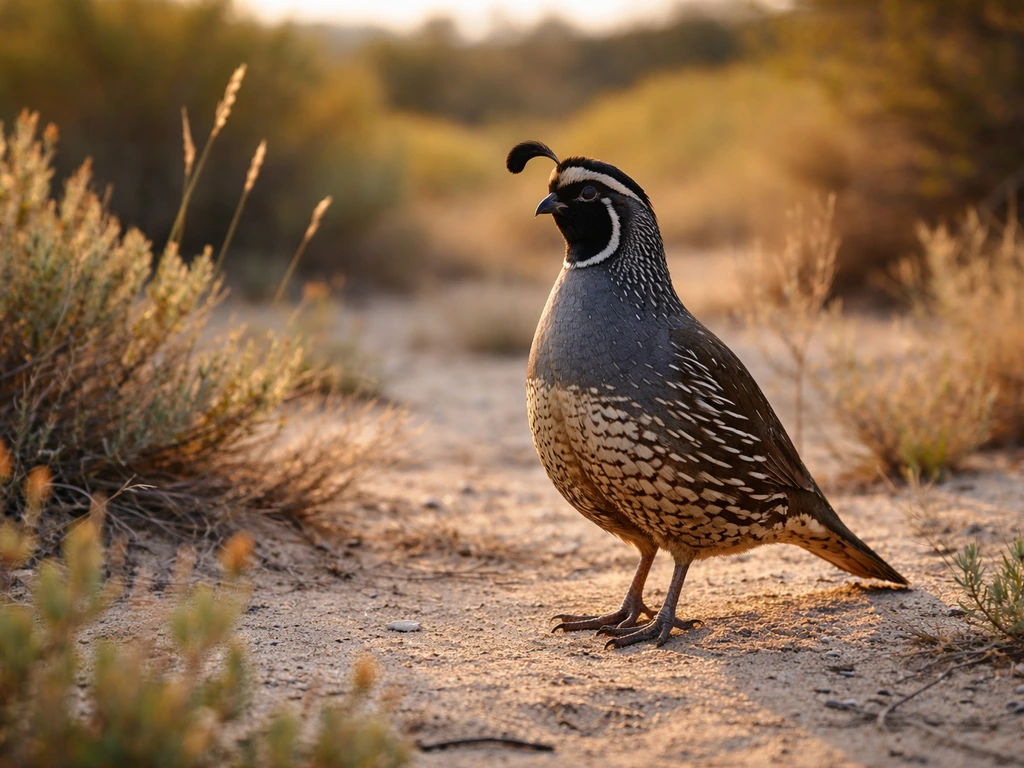
California's official state bird is the California Valley Quail (Callipepla californica, also listed under the older scientific name Lophortyx californica). It became the state bird in 1931 through Assembly Bill 776, Chapter 777, Statutes of 1931. That's the short answer. If you need it for a quiz, a school project, or just to settle a debate, there it is.
The rest of this article gives you the identification details to actually recognize this bird in the field, the reasons California picked it, and some historical and comparative context that makes the choice more interesting than it might first seem.
Why California chose the valley quail
The California Valley Quail is deeply woven into the landscape of the state. It's a native species found across a huge range of California habitats, from the coastal scrub and chaparral of Southern California to the oak woodlands of the Central Valley foothills. When legislators went looking for a bird that genuinely represented California, the valley quail was a natural fit: it's widespread, recognizable, and tied directly to the land in a way that migratory or non-native species simply aren't.
If you're curious about the deeper symbolism and rationale behind the decision, there's a dedicated look at why the quail is the state bird of California that goes further into the cultural and practical reasoning behind the 1931 designation. The short version is that the bird's native range, its association with California's natural environment, and its popularity among residents all contributed to making it the obvious choice for legislators at the time.
The legislation behind the designation
The designation is clean and well-documented. Assembly Bill 776 was passed and signed into law as Chapter 777 of the California Statutes of 1931. That single piece of legislation added the California Valley Quail to the official list of California state symbols. The California State Capitol Museum lists both the common name ("California Valley Quail") and the scientific name alongside that legislative citation, and it has remained unchanged ever since.
It's worth noting that the 1931 designation came during a broader era when many U.S. states were formalizing their official symbols. California was establishing multiple state emblems around this period, including the state flower, tree, and animal. The quail designation fits neatly into that movement to identify native species as emblems of state identity.
What the California Valley Quail actually looks like
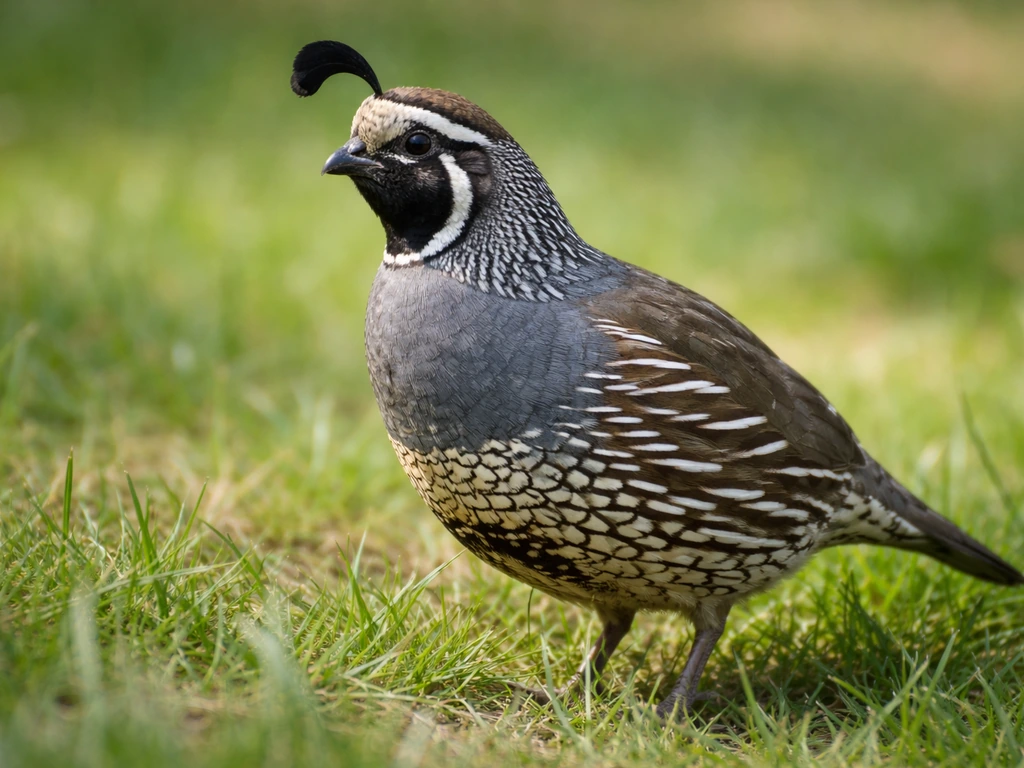
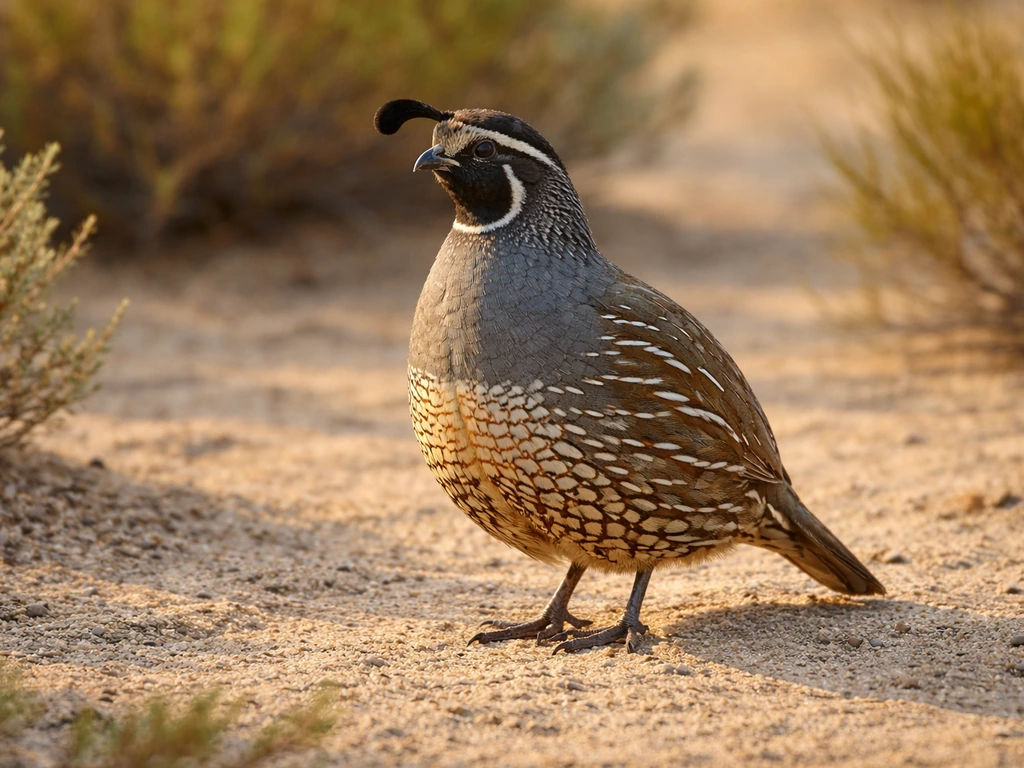
The California quail is a compact, round-bodied ground bird, roughly the size of a large fist. The feature most people notice first is the topknot: a comma-shaped plume of feathers that droops forward from the top of the head. Males have a longer, more pronounced topknot than females. Once you've seen one, you won't mistake it for anything else.
Adult males have a striking black face outlined by bold white stripes, gray-blue chest plumage, and a belly with a distinctive "scaled" black-and-white pattern, meaning the feathers have dark edges that create a fish-scale or tile-like look. There's also a chestnut patch in the center of the belly. The upperparts are a warm gray-brown. Females are more subdued overall, with a shorter topknot and a brown face rather than the bold black-and-white pattern, but they share the same scaled belly.
The one bird that sometimes gets confused with the California quail is the Mountain Quail. You can tell them apart quickly: Mountain Quail have a chestnut face, a long straight (not comma-shaped) topknot plume, and a belly with bold chestnut-and-white bars rather than the scaly pattern. If you see the scaled belly and the drooping comma topknot, you've got a California quail.
Quick ID checklist
- Comma-shaped forward-drooping topknot (longer and more pronounced in males)
- Black face with bold white stripes (adult males); brown face (females)
- Scaled black-and-white belly pattern with a chestnut center patch
- Gray-brown upperparts and gray-blue chest
- Compact, round body shape; ground-dwelling behavior
More than just a state bird: the full picture of California's symbols
If you're researching California state symbols more broadly, the quail doesn't exist in isolation. California has a full suite of official emblems, and they're often researched together. For a paired look at both the bird and the state flower side by side, the article on the California state bird and flower covers that combination cleanly.
There are also some genuinely interesting quirks about the California quail as a state symbol. If you want to dig into what sets it apart from most other state birds, what makes the state bird of California unusual is worth reading. It touches on the traits and circumstances that make this particular designation stand out compared to other states.
How to verify the designation yourself
If you need an authoritative source rather than just taking this article's word for it, the California State Capitol Museum is the most direct official resource. Their online exhibit on California state symbols lists the California Valley Quail explicitly, with the scientific name Lophortyx californica and the legislative citation (Assembly Bill 776, Chapter 777, 1931). California legislative documents referencing state symbols, such as AB 1067 from the Assembly Committee on Governmental Organization, also confirm the designation using the same language and citation.
For bird identification verification, the Cornell Lab of Ornithology's All About Birds database and the USGS bird identification resources both document the California quail's field marks in detail and confirm it as a native California species.
How California's bird compares to other states
No other U.S. state has adopted the California Valley Quail as its official state bird. The species is native primarily to California and parts of the Pacific Coast, so it makes sense that no other state has claimed it. That said, quail as a category do appear in other states' official symbol lists. Missouri, for example, designates the bobwhite quail as its state game bird (note: game bird, not state bird, which is a distinct category). The bobwhite is a completely different species from the California quail, found in the eastern and central United States rather than the West.
The broader pattern worth knowing is that several states do share the same state bird. The Northern Cardinal, for instance, is the state bird of seven different states. The California quail is one of the more unique designations precisely because it belongs to a species with a limited native range.
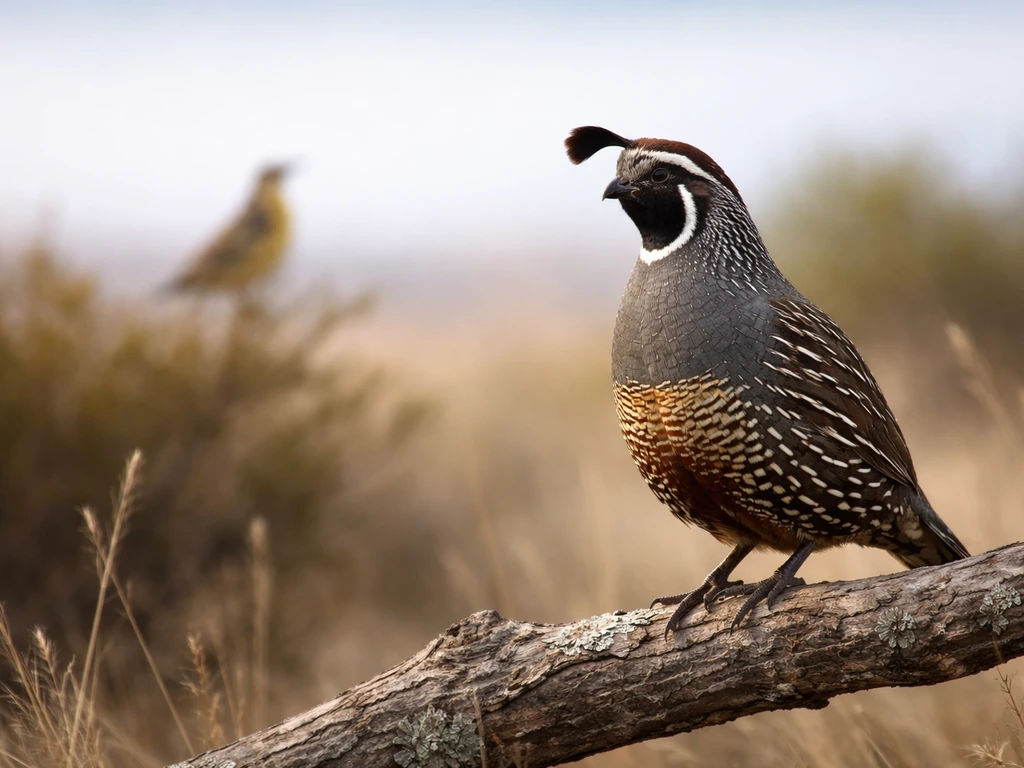
State birds at a glance: California vs. neighboring western states
| State | Official State Bird | Shared with Other States? |
|---|
| California | California Valley Quail | No (unique to California) |
| Oregon | Western Meadowlark | Yes (shared with 5 other states) |
| Nevada | Mountain Bluebird | Yes (shared with Idaho) |
| Arizona | Cactus Wren | No (unique to Arizona) |
| Utah | California Gull | No (unique to Utah) |
On that note, Utah's state bird (the California Gull) is an interesting case because the common name includes "California" even though it belongs to Utah. If you've ever run into that bird in a crossword clue context, the article on the state whose bird is the California Gull clears up the confusion quickly.
Local and regional bird designations in California
Beyond the state level, some California cities and communities have their own unofficial or official bird associations. If you're interested in how bird designations work at the local level within California, it's worth knowing that individual cities sometimes recognize a species tied to their particular coastal or inland habitat. For example, the official bird of Redondo Beach, California reflects that city's specific coastal identity rather than the statewide designation.
The California Valley Quail remains the statewide designation since 1931, unchanged, and well-documented in official legislative records. It's one of the cleaner, more straightforward state bird designations in the country: native species, clear legislation, unique to California, and still abundant across the state today.