
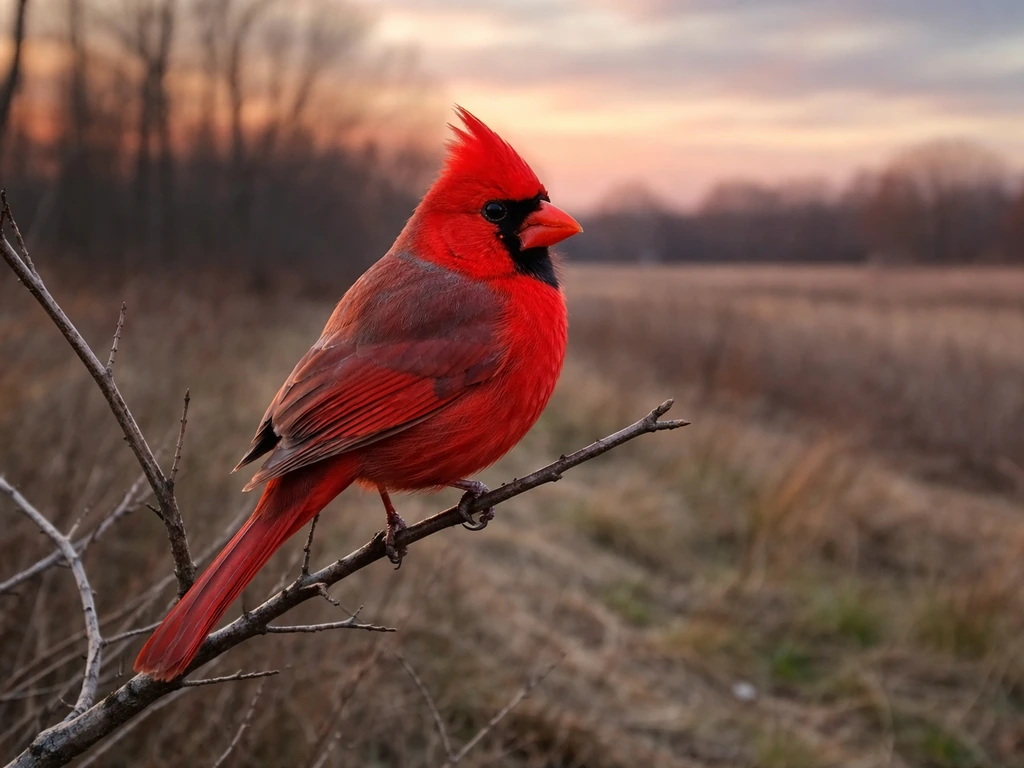
Indiana chose the northern cardinal (Cardinalis cardinalis) as its state bird in 1933 because the species is year-round, instantly recognizable, and genuinely common across the state. Illinois made the same choice four years earlier, in 1929, after a statewide schoolchildren's vote picked the cardinal over four other candidates by a wide margin. Both states were drawn to the same bird for essentially the same reasons: it stays through winter, it lives in backyards and hedgerows that everyday residents walk past, and the male's all-red plumage with a pointed crest makes it impossible to confuse with anything else.
Why Is the Cardinal Indiana and Illinois State Bird?

Marcus Webb
15 May 2026
What it means to be a state bird

A state bird is an officially designated species adopted by a state legislature to represent the state's natural character and regional identity. The designation is written into law and typically stays permanent unless the legislature actively changes it. Being named a state bird doesn't affect wildlife protections on its own, but it reflects which species residents and lawmakers felt best symbolized the state. Most state bird designations happened in the early to mid 20th century, often driven by votes organized by women's clubs, conservation groups, or schoolchildren, and then ratified by state assemblies. The idea was to pick a species that felt genuinely local, not something exotic or rare.
Why Illinois chose the northern cardinal
Illinois made the northern cardinal its official state bird on June 4, 1929. The process was driven by a statewide vote among schoolchildren, which the Illinois General Assembly then used as the basis for the formal designation. The vote wasn't close: the cardinal pulled in 39,226 votes, well ahead of the bluebird at 30,306, the meadowlark at 16,237, the quail at 15,843, and the oriole at 15,449. The Illinois State Museum documented those totals, and the Illinois Department of Natural Resources attributes the selection directly to that schoolchildren vote.
The legal text in the Illinois Compiled Statutes (5 ILCS 460/10) names the species using its scientific name, Cardinalis cardinalis, rather than just the common name "northern cardinal." That detail matters for terminology: when Illinois law says "cardinal," it means exactly this species. The Illinois DNR's own pages use "northern cardinal" and the full scientific name interchangeably, so there's no ambiguity about which bird the state is honoring.
Illinois chose the cardinal for practical, observable reasons. The bird is a permanent resident, meaning it doesn't migrate south for winter like many songbirds. Illinois schoolchildren and lawmakers were selecting something they could actually see year-round in their backyards, gardens, and forest edges. The cardinal's bright coloring and familiar song made it a natural pick as a recognizable symbol for the state's natural heritage.
Why Indiana chose the cardinal as its state bird
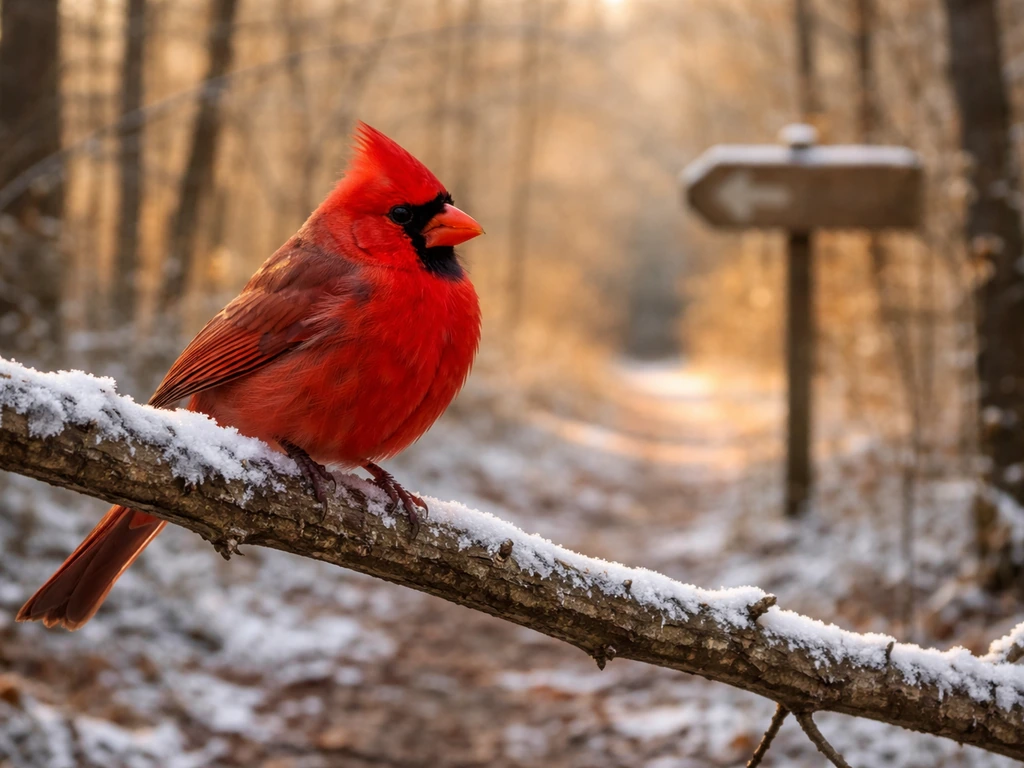
Indiana designated the cardinal as its official state bird in 1933, four years after Illinois. Indiana's state bird is commonly identified as the northern cardinal, not another species. The designation is codified in Indiana Code IC 1-2-8-1, which names the species using the older taxonomic label "Richmondena Cardinalis Cardinalis." That older name refers to the same bird now classified as Cardinalis cardinalis, so there's no confusion about what the law intended.
The Indiana History Bureau describes the bird as the "Red Bird or Cardinal" and highlights the same core traits that made it a compelling choice: male is bright red, female is brown with dull red highlights on crest, wings, and tail, and critically, the species is present year-round. Indiana residents see this bird in hedgerows, wood margins, and roadsides in every season. The Indiana DNR adds a useful identification anchor to explain the appeal: the northern cardinal is the only red bird in the United States that also has a crest. That combination of common presence and unmistakable appearance made it an easy, broad-based choice for a state symbol.
Quick identification: how to recognize a northern cardinal
The northern cardinal is a fairly large songbird with a long tail, a prominent pointed crest, and a thick, conical, coral-red bill. Those three structural features together are enough to identify it even at a distance or in poor light. According to eBird, the crest, large red bill, and long tail make this species distinctive even with a poor view.
Male and female plumages are very different, which trips up beginners. The male is entirely red with a black face mask around the bill and eyes. The female is warm brown overall with dull red tinting on the crest, wings, and tail. Both sexes share the crest and thick bill, so even a brown female cardinal is identifiable once you know what to look for. Juveniles look similar to females but have a darker bill rather than the adult's coral-red one.
Two birds sometimes get confused with the cardinal. The house finch male has rosy red coloring around the face and upper breast, but its back, belly, and tail are streaky brown, and it lacks both the crest and the heavy bill. The rose-breasted grosbeak has a large pinkish bill that can look structurally similar, but the male has a striking black-and-white pattern with a rose-red triangle on its chest. National Geographic characterizes the rose-breasted grosbeak as a bird of wooded habitats in the Midwest and eastern regions and highlights its large, pinkish bill as a key feature that can cause confusion with cardinals rose-breasted grosbeak has a large pinkish bill. Neither species has the all-red male plumage plus crest combination that makes the northern cardinal so distinct.
| Feature | Northern Cardinal | House Finch | Rose-breasted Grosbeak |
|---|---|---|---|
| Crest | Yes, prominent | No | No |
| Male color | Entirely red | Rosy red on face/breast only, streaky elsewhere | Black and white with rose chest patch |
| Bill shape | Very thick, conical, coral-red | Smaller conical bill | Large, pinkish, triangular |
| Black face mask | Yes (male) | No | No |
| Year-round in Indiana/Illinois | Yes | Yes | No (migratory) |
How the designation process worked: a quick timeline
- 1929 (Illinois): Illinois schoolchildren participate in a statewide bird vote. The cardinal wins with 39,226 votes. The Illinois General Assembly officially names it the state bird, effective June 4, 1929.
- 1933 (Indiana): Indiana's General Assembly designates the cardinal as the official state bird. The statute (IC 1-2-8-1) uses the scientific name Richmondena Cardinalis Cardinalis in the legal text.
- 1933 (North Carolina): North Carolina adopts the cardinal the same year as Indiana, with the designation driven by the North Carolina Federation of Women's Clubs before passing through the General Assembly.
- 1950 (Virginia): Virginia adopts the cardinal by House Resolution No. 9 on January 25, 1950, with the resolution specifically citing the bird's winter presence as a reason for the selection.
The pattern across states is consistent: a civic organization or schoolchildren's vote would identify a popular local species, the state assembly would ratify it, and the designation would be written into law with the scientific name included to prevent any future ambiguity about which species was intended. Both Illinois and Indiana followed this model closely.
How the same bird connects multiple states
The blank" rel="noopener noreferrer">northern cardinal is one of the most shared state birds in the country. At least seven states have designated it as their official bird, including Illinois, Indiana, Kentucky, Virginia, Ohio, North Carolina, and West Virginia. That's not a coincidence. The northern cardinal's range covers the entire eastern half of the United States, it doesn't migrate, and it adapts easily to suburban and rural environments alike. Any state in that region looking for a widely recognized, permanently resident songbird was likely to land on the same species.
The reasons each state gives for choosing it overlap significantly. Illinois points to its schoolchildren's vote and the bird's recognizability. Indiana emphasizes its year-round visibility along hedgerows and roadsides and the fact that it's the only crested red bird in the country. Kentucky and Virginia also stress the bird's winter presence, which was a recurring theme in mid-20th century state-symbol discussions: a bird that stays through harsh winters felt like a more committed local symbol than a migratory species that spends half the year elsewhere. Kentucky is among the states that cite the northern cardinal's winter presence when explaining why it became the state bird.
If you're comparing Indiana specifically with its neighbors: Indiana's 1933 designation came in the same year as North Carolina's, and both Kentucky and Virginia followed later. The shared bird creates an interesting regional thread, and if you're exploring why the cardinal keeps appearing across the Midwest and Southeast, the consistent answer is habitat range, year-round residency, and unmistakable appearance. You can dig into each state's specific reasons separately since the framing and civic processes behind each designation had their own local flavor, but the species itself earned the honor across the board for the same core reasons.
Where to go from here
If you want to confirm Indiana's or Illinois's designation for yourself, the primary legal sources are Indiana Code IC 1-2-8-1 and Illinois Compiled Statutes 5 ILCS 460/10. Both name the species in scientific notation so there's no room for interpretation. For field identification, the Illinois DNR's wild birds page and Cornell Lab's All About Birds northern cardinal account are the most practical references, with range maps, photos, and audio of the distinctive whistled song. And if you're curious about the neighboring states that chose the same bird, Kentucky and Virginia each have their own distinct stories behind why the cardinal ended up as their symbol too. In Ohio, the state flower and state bird are different symbols chosen to represent the state's character Ohio state flower and bird.
FAQ
Is the cardinal state bird of Indiana definitely the northern cardinal, not a different “cardinal” species?
Yes. Indiana’s statute names the species using a scientific label (including the older Richmondena naming), and it aligns with modern taxonomy for the northern cardinal (Cardinalis cardinalis). If you ever see “cardinal” used informally elsewhere, rely on the Indiana Code wording to confirm the exact species.
Why didn’t Indiana choose a migratory songbird instead?
For state-symbol votes in that era, organizers tended to favor birds people could reliably see in every season. A migratory species can be absent for months, which makes it a less consistent “year-round” symbol, especially for residents who experience winter conditions in the state.
Does naming the northern cardinal as a state bird legally protect it?
Not by itself. State bird status is mainly symbolic and reflects which species residents wanted to represent Indiana. Wildlife protections come from separate conservation and wildlife laws, which may or may not include specific species protections beyond general protections.
What if I only see female cardinals sometimes, does that mean they are disappearing?
Not usually. Female cardinals are present year-round like males, but their coloration is less noticeable, so they’re easier to miss. In winter, both sexes often show up more around feeders, but females can blend into branches and shrubs compared with the bright red male.
How can I tell a northern cardinal from a house finch when both show red around winter feeders?
Focus on the crest and the bill plus body shape. Northern cardinals have a prominent pointed crest and a thick conical bill, and males are uniformly red with a black face mask. House finch males are red more in patchy face or breast areas, and they lack both the crest and the heavier “cardinal” bill structure.
Can a juvenile cardinal be mistaken for something else?
Yes. Young cardinals often resemble females in overall brown tones, and their bills are darker than the bright coral-red adult bill. If you observe a crested bird with a thick conical bill but more muted color, juvenile age is a common explanation.
Is the northern cardinal considered common in Indiana specifically, or just common in the region?
It’s common in Indiana in the practical, day-to-day sense the lawmakers and voters likely cared about. The article’s descriptions match the real-world pattern that cardinals use hedgerows, wood edges, and suburban plantings, so residents encounter them without needing specialized birding locations.
Are there any times or habitats in Indiana where cardinals are less likely to show up?
They can be less frequent in heavily cleared landscapes with few shrubs, hedgerows, or edge habitats. Cardinals strongly favor cover near human activity (gardens, yards, forest margins), so the absence of those features usually reduces sightings even when the species is present statewide.
If I want to verify the law, what wording should I look for in Indiana?
Look for the species reference in Indiana Code IC 1-2-8-1. The statute uses an older scientific label, but it still points to the northern cardinal species. Treat the scientific name as the authoritative identifier rather than the common name alone.
Next Articles
Which Is Karnataka State Bird? Identification and Facts
Discover Karnataka’s official state bird, key ID traits, where to spot it, and why it was chosen.

What Is the Telangana State Bird? Official Bird and How to Spot It
Discover Telangana’s official state bird, key traits to spot it, and why it was chosen, with quick context.
What Is Andhra Pradesh State Bird? ID and Habitat Guide
Learn the Andhra Pradesh state bird, how to identify it, its habitat, and tips to spot it in the wild.