
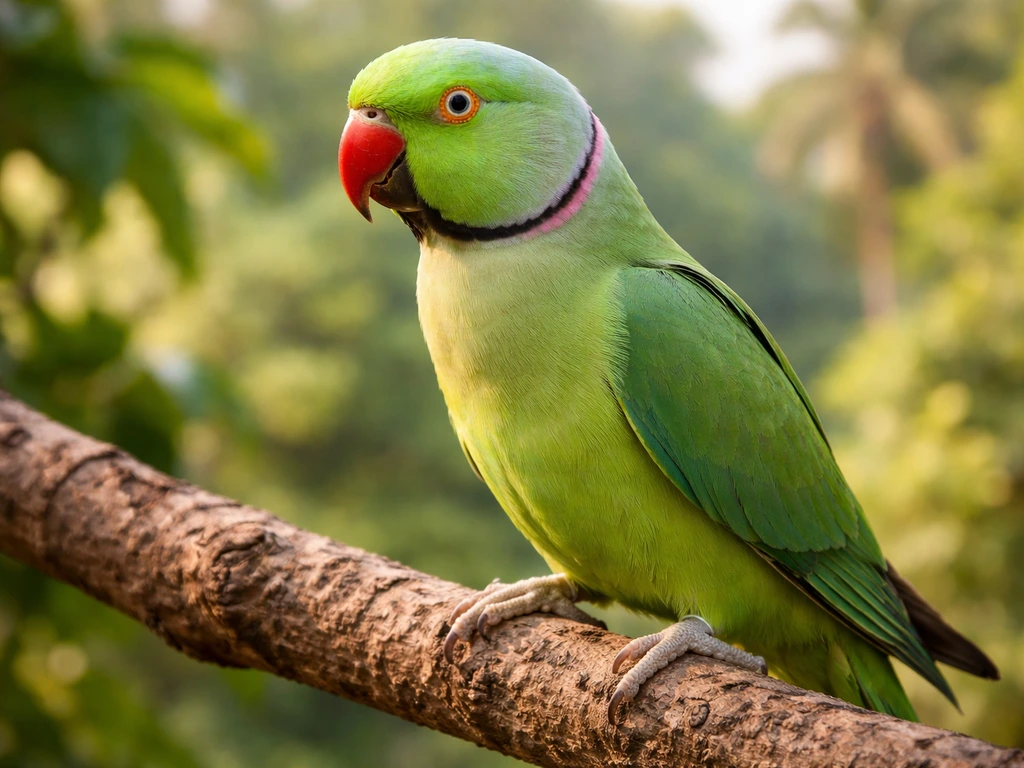
The official state bird of Andhra Pradesh is the Rose-ringed Parakeet, known locally as Rama Chiluka, with the scientific name Psittacula krameri. This was formally notified under G.O.MS.No. 59 issued by the EFS&T Department on May 30, 2018, and published in an extraordinary issue of the Andhra Pradesh Gazette on June 4, 2018.
What Is Andhra Pradesh State Bird? ID and Habitat Guide

Marcus Webb
7 Jun 2026
Why Andhra Pradesh Chose the Rose-ringed Parakeet
The choice came out of necessity as much as pride. When Andhra Pradesh was bifurcated in 2014 to create Telangana as a separate state, the original combined state's symbols stayed with neither state officially. By 2018, the AP government moved to establish its own distinct identity, notifying a full set of state symbols including the state bird, animal, tree, and flower. The government's own rationale in the order text was straightforward: it was "necessary to have separate symbols for the State of Andhra Pradesh after bifurcation of the combined State."
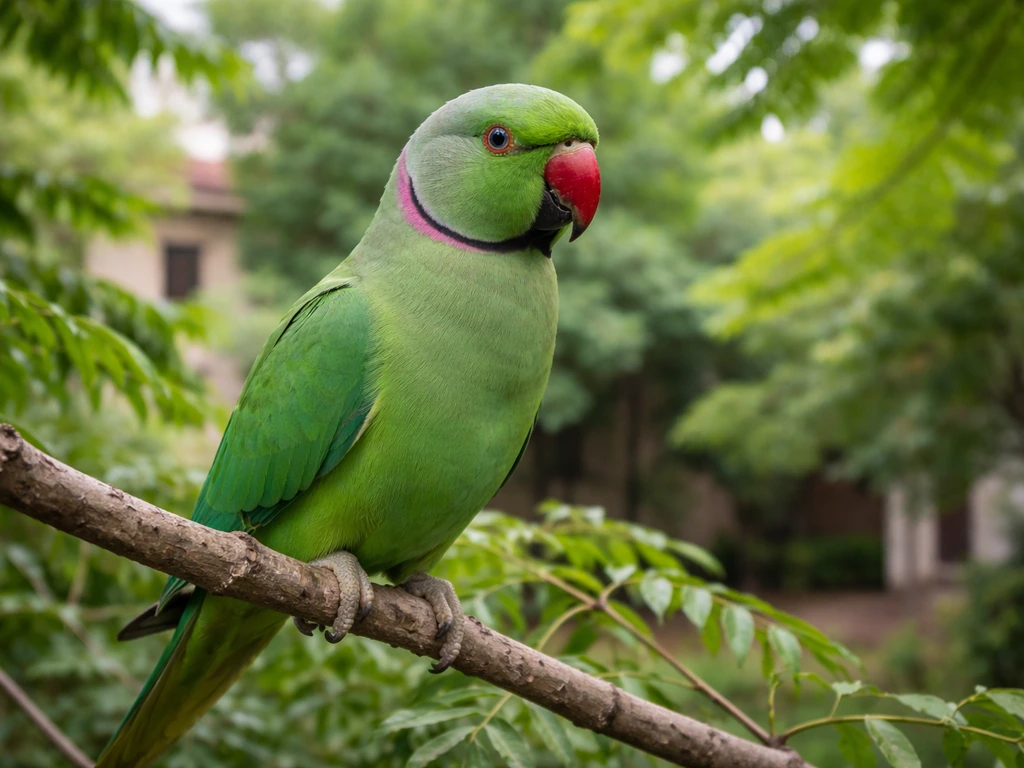
The rose-ringed parakeet fit naturally into that role. It is deeply woven into Telugu culture, with the name Rama Chiluka (also written Ramachilaka) carrying warm, affectionate connotations in local tradition and folklore. The bird is admired for its bright green plumage, cheerful noise, and familiar presence in villages, farms, and urban gardens across the region. It is not a distant or rare symbol; it is a bird most people in Andhra Pradesh have actually seen.
How to Identify the Rose-ringed Parakeet in the Field
Once you know what to look for, this bird is one of the easier parakeets to pin down. It is a medium-sized parrot, measuring roughly 36 to 40 cm in length with a wingspan of 45 to 50 cm. Most of that length is tail: it has a very long, pointed tail that gives it an instantly recognizable silhouette in flight.
Males vs. Females: The Neck Ring Is the Key
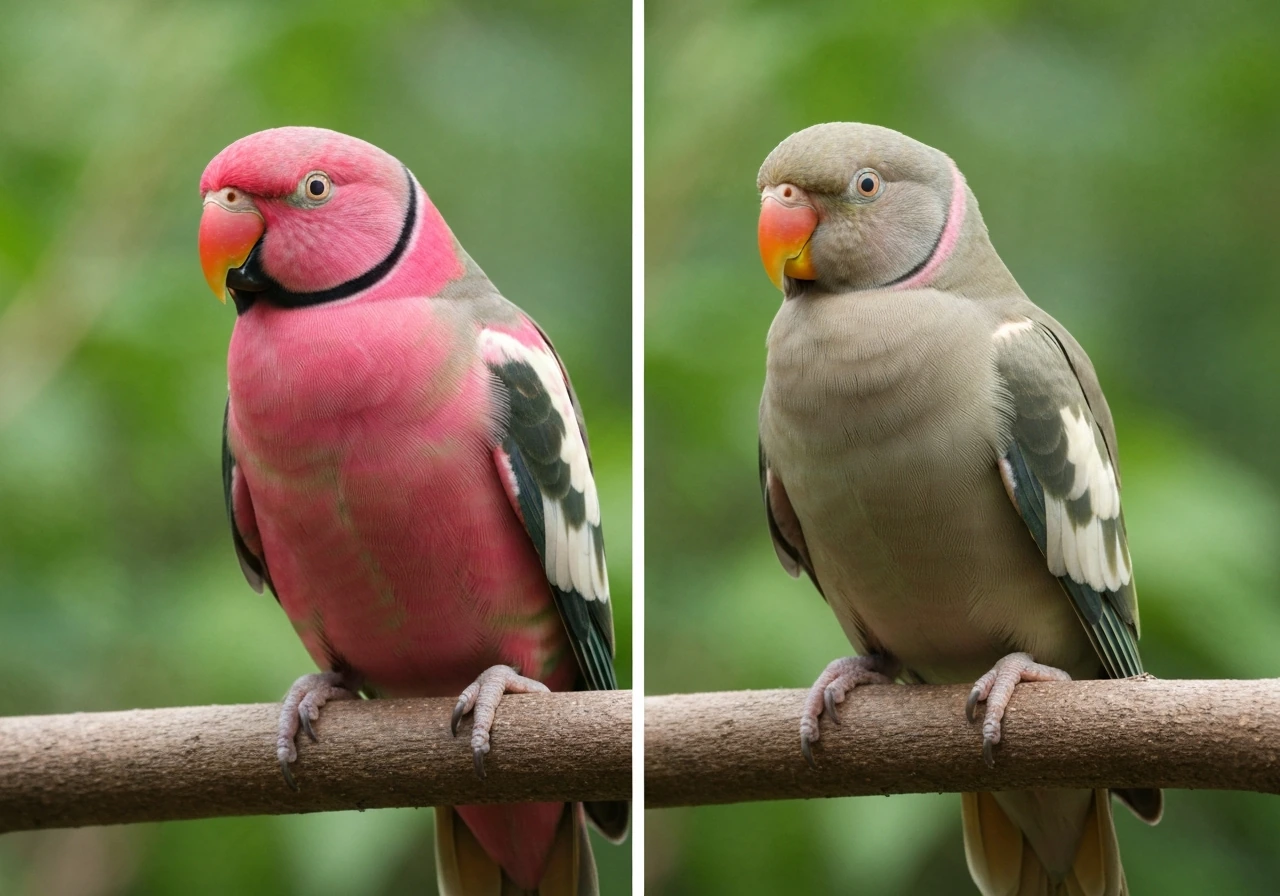
Adult males carry a distinctive neck ring that is hard to miss once you know it. It consists of a black chin, a wide black stripe across the lower cheeks, a pink collar around the hindneck, and a blue-washed nape. The bill is red with a black-tipped upper mandible. Females and immature birds are trickier: they either show no neck ring at all or only a faint, shadow-like ring. So if you see a plain pale-green parakeet with a long tail and no obvious ring, you are likely looking at a female or young bird.
| Feature | Adult Male | Female / Immature |
|---|---|---|
| Neck ring | Bold pink and black ring | Absent or faint shadow ring |
| Chin | Black | Plain green |
| Nape | Blue-washed | Plain green |
| Bill | Red with black tip | Similar but less vivid |
| Tail | Very long, pointed | Very long, pointed |
| Overall color | Pale to emerald green | Pale to emerald green |
Common Look-alikes and How to Tell Them Apart
blank" rel="noopener noreferrer">The most frequent confusion in Andhra Pradesh is with the Alexandrine Parakeet (Psittacula eupatria), which belongs to the same genus and overlaps widely in urban and woodland habitats. The Alexandrine is noticeably larger, has a deep red shoulder patch, and its neck ring (in males) is heavier and darker. If the bird looks chunky and has that reddish wing patch, it is an Alexandrine, not a rose-ringed. Size alone is often enough to separate them once you have seen both.
Two other look-alikes are less likely to cause problems in lowland Andhra Pradesh. The Slaty-headed Parakeet (Psittacula himalayana) is an altitudinal species tied to Himalayan and hill forests, so you simply would not encounter it in coastal or Deccan Andhra Pradesh. The Blue-winged Parakeet (Psittacula columboides, also called the Malabar Parakeet) is endemic to the Western Ghats and stays in dense forest cover there, so it rarely creates confusion for observers in the eastern part of the peninsula.
Where to Spot the Rama Chiluka in Andhra Pradesh
This is one of the most accessible birds to find in the state because it thrives in human-modified landscapes. You do not need to go deep into a forest or a protected reserve. Rose-ringed parakeets are at home in farms, orchards, town gardens, village trees, and even holes in older buildings and forts where they nest. They are noisy and conspicuous, which works in your favor.
The best practical approach is to watch for noisy flocks moving over farmland and orchards during the day, especially in the morning when they head out to feed. Around dusk, they often converge in large, raucous communal roosts, which can involve dozens to hundreds of birds and are hard to miss once you are in the right area. eBird records for Andhra Pradesh show documented sightings from Visakhapatnam, Prakasam district, and localities like Chadalavada, suggesting they are reliably present across the coastal districts and interior farmland alike.
- Farmland and orchards with scattered trees: their preferred feeding habitat
- Urban parks, gardens, and tree-lined roads in cities like Visakhapatnam, Vijayawada, and Tirupati
- Riparian woodland and areas near water with mature trees for nesting
- Older buildings, ruins, and forts where they use cavities for nesting
- Open savanna and grassland edges with scattered trees
If you are using an app like eBird or iNaturalist to plan a trip, filtering records by district in Andhra Pradesh will show you exactly where recent sightings have been logged, which is the most reliable way to find a good spot quickly.
How It Compares to Neighboring States' Birds
Andhra Pradesh's neighboring states have made quite different choices for their state birds, which makes for interesting regional comparison. Telangana, which was carved from the same combined state, designated the Indian Roller (Coracias benghalensis) as its state bird, so the two successor states ended up with completely distinct symbols. Karnataka also has its own state bird designation. Karnataka’s state bird is the Indian Roller, which is karnataka state bird.
Kerala went with the Great Hornbill, a dramatically different forest species, while Tamil Nadu chose the Emerald Dove. Tamil Nadu’s state bird is the Emerald Dove. If you are wondering which is Kerala state bird, it is the Great Hornbill Kerala went with the Great Hornbill. Kerala is also known for why hornbill is the state bird of Kerala, largely because the Great Hornbill represents the health of its forest habitats and local biodiversity.
So Andhra Pradesh stands out as the only state in the immediate southern cluster to elevate a parakeet to state bird status.
Globally, the rose-ringed parakeet's native range covers southern Asia (India, Nepal, Sri Lanka, Pakistan) and parts of central Africa. It has also established feral populations in parts of California and Florida in the United States, and across much of Europe and the Middle East, which makes it one of the most widely recognized parakeet species in the world. Choosing it as a state symbol connects Andhra Pradesh to a bird with real cultural depth at home and growing recognition internationally.
FAQ
Is the Rose-ringed Parakeet the state bird of Andhra Pradesh for everyone, or are there older symbols from before 2018?
For formal state-symbol purposes, the currently recognized state bird is the Rose-ringed Parakeet notified in 2018. After the 2014 bifurcation, older combined-state symbol choices were not carried as Andhra Pradesh’s official symbols, so you should rely on the 2018 notification rather than pre-bifurcation references you may see online.
How can I tell a Rose-ringed Parakeet from an Alexandrine Parakeet quickly in the field?
Use a two-step check: first look for the deep red shoulder patch, if present it strongly suggests Alexandrine. Second, compare the male neck ring intensity, Alexandrines tend to show a heavier, darker ring, while Rose-ringed males show a clearer neck ring pattern with a more distinct contrast around the lower cheeks and hindneck.
What should I do if the bird has no visible neck ring, am I looking at the wrong species?
Not necessarily. Females and immature Rose-ringed Parakeets can show no neck ring or only a faint shadow-like ring. If the bird still has the long, pointed tail and the general green parakeet look, treat it as likely Rose-ringed, then confirm with size and any visible cheek or collar pattern rather than expecting a strong ring on every bird.
Where in Andhra Pradesh is it most likely to be seen, coastal or interior?
They are commonly observed in both farmland and town gardens across coastal districts and interior localities. Practically, look for noisy flocks over orchards and agricultural areas during the morning, then watch for dusk roosting activity nearby older trees or built structures where they may nest.
Are these parakeets only seen in cities, or can I expect them in villages and farms?
You can expect them well beyond cities. The species thrives in human-modified landscapes, including village trees, orchards, farms, and sometimes cavities in older buildings and forts, so countryside birding often works as well as urban birding.
Do I need binoculars to identify the state bird reliably?
Binoculars help a lot, but the long, pointed tail and the overall silhouette in flight are often noticeable even without them. For accurate sex-related clues like the neck ring, or to rule out an Alexandrine, binoculars (or a zoom camera) make the comparison much easier.
What time of day gives the highest chance of spotting a communal roost?
Late afternoon to dusk is typically best. They often gather in large, noisy communal roosts around evening, and once they reach the roost area the number of birds can be very high, which makes detection easier than random daytime searching.
If I use an eBird or iNaturalist filter, what’s the best way to plan without overthinking it?
Filter by district in Andhra Pradesh and prioritize the most recent entries, then aim your observation during daytime feeding hours and a short dusk window. Recent district records plus the morning-to-evening rhythm is usually a better strategy than relying on one-off sightings.
Are there any plausible look-alikes in Andhra Pradesh besides the Alexandrine and slaty-headed types mentioned?
In the lowland and commonly visited areas of Andhra Pradesh, the most frequent confusion is usually with Alexandrine Parakeets. Slaty-headed is largely tied to hill and Himalayan forests, so it is unlikely in coastal and Deccan lowlands, which reduces the number of serious contenders for most travelers.
Does the state bird designation affect conservation rules for that species in Andhra Pradesh?
A state-symbol designation primarily establishes cultural and official identity. If you are looking for conservation protection, it depends on broader wildlife laws and protection categories, not just the state-bird status, so the bird’s legal safeguards come from national and state wildlife regulations.