Kerala's official state bird is the Great Hornbill (Buceros bicornis). The Kerala Forest Department explicitly names it as 'our State bird,' and that's the correct terminology to use here. Kerala is a state within India, not a country, so it has a state bird, not a 'national bird.' India's national bird is the Indian Peacock, which is a separate designation entirely.
Which Is Kerala State Bird? Identification, Meaning

Marcus Webb
29 May 2026
State bird vs. 'national bird' of Kerala
It's worth clearing this up because 'national bird of Kerala' is a phrase that comes up in searches fairly often. Kerala doesn't have a national bird because it isn't a nation. National symbols belong to countries, and India's national bird designation (the Indian Peacock) sits at the country level. At the sub-national level, each Indian state designates its own state bird as an official state symbol. Kerala's official state symbol bird is the Great Hornbill. That's the authoritative answer from the Kerala Forest Department and the Kerala State Council for Science, Technology and Environment.
The official state bird: species and scientific name
The Great Hornbill goes by a couple of names in official Kerala government sources. You'll see it listed as both 'Great Hornbill' and 'Great Indian Hornbill,' and the scientific name given is Buceros bicornis, sometimes written with the subspecies tag as Buceros bicornis homrai. For identification and listing purposes, the recognized species name is Buceros bicornis (Linnaeus, 1758). No US state uses this species as its state bird. The genus Buceros doesn't appear anywhere on the standard US state bird list, which makes sense given that hornbills are an Old World family with no native North American representatives.
How to identify the Great Hornbill
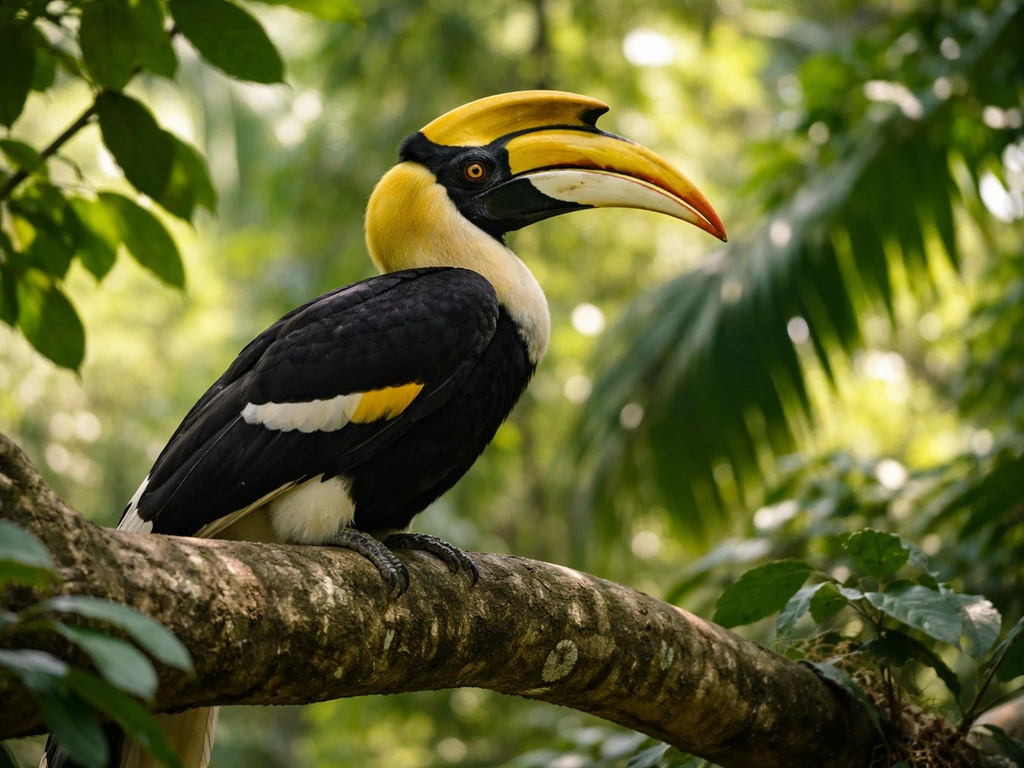
This is not a bird you'll confuse with anything else once you've seen it. It's large, loud, and visually striking in a way that immediately explains why it was chosen as a state symbol.
Size and plumage
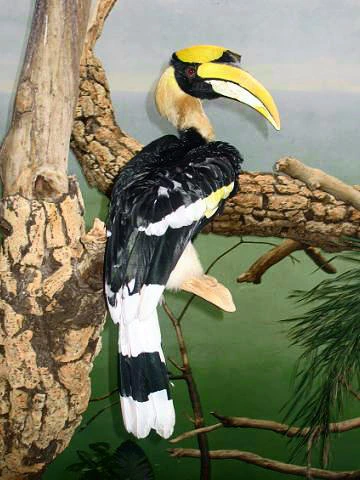
Great Hornbills measure roughly 95 to 120 cm in length and weigh around 3 kg on average. The base plumage is black with distinctive white patches on the neck, abdomen, wings, and tail. That bold black-and-white pattern combined with its sheer size makes it one of the most visually commanding birds in the Western Ghats.
The bill and casque
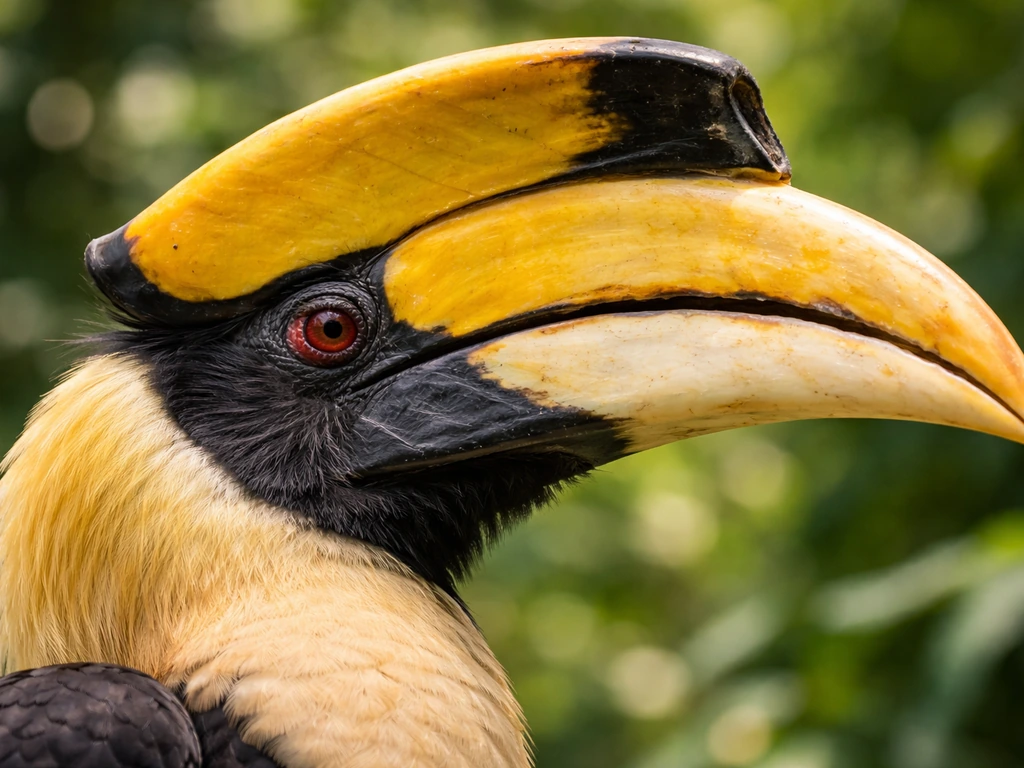
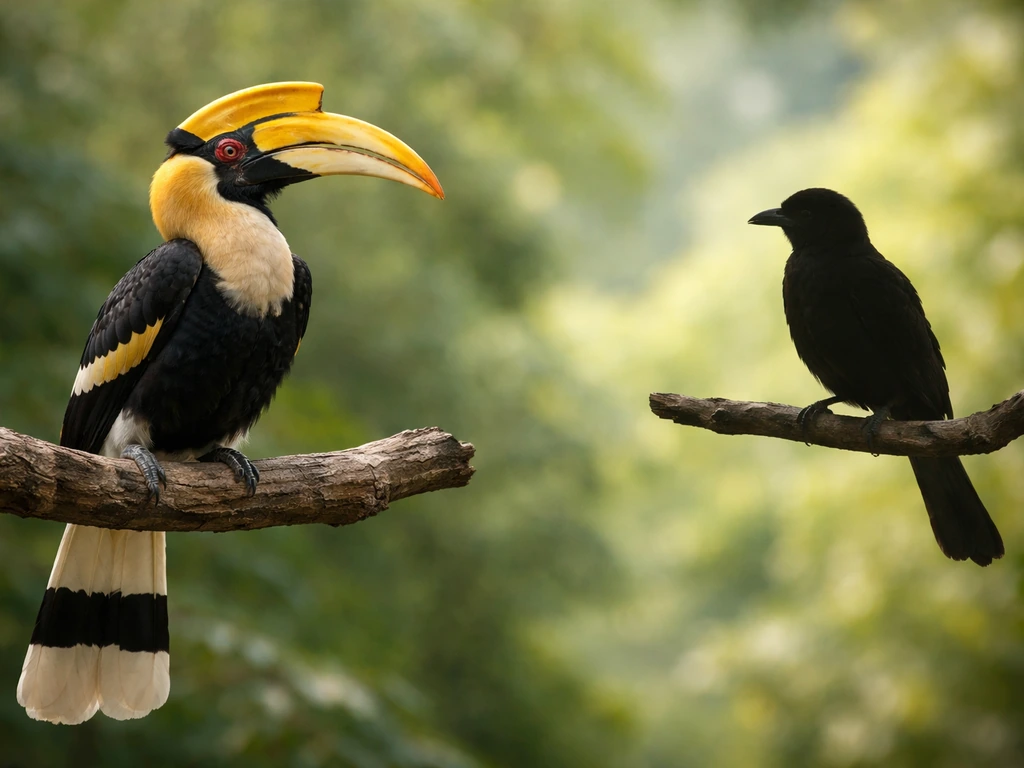
The defining feature is the massive yellow-and-black bill topped with an equally impressive hollow casque, the horn-shaped structure that gives hornbills their name. The casque is bright yellow and black and sits prominently above the bill. It's not just decorative: it plays a role in amplifying calls and in species recognition. This is the detail that makes the Great Hornbill instantly recognizable in illustrations, carvings, and field sightings alike.
Flight and voice
In flight, Great Hornbills are hard to miss even before you see them. Their wingbeats are deliberate and labored, and they alternate between flapping and sailing on outspread wings, producing a loud, whooshing sound that carries through the forest canopy. Their call is equally distinctive: a loud, deep barking note that is most commonly heard at the onset of the breeding season and when birds return to their roost.
Habitat and range in Kerala
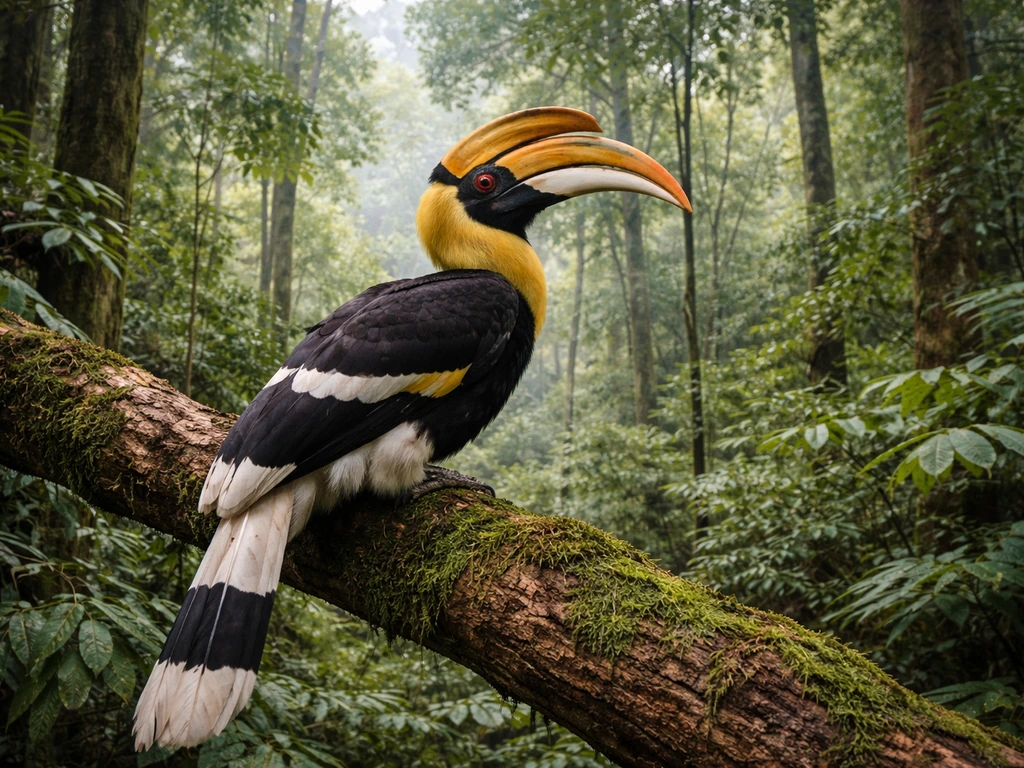
In Kerala, Great Hornbills are associated with the Western Ghats, which is the mountain range running along the state's eastern edge. The species favors wet, tall evergreen forests and moist deciduous forests at elevations of roughly 600 to 2,000 meters. They're arboreal, diurnal, and non-migratory, which means if a forest patch has the right old-growth trees, the same birds can turn up there year after year. Nesting is done in natural cavities in large old trees, and pairs return to the same nesting sites repeatedly. Within India more broadly, the species is also found in the Himalayas, but Kerala's Western Ghats population is one of the most well-documented in the country.
Why Kerala chose the Great Hornbill
Kerala's government designated the Great Hornbill as the state bird because of its size, its striking appearance, and its deep significance in tribal cultures and rituals across the region. The bird's large presence and unmistakable look made it a natural fit as a symbol for a state defined by its biodiversity and its forests. The Western Ghats are one of the world's eight biodiversity hotspots, and the Great Hornbill is one of the most iconic species associated with that landscape.
The cultural dimension is just as important as the ecological one. Hornbill feathers and imagery appear in the traditional dress and ceremonies of multiple tribal communities across the Western Ghats and Northeast India. The bird carries a weight of cultural identity that goes beyond simple wildlife symbolism. Choosing it as the state bird was a recognition of both natural heritage and living cultural tradition.
How Kerala's state bird compares with neighboring states
Each Indian state picks its own official state bird, and the choices across southern India reflect different regional priorities and biodiversity. Kerala's neighbors have gone in quite different directions.
| State | State Bird | Scientific Name |
|---|---|---|
| Kerala | Great Hornbill | Buceros bicornis |
| Karnataka | Indian Roller | Coracias benghalensis |
| Tamil Nadu | Emerald Dove | Chalcophaps indica |
| Andhra Pradesh | Indian Roller | Coracias benghalensis |
| Telangana | Indian Roller (Palapitta) | Coracias benghalensis |
One thing that stands out immediately: Karnataka, Andhra Pradesh, and Telangana all share the Indian Roller as their state bird, which is actually a pattern seen in US state birds too, where popular species like the Northern Cardinal are shared across multiple states. Karnataka, for example, lists the Indian Roller as its state bird. Telangana’s state bird is the Indian Roller, the same species shared by Karnataka and Andhra Pradesh. Kerala bucks that trend by going with the Great Hornbill, a much less common designation that reflects the state's distinct forest ecosystem. The Great Hornbill is also the state bird of Arunachal Pradesh, so Kerala does share the species with at least one other Indian state.
As noted earlier, no US state uses the Great Hornbill or any Buceros species as its state bird. Almanac.com publishes a complete US state bird list with scientific names, which is the kind of reference you can use to check that Buceros bicornis does not appear among US state birds. Hornbills are native to Africa and Asia, so there's no overlap with the North American state-bird lists this site covers.
Where to explore next
If you landed here while researching Indian state birds alongside US state birds, the comparison structure is actually quite similar: both systems use official government designations, the same species can be shared across multiple states, and the selection criteria tend to mix ecological significance with cultural identity. The Great Hornbill page is a solid anchor for understanding how those choices work in the context of the Western Ghats and South Asia.
For related state bird comparisons in the same region, the state birds of Telangana, Karnataka, Tamil Nadu, and Andhra Pradesh make for useful reading alongside Kerala's designation, especially to see why the Indian Roller ended up as the shared choice for three neighboring states while Kerala went its own way with the hornbill. The Telangana state bird is the Indian Roller, also called Palapitta state birds of Telangana. For example, the Telangana government lists the State Bird as [Palapitta, also known as the Indian Roller or Blue Jay](https://www. telangana. gov.
in/about/state-symbols). If you are also curious about the state bird of Tamil Nadu, check the related article comparing those neighboring state symbols. There's also a dedicated article on why the hornbill was specifically chosen as Kerala's state bird if you want to go deeper into the cultural and ecological reasoning behind the designation.
FAQ
Is the Great Hornbill the only official state bird symbol of Kerala?
Yes. Kerala officially recognizes the Great Hornbill as its state bird. If you see other hornbill-related items online, they are typically wildlife information or cultural references, not additional official state-bird designations.
What is the correct wording, “state bird of Kerala” or “national bird of Kerala”?
Use “state bird of Kerala.” “National bird of Kerala” is a common search phrasing, but it is not accurate because Kerala is a state, not a sovereign country with a national symbol.
Are the names “Great Hornbill” and “Great Indian Hornbill” referring to the same bird?
They refer to the same species used in official listings. Depending on the source, both common names may appear for Buceros bicornis, so treat them as synonyms rather than different birds.
Does the scientific name ever include subspecies, and does that change the identity?
Sometimes you will see a subspecies tag (for example, an extra name segment after Buceros bicornis). That does not mean Kerala’s state bird changes, it just reflects how taxonomists classify populations.
If I am comparing Kerala with US state birds, should I expect overlap in species or genus?
No. Kerala’s state bird is an Old World hornbill from Africa and Asia, while US state bird selections are based on species native to North America. So overlap is essentially not expected.
Where in Kerala are Great Hornbills most likely to be found?
They are most associated with the Western Ghats habitats, especially wet evergreen and moist deciduous forests at higher elevations (roughly hundreds up to about 2,000 meters). Urban areas and heavily fragmented habitats are much less likely to support them.
How can I distinguish the Great Hornbill from other large birds at a glance?
Look for the bold black-and-white body pattern plus the massive yellow-and-black bill with the casque on top. The combination of size, the stark plumage, and the standout casque makes it unusually recognizable.
When would I be most likely to hear their calls in Kerala?
Their loud, deep barking call is most commonly heard around the onset of the breeding season and when birds return to their roost. If you are trying to observe them, timing visits around breeding periods can improve your odds.
Do Great Hornbills migrate in Kerala?
No. They are described as non-migratory, so if suitable mature forest with nesting cavities is present, the same birds can remain in the area year after year and return to the same nesting sites.