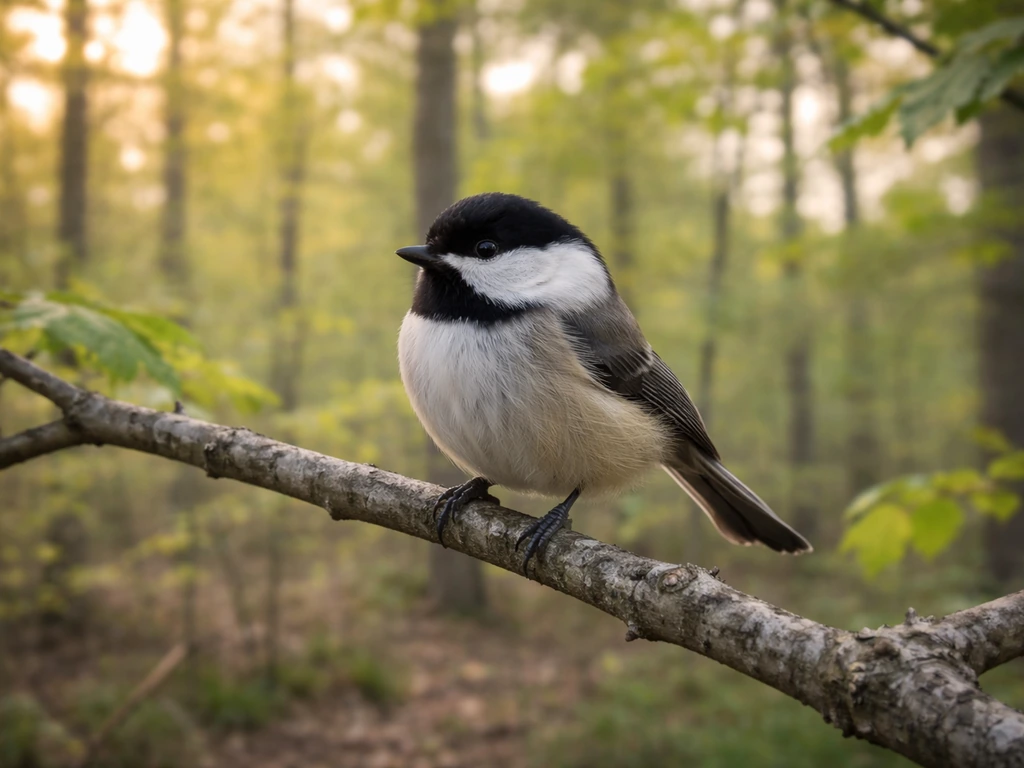
Maine's official state bird is the chickadee, and in practice that means the Black-capped Chickadee (Poecile atricapillus). The 1927 statute uses the generic term 'chickadee,' but the Black-capped is the species universally associated with the designation, shown on Maine license plates, and listed on the Maine Secretary of State's own symbol page.
What Is Maine's State Bird? Bird ID, History, Facts

Marcus Webb
26 Apr 2026
Quick identification guide
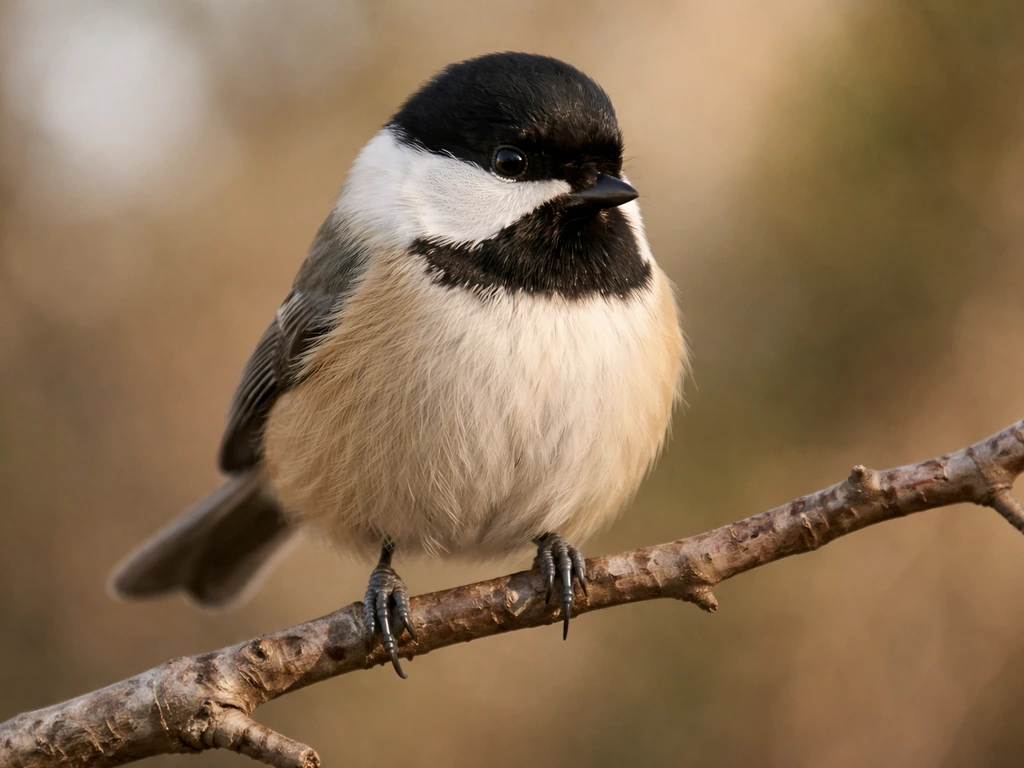
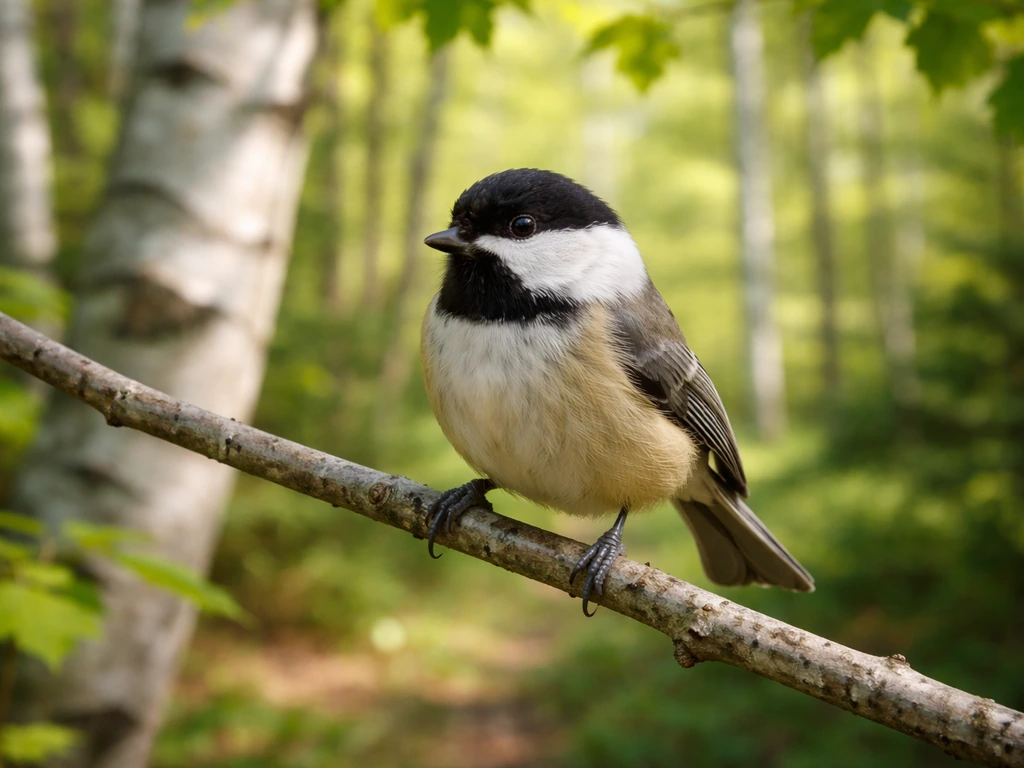
The Black-capped Chickadee is a small, compact bird, roughly 5 inches in length. It's one of the easier birds to identify once you know what to look for: a crisp, pure black cap covering the top of the head and hind neck, a matching black bib on the throat, and clean white cheeks that contrast sharply with both. The back is gray, the wings show subtle white edging, and the sides carry a soft buff or tawny wash. The bill is short and stout. It's not a flashy bird, but the black-and-white head pattern is unmistakable.
Sound is just as useful as sight for identification. The classic call is a clear, raspy 'chick-a-dee-dee-dee,' which is lower and slower than the similar Carolina Chickadee's version. The song is a clean, whistled 'fee-bee' or 'fee-bee-ee.' If you hear either of those sounds in a Maine woodlot or backyard, there's a good chance you're looking at the state bird.
One thing worth knowing for Maine specifically: the state actually has two chickadee species. The Boreal Chickadee also occurs here, particularly in northern and heavily forested areas. The Boreal has a brown cap (not black) and a more muffled, raspy call, which makes it easier to tell apart once you know the difference. In most of Maine's populated areas, you'll be dealing with the Black-capped.
Where to find chickadees in Maine
The Black-capped Chickadee is genuinely one of the most widespread birds in Maine. It lives in deciduous and mixed forests and is especially common along forest edges, near birches and alders, and in open woodland rather than deep, purely coniferous stands. It adapts well to agricultural edges and suburban neighborhoods, which means you don't have to go deep into the woods to find it.
The easiest way to see one up close is a backyard feeder with sunflower seeds or suet. Chickadees are feeder regulars throughout the state, year-round. They're one of the few birds that stay in Maine through the coldest winters rather than migrating south, so you can spot them in January just as easily as July. State parks, nature preserves, and any trail through mixed forest in Maine will also turn up chickadees reliably.
Why Maine chose the chickadee
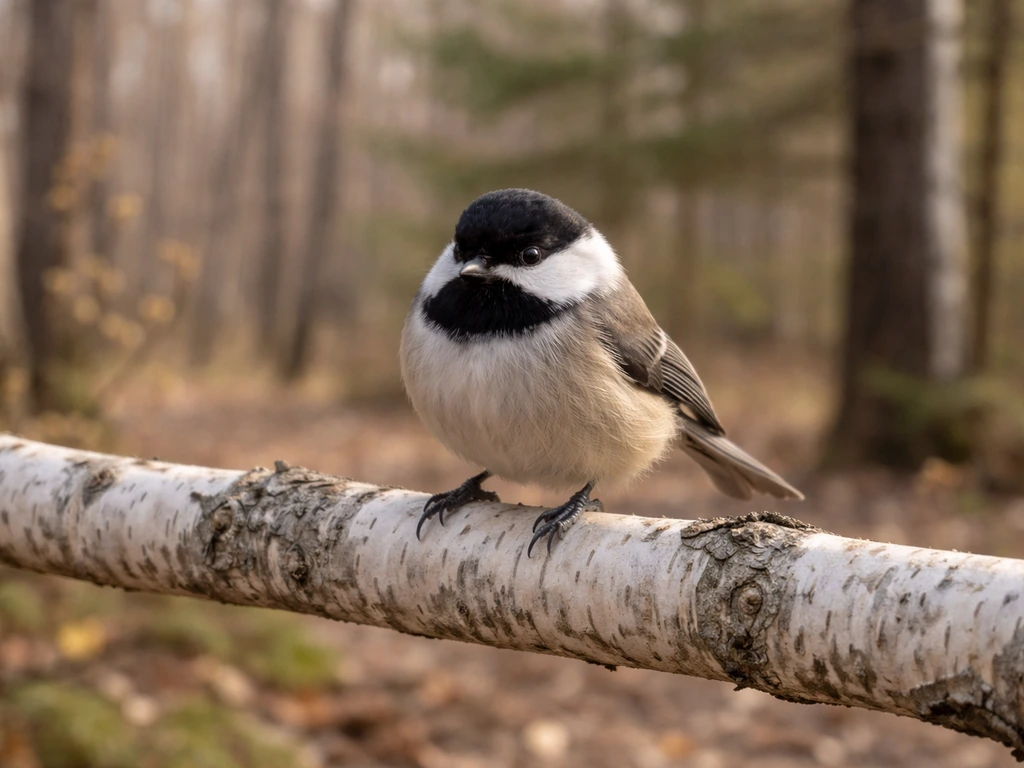
The chickadee makes sense as Maine's symbol for a simple reason: it's everywhere, and it stays. Unlike migratory species that only visit seasonally, the Black-capped Chickadee is a constant presence across the state in every season and nearly every habitat type. It's as much a part of a Maine winter morning as snow on the ground. That year-round familiarity, combined with its distinctive and cheerful call, makes it something most Maine residents recognize immediately.
It also fits the general spirit of many state-bird selections from the 1920s: choose a bird that's common, recognizable, and genuinely tied to the landscape rather than something rare or exotic. The chickadee isn't hard to find, but it's genuinely beloved.
How the designation became official
Maine's Legislature adopted the chickadee as the official state bird in 1927. That same decade saw a wave of state-bird designations across the country, with many states formalizing their choices around the same time. Maine's statute, codified as Title 1, Section 209 of the Maine Revised Statutes, reads simply: 'The state bird shall be the chickadee.' No species is named.
That vagueness has created some ongoing discussion. Maine has two chickadee species (Black-capped and Boreal), and the 1927 lawmakers didn't specify which one they meant. The Maine Secretary of State's office lists the bird as 'Chickadee (Parus atricapillus),' the old scientific name for the Black-capped, making the intent fairly clear. In 2019, a bill called LD 572 was introduced in the Maine Legislature to formally clarify the designation, proposing to name either the Black-capped or Boreal Chickadee specifically. That legislative effort reflects the quirk in the original statute, though for all practical purposes the Black-capped Chickadee has always been treated as Maine's state bird, including its appearance on Maine license plates. The Maine Bureau of Motor Vehicles discusses the Chickadee license plate and its replacement or transition to other plate designs appearance on Maine license plates.
Does any other state share Maine's state bird?
Yes. Massachusetts also claims the Black-capped Chickadee as its official state bird, making it one of the cases where two neighboring states share the exact same species. This makes sense geographically since the Black-capped Chickadee's range covers much of the northern United States and Canada, and New England as a whole is prime chickadee territory. If you're exploring state bird comparisons across the region, the Massachusetts and Maine designations are a natural pair to look at together. You might also be wondering what Massachusetts chose as its own state bird Massachusetts's state bird. If you are comparing state birds like Massachusetts and Maine, you can also use this as a starting point for how to draw massachusetts state bird with the right proportions and markings. If you’re wondering why Massachusetts chose the Black-capped Chickadee, it comes down to the bird’s familiarity and strong regional fit.
| State | Official State Bird | Species Named in Law |
|---|---|---|
| Maine | Chickadee | No (generic; Black-capped assumed) |
| Massachusetts | Black-capped Chickadee | Yes (Black-capped Chickadee) |
What to do next
If you want to see Maine's state bird for yourself, set up a sunflower seed feeder anywhere in the state and you'll have chickadees within days. For deeper identification work, learning the 'fee-bee' song and the 'chick-a-dee-dee-dee' call is the fastest path to confident identification. If you're in northern Maine and your chickadee has a brown cap and a hoarser call, you've found the Boreal Chickadee instead, which is a bonus sighting worth noting.
For those interested in how state-bird choices compare across New England, looking at Massachusetts's Black-capped Chickadee designation alongside Maine's gives useful context on how neighboring states often end up with the same species. Oregon's state bird selection, by contrast, takes a completely different regional approach, and comparing them shows how much state-bird choices reflect local identity and landscape. Oregon's driver's license features its state bird, the Western Meadowlark Oregon's state bird. Oregon's state bird is the Western Meadowlark.
FAQ
If Maine just says “chickadee,” which exact species is meant?
No, Maine’s statute names “chickadee” without specifying a species. In practice, state branding and identification guides treat it as the Black-capped Chickadee, while the Boreal Chickadee can also be present in northern Maine.
How can I tell the Boreal Chickadee from the Black-capped in Maine?
You can still use the song and call differences even at a feeder. The Black-capped usually gives the clearer “chick-a-dee-dee-dee” and a whistled “fee-bee,” while the Boreal’s call tends to sound more muffled or hoarse.
Will I see Maine’s state bird at a feeder in winter, or only in summer?
Yes. Chickadees commonly visit feeders year-round, but if you stop offering food in winter, sightings often drop within days. Using high-quality sunflower seeds, and adding suet during the coldest weeks, increases your chances.
What are the most common identification mistakes people make with chickadees?
A chickadee’s “white cheeks” and black cap-bib pattern are the fastest visual cues, but lighting matters. In poor light, the buffy side wash can look grayish, so try to compare both the face pattern and the crispness of the black head markings.
If I hear a chickadee call that sounds similar, how do I know it’s the right one?
It’s normal to hear “fee-bee” or “chick-a-dee” from a different chickadee species in the region. If you want a confident Maine state-bird match, note whether the cap is black (Black-capped) versus brown (Boreal), and focus on the sound quality of the call.
Does the chance of seeing the “state bird” change depending on which part of Maine I’m in?
It can help to check where you are. In populated central and southern areas, Black-capped Chickadees are more likely, while Boreal Chickadees are more probable in northern, heavily forested locations.
What’s a simple way to teach or learn the state bird identification quickly?
For a kid-friendly or casual ID approach, use a two-step method: first look for the black cap and bib with clean white cheeks, then confirm with the call pattern (the Black-capped’s call tends to be clearer and slower than the Carolina’s).
Is Maine the only state that uses the Black-capped Chickadee as its state bird?
Yes, another nearby state also uses the Black-capped Chickadee. Massachusetts and Maine can feel confusing during bird comparisons, because the same species can be official in both places.
Next Article
What Is the State Bird for Massachusetts? Identification Guide
Learn the official Massachusetts state bird, how to identify it, where to spot it, and why it was chosen.