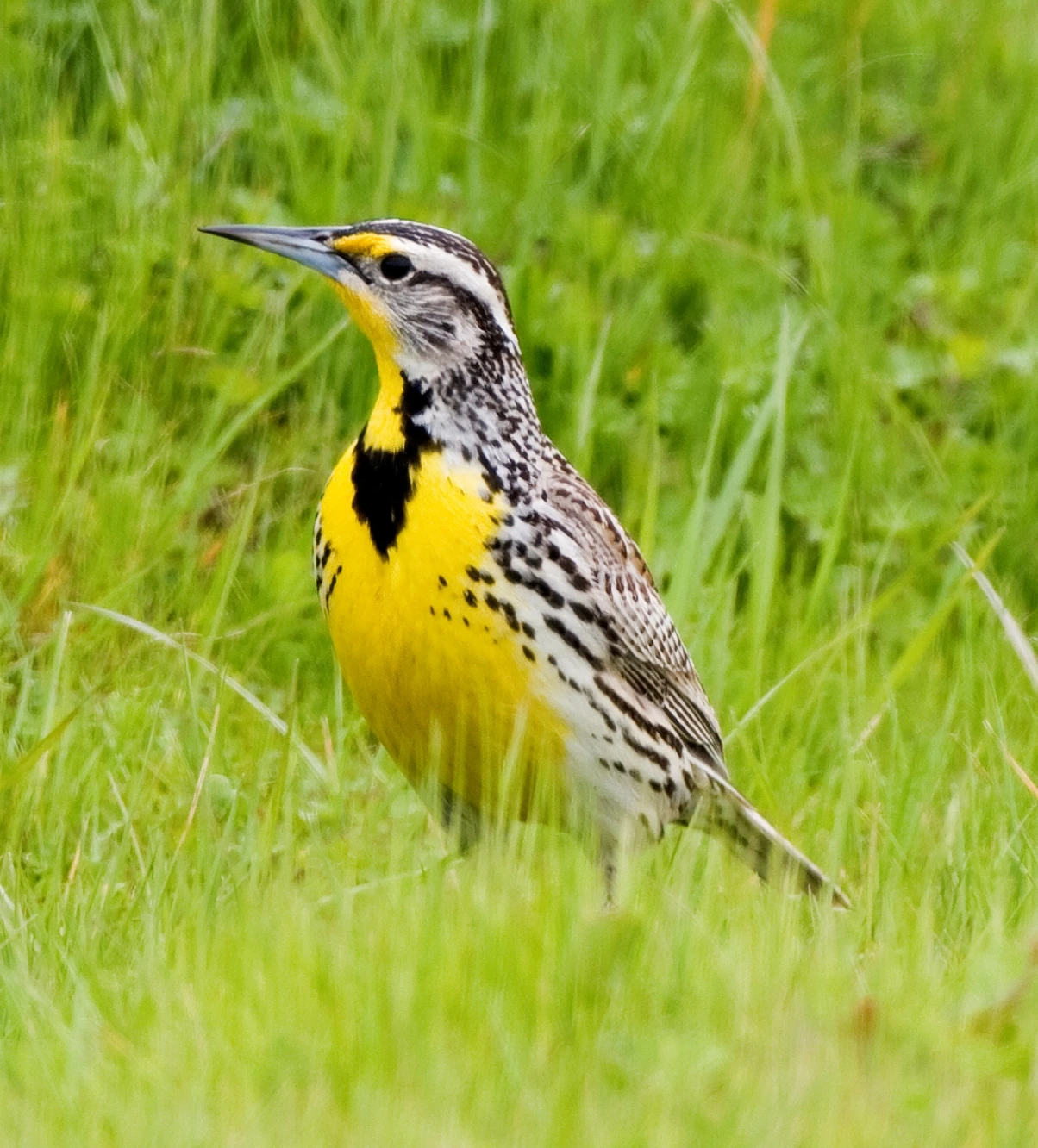
Montana's official state bird is the western meadowlark (Sturnella neglecta). It was designated by the Montana legislature in 1931, and the choice came straight from a referendum vote of Montana school children. That vote is actually written into the statute itself, making it one of the more charming origin stories among all 50 state bird designations.
What Is Montana’s State Bird? Species ID and Facts

Marcus Webb
24 Apr 2026
Montana's official state bird
The exact language in Montana Code Annotated 1-1-504 reads: 'the bird known as the western meadowlark, Sturnella neglecta (Audubon).' That common name plus scientific name pairing is the official designation. If you ever need to confirm you have the right species, that statute text is the definitive source. Common name: western meadowlark. Scientific name: Sturnella neglecta.
How to recognize the western meadowlark
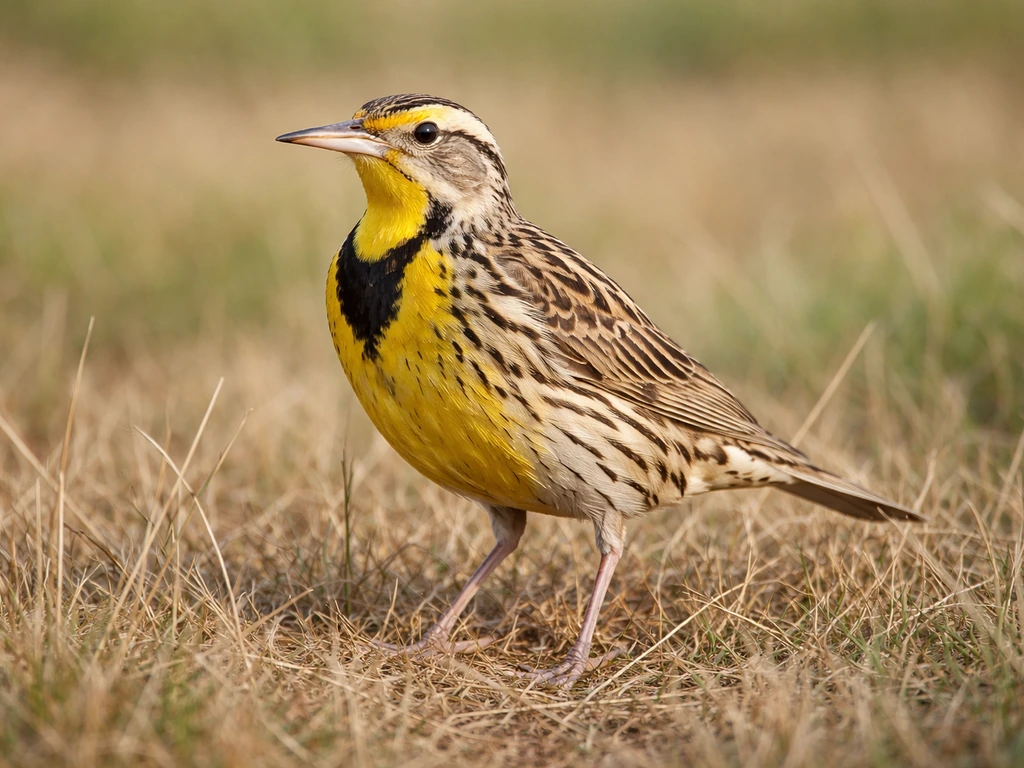
The western meadowlark is a medium-sized songbird built for life on the ground. It has long legs, a long slender bill, and a short tail with noticeably stiff, rigid feathers that give the tail a spiky look in the field. The wings are short and rounded. It is not a small bird, but it is compact and sturdy.
The single most reliable visual field mark is the bold black 'V' across a bright yellow breast. That V-shaped bib is impossible to miss when the bird is facing you. The upperparts are intricately patterned in brown, black, and buff, which provides excellent camouflage in grassland and prairie settings. Note that in fall the black V can be partly veiled by feather tips, so it may look less sharp than in spring.
One extra cue that separates the western meadowlark from its very similar cousin, the eastern meadowlark: the yellow on the throat extends farther up into the face on the western species. It is a subtle difference at distance, but useful when you get a decent look.
The best identification tool, though, is the voice. The western meadowlark sings a rich, flute-like, gurgling song that is completely different from the eastern meadowlark's clear, whistled phrases. Even experts lean heavily on sound to separate these two species, since the plumage is so similar. A commonly heard call is a low, bell-like 'pluk' or 'chupp,' used when disturbed and during courtship. If you hear that call and see a bird with the yellow-and-black V, you have your western meadowlark.
Quick field marks at a glance
- Bold black 'V' on bright yellow breast (may be partly veiled in fall)
- Yellow on throat extends high into the face
- Short, stiff, spiky-looking tail
- Short, rounded wings
- Long slender bill and long legs
- Brown, black, and buff patterned upperparts
- Rich, gurgling, flute-like song; low 'pluk' or 'chupp' call notes
Why Montana chose the western meadowlark

The statute is unusually transparent about the reason: the western meadowlark was chosen because it was the preference expressed in a referendum vote of Montana school children. There is no additional conservation rationale or symbolic language buried in the law. The kids voted, the legislature listened, and the bird became official in 1931. That kind of direct democratic process makes Montana's designation stand out from states that relied on ornithological societies or wildlife commissions to make the call.
The choice also makes obvious sense given Montana's landscape. The western meadowlark is a fixture of open grasslands and prairies, exactly the terrain that defines much of eastern and central Montana. Any Montana school child spending time outdoors on the plains would have been very familiar with the bird's song and its habit of perching on fence posts and singing loudly. Familiarity likely drove the vote.
The history behind the designation
Montana officially designated the western meadowlark in 1931, enacted as Chapter 149, Laws of 1931 (Sec. 1, Ch. 149, L. 1931 in the statute's history line). The law was subsequently reenacted in 1935 and 1947 as Montana revised and reorganized its statutes. The 1931 date puts Montana among the earlier states to formalize a state bird, and the school children's referendum method was genuinely forward-thinking for the era. The designation has remained unchanged since then.
Montana is far from alone: states that share the western meadowlark

The western meadowlark holds the distinction of being one of the most widely shared state birds in the country. Six states have designated Sturnella neglecta as their official state bird, which is more states than any other single species except the northern cardinal (which is claimed by seven states). Montana shares its state bird with Kansas, Nebraska, North Dakota, Oregon, and Wyoming.
| State | Official designation | Year designated |
|---|---|---|
| Montana | Western meadowlark (Sturnella neglecta) | 1931 |
| Kansas | Western meadow lark (Sturnella neglecta) | 1937 |
| Nebraska | Western meadowlark (Sturnella neglecta) | 1929 |
| North Dakota | Western meadowlark (Sturnella neglecta) | 1947 |
| Oregon | Western meadowlark (Sturnella neglecta) | 1927 |
| Wyoming | Western meadowlark (Sturnella neglecta) | 1927 |
The pattern here is not a coincidence. All six states are either Great Plains states or states with significant prairie and open grassland habitat, which is exactly where the western meadowlark thrives. Oregon is the slight outlier geographically, but its eastern half is dominated by high desert and grassland where meadowlarks are common. If you are also looking up Nebraska's state bird or North Dakota's state bird, you will land on the exact same species. North Dakota's state bird is also the western meadowlark. Nebraska's state bird is the same western meadowlark what is nebraska's state bird.
Nevada breaks this pattern interestingly: Nevada's state bird is the mountain bluebird, a completely different species. If you are wondering what the Nevada state bird is, it is the mountain bluebird Nevada's state bird is the mountain bluebird. If you are curious about the details, see what is the bird of Nevada for the official answer and context what the Nevada state bird is. So if you are comparing neighboring states in the West, Montana and Nevada diverge sharply on their state bird choices, even though both states share wide-open terrain. If you are specifically comparing Montana to Nevada, you may also want to see why is the mountain bluebird nevada's state bird for the reason behind Nevada's pick.
Where to go from here
If you want to go deeper on the western meadowlark itself, this site has individual pages for each of the six states that share this bird, so you can compare how Kansas, Nebraska, North Dakota, Oregon, and Wyoming each framed their designation and when they made it official. Each page covers the same core identification information, which is useful if you want to confirm the species across different geographic contexts.
For hands-on identification help beyond what is here, Cornell Lab's All About Birds has a dedicated sounds page for the western meadowlark that lets you hear both the song and the call notes side by side, which is the fastest way to lock in the voice. Audubon's field guide entry pairs at-a-glance visual cues with habitat and behavior notes. And if you want the authoritative source on Montana's exact designation language, the Montana Code Annotated section 1-1-504 is publicly available and worth a look if you need the statute text for any official purpose.
The bottom line: Montana's state bird is the western meadowlark, chosen by school children in 1931, identified by its black V on a yellow breast and its unmistakable gurgling song, and shared with five other states across the American West and Great Plains.
FAQ
Is Montana’s state bird definitely the western meadowlark, or is there any similar “meadowlark” that people mix it up with?
It is specifically the western meadowlark (Sturnella neglecta). People most often confuse it with the eastern meadowlark, but Montana’s bird is the western species, which you can separate by the deeper gurgling song and a yellow throat that reaches farther up the face, not just by appearance.
How can I confirm I’m seeing the right bird if the black “V” looks faint?
Check the overall combination, not the V alone. In fall, the V can appear less crisp as feather edges veil the black, so rely on the yellow breast plus the field shape (long legs, slender bill, compact body) and then confirm with the voice if possible.
What if I only hear the bird, I never get a clear view?
Voice is the best fallback. Western meadowlarks sing a rich, flute-like, gurgling song, and they have a low, bell-like call such as “pluk” or “chupp” when disturbed or during courtship. If the sound matches and you are in open grassland or prairie, the ID is much more likely than guessing from plumage alone.
Where in Montana should I go if I want the highest chance of seeing western meadowlarks?
Aim for open grasslands and prairie-like habitats, including areas with low vegetation where ground perching is likely, such as fence lines and rangeland edges. Urban parks can have them, but the species is most predictable in more open, plains-style settings.
Do western meadowlarks perch on the ground or on fences, and is that useful for identification?
They often perch on fence posts or sing from prominent spots while still being very grounded in behavior. That fence-post singing pattern, plus the yellow-and-black V and their song, can help confirm you are looking at a western meadowlark rather than a different yellow-breasted songbird.
Is Montana’s designation written in the same exact wording as the statute quoted in the article?
For official purposes, the safest approach is to use the Montana Code Annotated language itself and match both the common name and the scientific name (Sturnella neglecta). If you are using it for a school report, citation, or legal-like documentation, cite the statute section text rather than a secondary summary.
Why do some sources list meadowlarks under different “western” versus “eastern” names, and does that affect Montana’s state bird?
Those “western” and “eastern” labels describe different species within the meadowlark group. Montana’s state bird is tied to the western species name, Sturnella neglecta, so you should not substitute the eastern species even if both share the same basic meadowlark look.
Does Montana share its state bird with other states, and is it always the same western species?
Yes, Montana shares the state bird with Kansas, Nebraska, North Dakota, Oregon, and Wyoming, and in all cases it is the same western meadowlark species (Sturnella neglecta). The key is the species name, since different states can use similar common names for different species.
Could a hybrid or unusual plumage make identification unreliable?
Rarely, plumage can look off due to lighting, molting, or individual variation, which is why the article emphasizes using multiple cues. If the throat-yellow pattern is unclear and the V is muted, the song and the habitat choice are the most reliable decision aids.