Hawaiʻi chose the nēnē (Hawaiian goose, Branta sandvicensis) as its state bird because the species is found nowhere else on Earth, carries deep roots in Hawaiian culture, and its near-extinction story made it a powerful symbol of the islands' conservation fight. When Hawaiʻi became a state in 1959, designating the nēnē was a way to put a native, irreplaceable bird at the center of the new state's identity, and, practically speaking, to help secure federal funding to bring a critically endangered species back from the brink.
Why Is the Nēnē Hawaiʻi’s State Bird? Reasons and ID Tips

Marcus Webb
22 May 2026
What the Nēnē Is and Where It Lives in Hawaiʻi
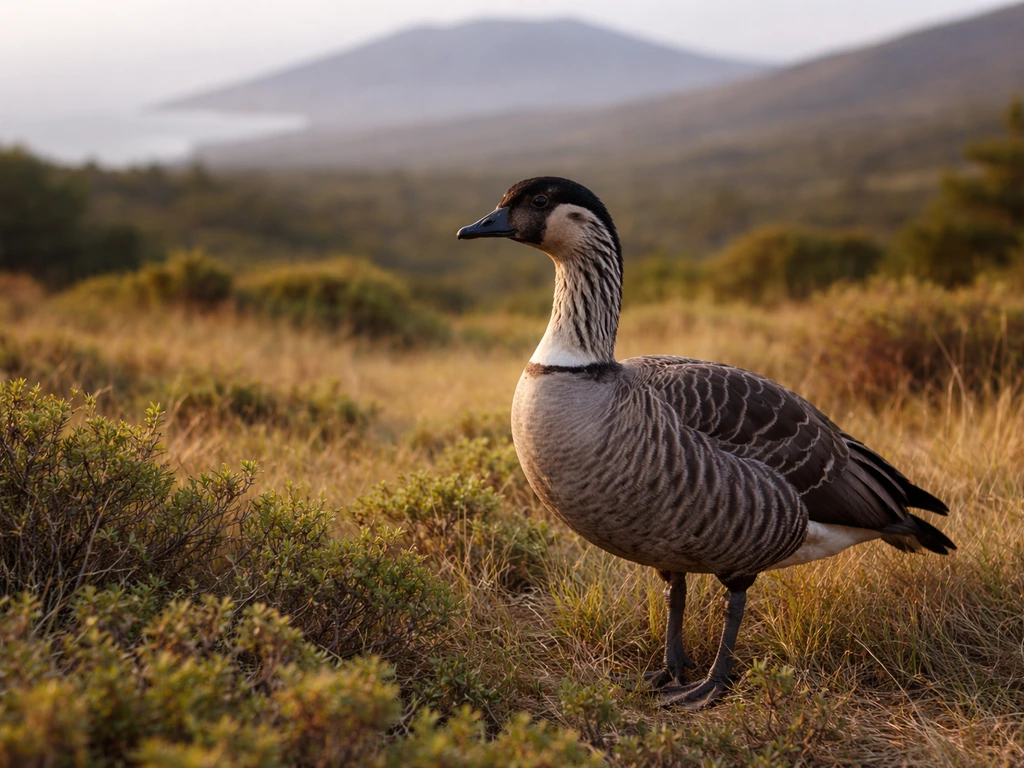
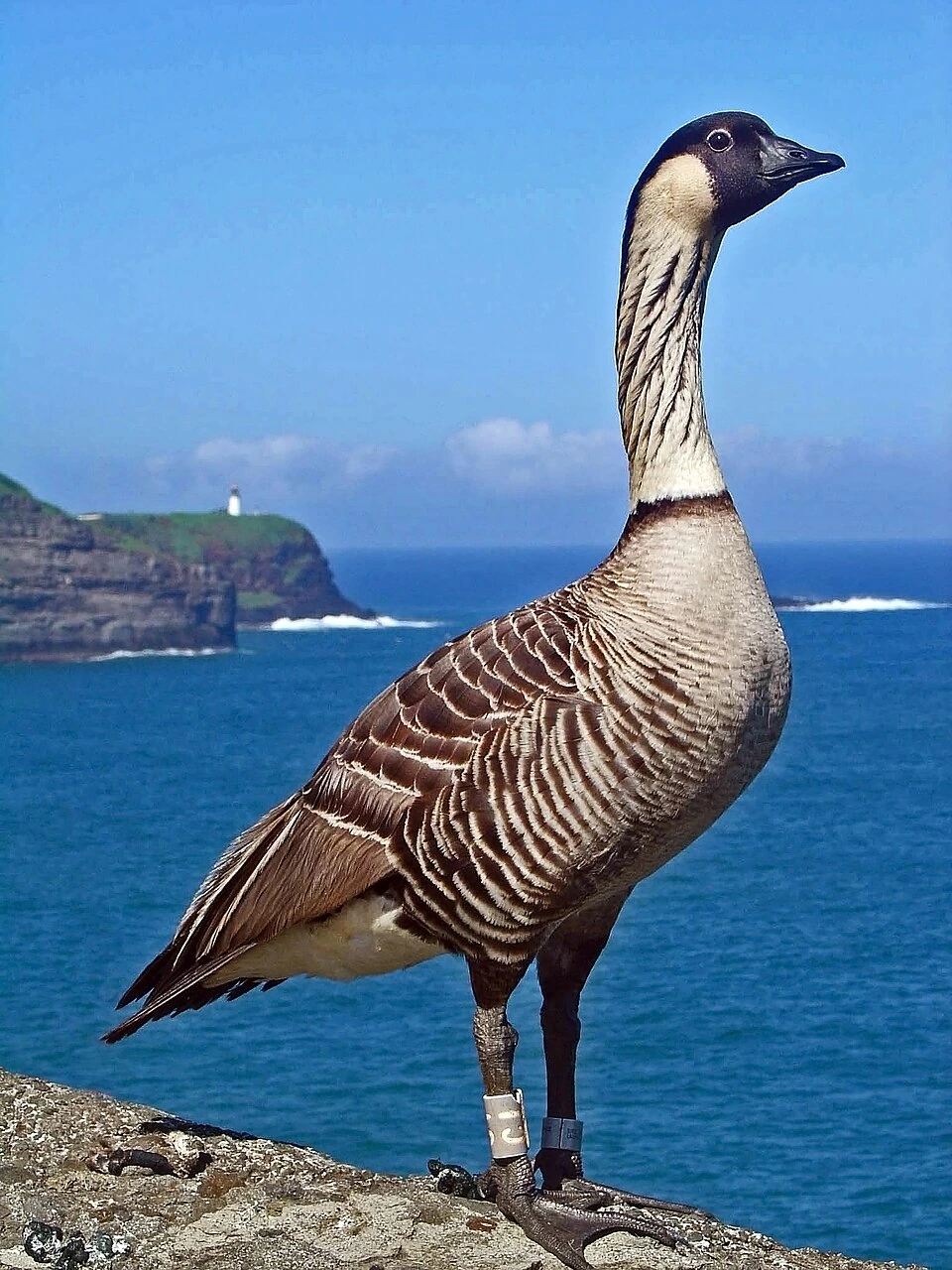
The nēnē is a medium-sized goose, measuring about 21 to 26 inches (53 to 66 cm) in length, noticeably smaller than a Canada goose. It is the world's rarest goose and the only one endemic to the Hawaiian Islands. Unlike most geese, the nēnē has adapted over thousands of years to life on volcanic slopes rather than wetlands, with reduced webbing between its toes to help it navigate rocky lava fields and shrubland.
In the wild today, nēnē live on the Big Island (Hawaiʻi), Maui, Kauaʻi, Molokaʻi, and Oʻahu, though the Oʻahu population was reestablished through reintroduction programs. Conservation experts believe nēnē probably once occurred on all the main Hawaiian Islands. Kauaʻi has been especially important to recovery: by 2012 it was estimated to hold roughly 60% of the statewide nēnē population. By 1960 and 1997, the U.S. Fish & Wildlife Service reports that over 2,000 nēnē were released on Hawaiʻi and Maui, and it estimated Kauaʻi accounted for about 60% of the statewide population by 2012 Kauaʻi accounted for an estimated 60% of the statewide nēnē population by 2012..
Why Hawaiʻi Chose the Nēnē as Its State Bird
The core reason is endemism. The nēnē exists nowhere else on the planet. Choosing it as the state bird was a statement that Hawaiʻi's natural heritage is unique, that the islands hold life found nowhere else. The nēnē is the only surviving endemic goose species in Hawaiʻi; fossil records show at least five other endemic goose species once existed there, all now extinct. The nēnē is the last one standing.
There was also a very practical motivation. By the time statehood arrived, the nēnē had been hunted and harassed to the edge of extinction, down to an estimated 30 birds by 1952. Conservation advocates pushed for the state-bird designation partly to raise the species' public profile and help unlock federal conservation funding. Giving the bird official state status put real political weight behind recovery efforts at a critical moment.
The Timeline: From Near Extinction to Official Symbol
The nēnē's story is one of dramatic collapse followed by hard-won recovery. Here is how the key events unfolded:
- Pre-contact era: Nēnē were widespread across the main Hawaiian Islands and held a place in Hawaiian cultural tradition, including mention in the Kumulipo, Hawaiʻi's creation chant.
- 19th and early 20th centuries: Hunting, habitat loss, and introduced predators (mongooses, cats, dogs, rats) pushed the nēnē toward extinction across most of its range.
- 1952: The wild population bottomed out at an estimated 30 individuals — an almost unimaginably small number for a species that once ranged across the archipelago.
- 1957–1958: The U.S. Congress passed S.4249, authorizing a federal program specifically for the conservation, restoration, and management of the nēnē. This was a direct legislative response to the crisis.
- 1959: Hawaiʻi achieves statehood, and the nēnē is designated the official state bird under what is now codified as Hawaiʻi Revised Statutes § 5-17.
- 1960–1997: More than 2,000 captive-bred nēnē were released on Hawaiʻi and Maui as part of organized recovery programs.
- 1991 onward: Captive-bred birds were released at Kilauea Point National Wildlife Refuge on Kauaʻi, where they successfully established a breeding population.
- 2019: The U.S. Fish and Wildlife Service downlisted the nēnē from endangered to threatened under the Endangered Species Act (84 FR 69918), reflecting genuine population recovery.
- Today: Several thousand nēnē live in the wild, though the State of Hawaiʻi still classifies the species as endangered under state law.
The Nēnē's Cultural Significance in Hawaiʻi
The nēnē is not just a conservation symbol, it is woven into Hawaiian identity going back centuries. In the Kumulipo, the Hawaiian creation chant, the nēnē is referenced as a guardian spirit of the land. Its seasonal movements between mountain and coastal habitats made it a living link between two worlds in the Hawaiian worldview, symbolizing the connection between upland and lowland, between the volcanic peaks and the sea.
The bird's name itself carries meaning. In ʻŌlelo Hawaiʻi (the Hawaiian language), "nēnē" translates roughly to a soft murmuring sound, "to chirp, as a cricket; to croak, or whimpering as a sleeping infant." That name reflects the bird's gentle, low call, which is quite different from the loud honking most people associate with geese. Place names across the islands also reflect the bird's historical presence: names like Puʻu Nēnē (goose hill) are embedded in the Hawaiian landscape. The nēnē was also historically used as food, which means it had both practical and spiritual dimensions in traditional Hawaiian life.
How to Identify the Nēnē in the Field
If you're visiting Hawaiʻi and want to spot a nēnē, knowing what to look for makes the difference. If you want to try your hand at it, learn the simple steps for how to draw the nēnē, Hawaiʻi’s state bird. If you want a creative project of your own, learn how to draw the Nevada state bird step by step spot a nēnē. The species is distinctive enough that a confident ID is very achievable once you know the key features. If you want to draw the nēnē, start by sketching its compact body and pale yellow neck with black streaks. If you're practicing a state-bird drawing, you can also use our guide on how to draw the Illinois state bird to get the proportions right.
| Feature | Nēnē | Canada Goose (for comparison) |
|---|---|---|
| Body length | 21–26 inches (53–66 cm) | 30–43 inches (76–110 cm) |
| Body color | Dark brown/sepia overall | Brown/gray-brown |
| Face and crown | Black | Black |
| Cheeks | Buff/cream-colored | White patch |
| Neck | Pale yellow to white with black streaks; furrowed texture | Solid black with white chin patch |
| Feet | Reduced webbing; adapted for rocky terrain | Fully webbed |
| Habitat | Volcanic slopes, lava fields, shrubland | Wetlands, lakes, grasslands |
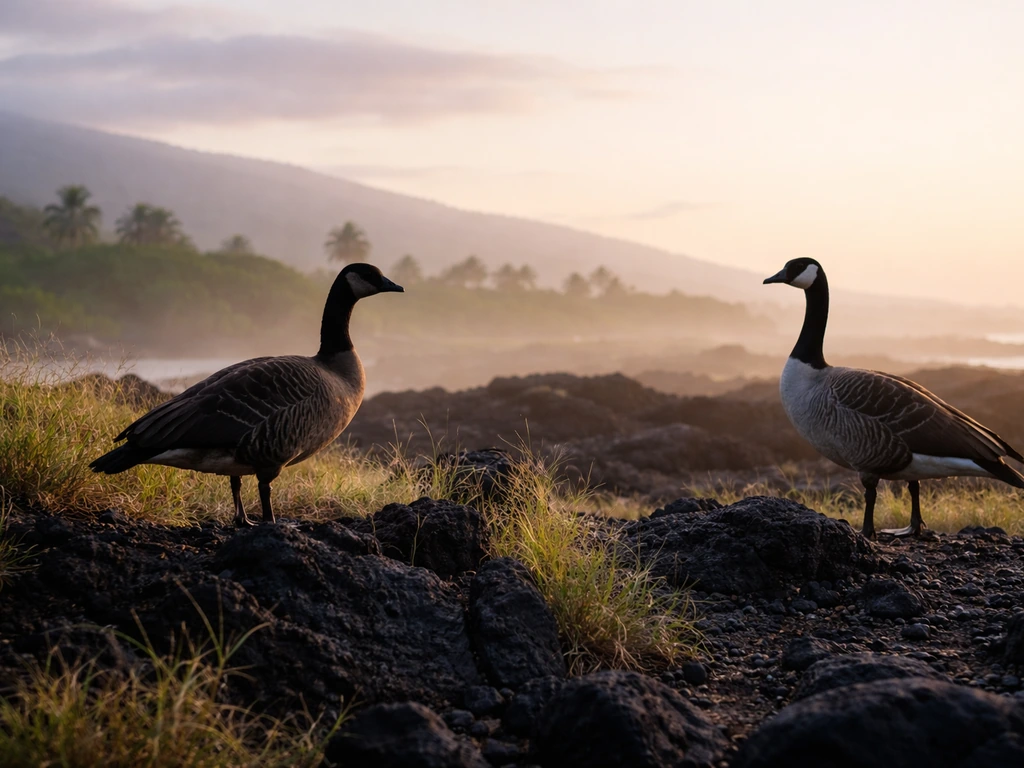
The single easiest field mark is the neck. A Canada goose has a solid black neck with a distinct white chin strap. The nēnē's neck is pale yellowish-white with black streaks and a visibly furrowed or corrugated texture, nothing else in Hawaii looks quite like it. If you want to learn how to draw the nēnē, start by sketching its pale neck with black streaks and compact goose shape, then add the distinctive head markings. The cream-colored cheeks against the black cap are also a reliable marker. At around 25 inches long, the nēnē is noticeably smaller and more compact than a Canada goose. On the Big Island, look for them on the slopes of Mauna Loa and Mauna Kea, and at Haleakalā National Park on Maui. Kilauea Point on Kauaʻi is another reliable spot.
How Hawaiʻi's Choice Compares to Other States
Most U.S. state birds are widespread, common species chosen more for familiarity or regional popularity than rarity. Encyclopaedia Britannica's overview of U.S. state birds also reflects that these lists typically favor familiar, nonrestricted species rather than narrowly restricted fauna Most state birds are widespread, common species chosen more for familiarity or regional popularity than rarity.. The American robin, northern cardinal, and northern mockingbird each serve as state birds for multiple states simultaneously, the mockingbird alone represents five states. The nēnē is the opposite of that pattern. It represents exactly one state because it can only exist in exactly one place.
The nēnē is also the only surviving member of its group: once there were at least six endemic goose species in Hawaiʻi, and the nēnē is the sole survivor. No other U.S. state has designated a bird that is both the last of its kind and classified under federal endangered species law at the time of designation. That combination of true endemism, near-extinction history, and legislative designation makes Hawaiʻi's choice genuinely singular among all 50 states.
If you're exploring other state bird designations on this site, the contrast is striking. Most state birds are picked because residents love seeing them in the backyard. Hawaiʻi picked the nēnē because losing it would mean losing something irreplaceable, a species that exists nowhere else on the planet and that nearly vanished entirely within living memory. If you want to draw the Ohio State bird, use its distinctive silhouette and bold coloring as your guide for an accurate sketch.
Conservation Status Today and Why It Still Matters
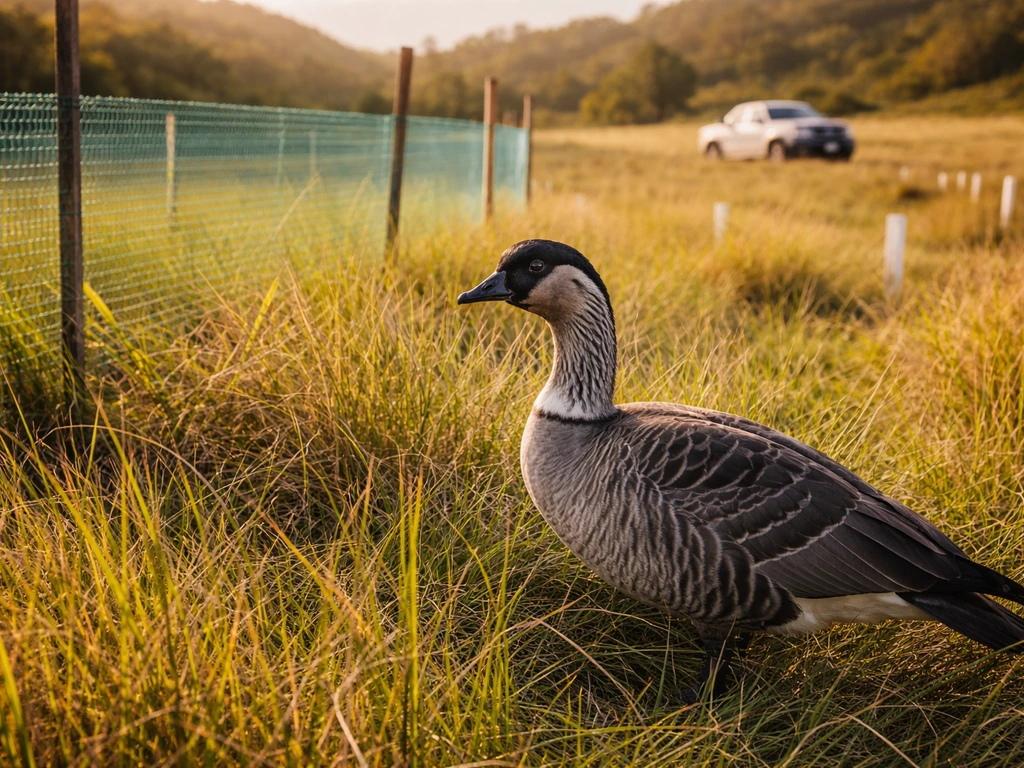
The nēnē's recovery is a real conservation success story, but it's not finished. From a low of roughly 30 birds in 1952, the population has grown to several thousand in the wild, a dramatic turnaround driven by captive breeding, predator control, and habitat protection. In 2019, the federal government downlisted the nēnē from endangered to threatened under the Endangered Species Act. That is genuine progress.
However, the State of Hawaiʻi still lists the nēnē as endangered under state law, and the threats that nearly wiped out the species have not gone away. Today's main dangers include:
- Predation by introduced mammals including mongooses, cats, dogs, and rats
- Toxoplasmosis, a disease spread by feral cats that can be fatal to nēnē
- Nutritional deficiencies and stress in high-elevation habitats
- Vehicle collisions on roads that cut through nēnē habitat
- Human disturbance in park and coastal areas where reintroduced birds now live
The NPS has noted that the nēnē "symbolizes the precarious existence of Hawaiʻi's native birdlife", and that framing is exactly right. The state-bird designation was never just ceremonial. It was a conservation act, and the species' ongoing vulnerability is a reminder of why that designation still carries weight. When you see a nēnē walking across a lava field at Hawaiʻi Volcanoes National Park, you're looking at a bird that almost wasn't there at all, and one that still needs active protection to stay.
FAQ
Is the nēnē state bird choice mainly about rarity, or does it also have a political and funding angle?
Because endemism is the headline reason, but the designation also served as a conservation tool at statehood. Making the nēnē the official symbol helped rally public attention and gave advocates extra leverage to secure federal recovery support for a species that was down to roughly 30 birds in the early 1950s.
If I’m looking for a nēnē, where should I search, wetlands or dry volcanic areas?
Unlike most geese, nēnē are adapted to dry, rocky volcanic slopes. If you are trying to spot one, don’t rely on classic “goose” wetland expectations, instead scan shrubland and lava-field edges, and expect movements between upland and coastal habitats through the year.
What single field mark helps me tell a nēnē from a Canada goose the fastest?
A Canada goose can look confusing at a distance because it is bigger and also has a distinctive head pattern. The nēnē’s easiest differentiator is its pale yellowish-white neck with black streaks and a textured, furrowed look, plus the cream cheeks against a black cap.
Does the nēnē’s name connect to how it sounds in real life?
“Nēnē” is often associated with the sound it makes in Hawaiian, a soft murmuring call. If you are expecting loud honking, you may miss them, since their vocalizations are generally lower and less goose-like in volume than people commonly assume.
Why does the article emphasize that the nēnē represents only one state, is that always true for state birds?
Yes, but the “exactly one state bird per species” idea can be misunderstood. Hawaiʻi chose a bird that exists nowhere else globally, so its geographic uniqueness matches the state identity. That means you should not interpret the choice as “one state bird per state,” but rather “one irreplaceable species tied to one place.”
Was the nēnē always found on Oʻahu in modern times?
The Oʻahu population was not always present in the same way it is today. Reintroduction programs helped restore it, so if you only think about current distribution, remember there was a human-assisted recovery component for some islands.
If it was downlisted federally, why is it still treated as endangered in Hawaiʻi?
Downlisting and delisting are easy to mix up. The nēnē was downlisted federally from endangered to threatened in 2019, but Hawaiʻi still lists it as endangered under state rules, so protections and recovery needs remain significant.
What’s the practical takeaway for conservation today, are the main threats the same everywhere?
Not necessarily. The bird’s conservation story is strongly tied to predator control, habitat protection, and breeding work, but those threats can change by location and season. A good field plan is to focus on protected sites and established recovery areas rather than random “try anywhere” scouting.
Next Articles

What Is Hawaii’s State Bird? The Nēnē (Hawaiian Goose)
Hawaii’s state bird is the nēnē, the Hawaiian goose, native and endangered on the islands with ongoing recovery.
Which Is Karnataka State Bird? Identification and Facts
Discover Karnataka’s official state bird, key ID traits, where to spot it, and why it was chosen.
What Is the Telangana State Bird? Official Bird and How to Spot It
Discover Telangana’s official state bird, key traits to spot it, and why it was chosen, with quick context.