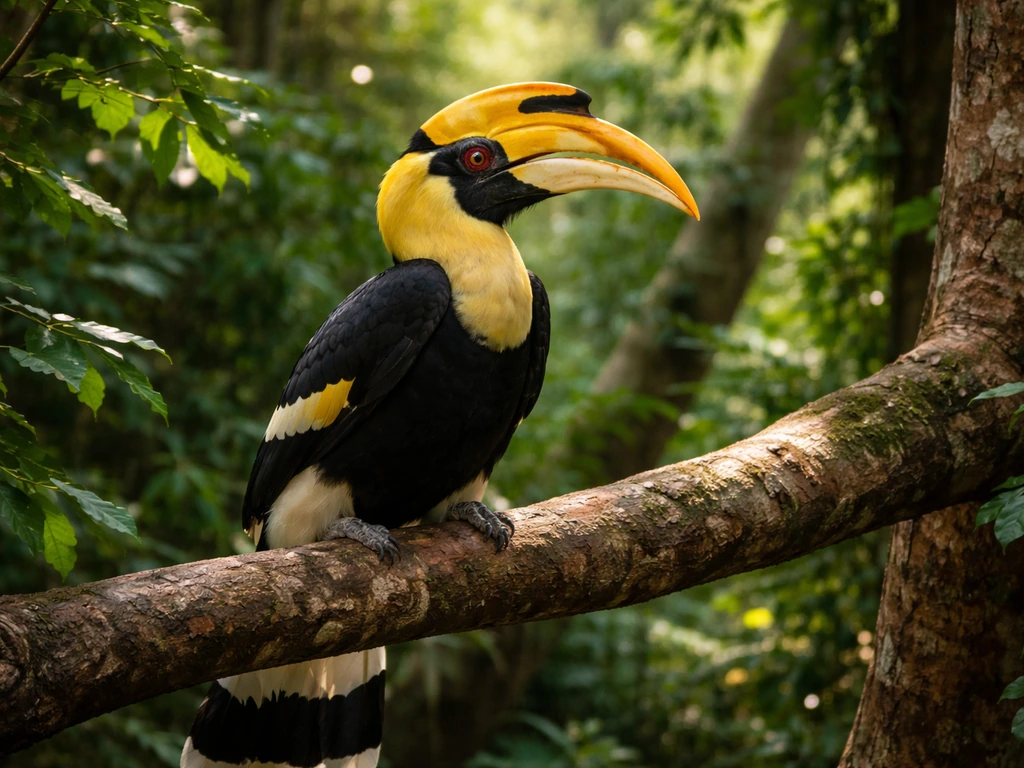
The hornbill designated as Kerala's state bird is the Great Hornbill (Buceros bicornis), known in Malayalam as 'malamuzhakki vezhambal' (മലമുഴക്കി വേഴാമ്പൽ). It was chosen because it is one of the most ecologically and culturally significant birds in Kerala's Western Ghats forests, a true icon of the biodiversity-rich landscape the state is famous for.
Why Hornbill Is the State Bird of Kerala: Reasons

Marcus Webb
31 May 2026
Which hornbill Kerala actually means
India has several hornbill species, so 'hornbill' alone is vague. When Kerala's official state symbol listings and the Kerala Forest Department refer to the state bird, they specifically name the Great Hornbill, Buceros bicornis (sometimes listed with the subspecies note 'homrai'). The Malayalam name translates roughly to 'mountain-thunderer hornbill,' a nod to its extraordinarily loud, resonant call that echoes through forested valleys. This is not the smaller Indian Grey Hornbill (Ocyceros birostris) that you might spot in urban parks across peninsular India. The Great Hornbill is a large, forest-dependent species and is the one you need to have in mind when Kerala's state bird comes up.
How Kerala made it official
The Great Hornbill appears on the Kerala Forest Department's official fauna listings as the State Bird of Kerala, and it is consistently cited in the state's official symbol compilations alongside the state animal (elephant), state flower (Kanikonna/Golden Shower), and state tree (coconut). While the exact year of formal legislative designation isn't always publicized widely, the status is consistent across government sources and has been listed in Kerala's official state-symbol records for decades. If you want to verify it directly, the Kerala Forest Department's Fauna of Kerala page and the Kerala government's official symbols listing are the two primary references to check.
Why the Great Hornbill? Culture, history, and meaning
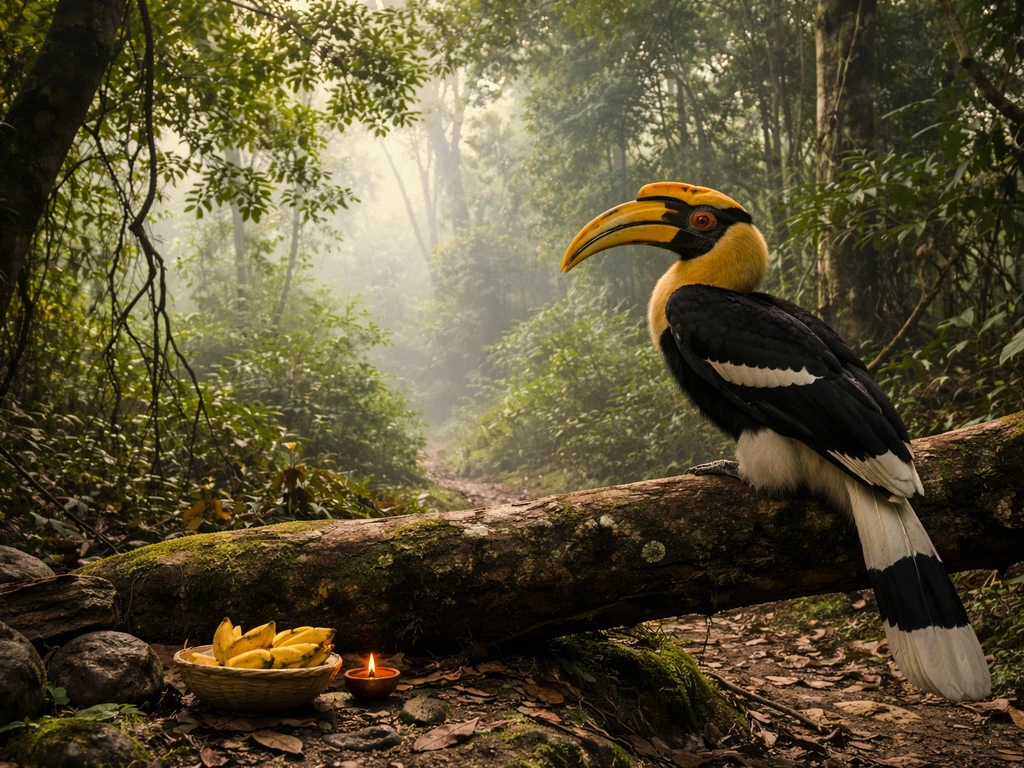
The choice makes a lot of sense once you understand what the Great Hornbill means to the people and the forests of Kerala. A few reasons stand out:
- Cultural symbolism: The Great Hornbill has deep roots in the traditions of tribal and indigenous communities across the Western Ghats. Its feathers and casque (the large yellow and red structure on top of its bill) carry ceremonial significance in several communities, making it a symbol with genuine local heritage rather than just a bureaucratic pick.
- Ecological flagship: Kerala is defined by its dense, humid forests of the Western Ghats, one of the world's eight biodiversity hotspots. The Great Hornbill is considered a flagship and keystone species of those forests. It disperses the seeds of large fruiting trees like fig, and its presence signals a healthy, intact forest ecosystem.
- Uniqueness to the region: Designating the Great Hornbill signals something specific about Kerala's ecological identity. It's a forest-interior bird that cannot survive in degraded or fragmented habitat, so choosing it as a state symbol reflects a commitment to the kind of landscape Kerala is most proud of.
- Striking appearance and recognizability: State birds are also symbols meant to resonate with people. The Great Hornbill is unmistakable, enormous, and visually dramatic. It is one of those birds that makes an impression the first time you see or hear it, which gives it real symbolic weight.
Where in Kerala you'll find it
The Great Hornbill is a bird of tall, undisturbed tropical and subtropical broadleaf forests, and in Kerala that means the Western Ghats. The key areas where it still thrives include Periyar Tiger Reserve (Thekkady), Silent Valley National Park, Parambikulam Tiger Reserve, and the Wayanad Wildlife Sanctuary. It strongly prefers large, old-growth trees, particularly tall figs and other fruiting species, because it nests in natural cavities in mature trunks and depends on large fruiting trees for food. Elevation-wise, it's found from the foothills up into mid-elevation forest, roughly 200 to 2000 meters. You won't find it in the lowland agricultural zones or coastal areas of Kerala. If you want to see one, your best bet is heading into the core forest zones of one of those protected areas, especially early morning when the birds are active and calling.
How to identify a Great Hornbill in the field
You won't confuse the Great Hornbill with much else once you know what to look for. Here are the key field marks:
- Size: This is a very large bird, roughly 95 to 130 cm (about 3.5 to 4.3 feet) in length, with a wingspan that can reach 150 cm. In flight, it looks almost prehistoric.
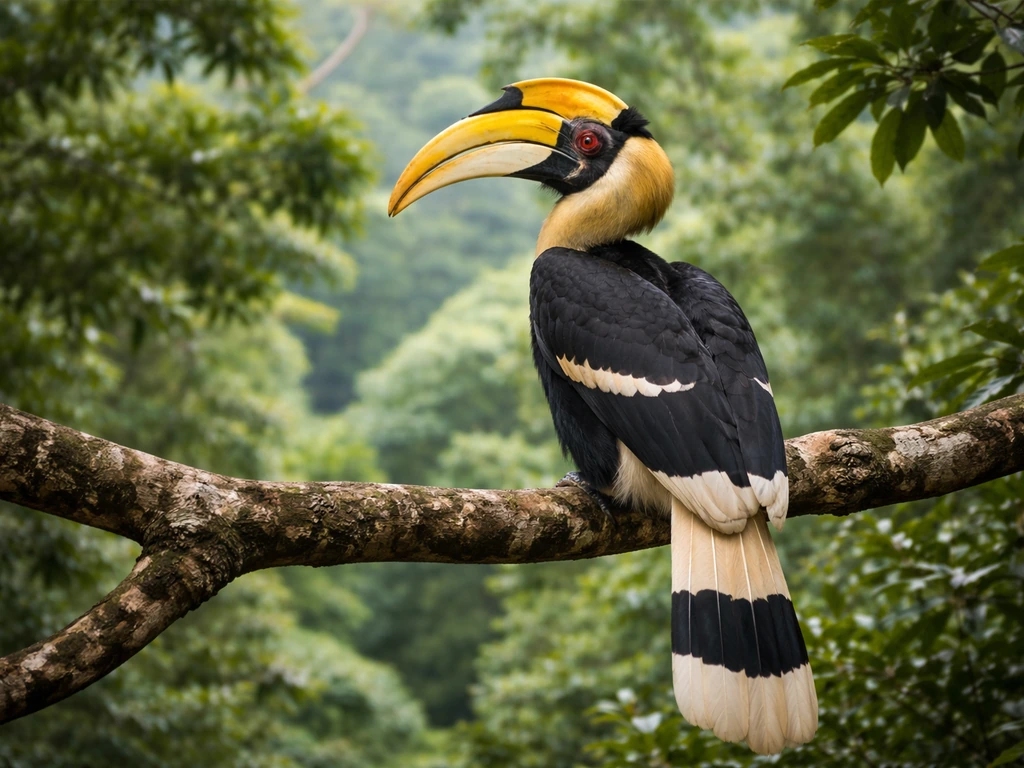
- Casque: The defining feature is the large, hollow, yellow-and-black casque sitting on top of the massive curved bill. It is bright yellow on top with a black band near the base.
- Plumage: Mostly black and white. The neck and underparts are white, the back and wings are black with white wing bars visible in flight, and the tail is white with a broad black band.
- Bill: Large, curved, yellow and black, looking disproportionately heavy for any bird.
- Call: Extremely loud, deep, barking calls (often described as 'kok kok kok') that carry a long distance through forest. In flight, the wingbeats produce a loud whooshing sound audible from quite far away.
- Eye: Males have red eyes with a black orbital ring; females have white or bluish-white eyes with a red orbital ring, a useful distinction for sex identification in the field.
Common mix-ups and how to get the name right
A few confusions come up regularly around this topic, and it's worth clearing them up directly.
Is it 'Great Indian Hornbill' or 'Great Hornbill'?
Both names are used for the same bird, Buceros bicornis. The Kerala Forest Department uses 'Great Indian Hornbill' in some official listings, while modern ornithological references and the IUCN tend to use simply 'Great Hornbill.' The scientific name Buceros bicornis is the unambiguous way to pin it down, regardless of which English common name you encounter.
Is the hornbill only Kerala's bird, or do other Indian states claim it too?
This is where people often get confused. The Great Hornbill is also the state bird of Arunachal Pradesh, a northeastern Indian state with its own distinct forest ecosystems. So if you see 'hornbill is the state bird of India' in a general list, it may be referring to either Kerala or Arunachal Pradesh. The context of southern India, Western Ghats, or Malayalam names all point to Kerala specifically. If you are comparing nearby southern states, Andhra Pradesh, Tamil Nadu, Karnataka, and Telangana each have different state birds, so the hornbill designation is specific to Kerala among its immediate neighbors. Tamil Nadu also has its own official state bird, the Blackbuck, which is different from Kerala's Great Hornbill state bird of Tamil Nadu. Andhra Pradesh’s state bird is also a different species, so it helps to check the official state-symbol listing for the correct bird name Andhra Pradesh, Tamil Nadu, Karnataka, and Telangana each have different state birds. Karnataka state bird is different from Kerala’s Great Hornbill. Telangana has a different official state bird, so make sure you check the specific state symbol list for Telangana Telangana state bird.
Don't confuse it with the Indian Grey Hornbill
The Indian Grey Hornbill (Ocyceros birostris) is a much smaller, brownish-grey bird commonly seen in gardens, urban trees, and open landscapes across India, including parts of Kerala's lowlands. It is not the state bird and is a completely different species. If someone says they saw a 'hornbill in Kerala' in a city park, they almost certainly saw the Grey Hornbill, not the Great Hornbill.
How to confirm the official designation yourself
If you need to cite this officially, the two most reliable routes are the Kerala Forest Department's Fauna of Kerala section on their website, and the Kerala government's official state symbols list. Both consistently name the Great Hornbill (Buceros bicornis) as the state bird under the Malayalam designation 'malamuzhakki vezhambal. A commonly repeated official-symbol listing identifies Kerala’s state bird as “malamuzhakki vezhambal / Great hornbill” (Buceros bicornis) Both consistently name the Great Hornbill (Buceros bicornis) as the state bird under the Malayalam designation 'malamuzhakki vezhambal.. ' For field reference, any edition of the Grimmett, Inskipp, and Inskipp field guide to Indian birds will give you a full species account under Buceros bicornis with range maps showing the Western Ghats population clearly.
| State | State Bird | Species |
|---|---|---|
| Kerala | Great Hornbill (malamuzhakki vezhambal) | Buceros bicornis |
| Karnataka | Indian Roller | Coracias benghalensis |
| Tamil Nadu | Emerald Dove | Chalcophaps indica |
| Andhra Pradesh | Indian Roller | Coracias benghalensis |
| Telangana | Indian Roller | Coracias benghalensis |
As the table above shows, Kerala stands out among its southern Indian neighbors precisely because its state bird is a forest-specialist of the Western Ghats rather than the widely distributed Indian Roller chosen by three neighboring states. That distinction is part of what makes the Great Hornbill such an appropriate and meaningful choice for Kerala's ecological and cultural identity.
FAQ
Is it definitely the Great Hornbill, or could Kerala’s state bird be a different hornbill species?
For Kerala, the state bird is consistently assigned to the Great Hornbill, Buceros bicornis, in official state-symbol and forest-department references. If you see another hornbill name in a general blog or quiz list, confirm it using the Malayalam designation and the scientific name, because multiple hornbill species exist across India.
What does the Malayalam name “malamuzhakki vezhambal” refer to in plain terms?
It is a descriptive nickname for the Great Hornbill, pointing to how its call carries far in forest valleys. If you are trying to match sources, treat this Malayalam name as a label for Buceros bicornis, not as a separate bird.
Where in Kerala is the hornbill most likely to be found, if I am visiting as a tourist?
Your best odds are in core forest and protected areas of the Western Ghats, especially zones like Periyar (Thekkady), Silent Valley, Parambikulam, and Wayanad Wildlife Sanctuary. The practical difference is time of day, early morning calls and activity are usually your best window.
Can I see the state bird in towns, plantations, or city parks in Kerala?
In most cases, no. The Great Hornbill is a forest-dependent species that relies on mature, old trees and large fruiting trees for nesting and food, so it is not typically found in lowland towns or urban parks. In cities you are more likely to encounter smaller or common hornbills, not the Great Hornbill.
What if someone tells me “hornbill is the state bird of India,” is that correct?
“Hornbill” is not a single national state-bird category for all of India. Kerala has the Great Hornbill as its state bird, and another hornbill-related designation exists in Arunachal Pradesh, so the correct species depends entirely on the state context.
Why do some sources call it “Great Indian Hornbill,” is that an error?
It is usually a naming variant used in some listings. The key is not the English common name, it is the scientific name Buceros bicornis, which uniquely identifies the bird.
How can I tell the Great Hornbill apart from the Indian Grey Hornbill that people see around Kerala?
Size and habitat are the quick guides. The Indian Grey Hornbill is smaller and often seen in urban or open landscapes, while the Great Hornbill is larger and tied to undisturbed forest with old, tall trees. If a report includes city parks and lowlands, it is very likely the Grey Hornbill.
If I am writing or citing this for a school project, what should I include to avoid mistakes?
State the bird with both the common name and scientific name (Great Hornbill, Buceros bicornis) and, for Kerala, the Malayalam designation. That combination prevents confusion with other hornbills that have similar English names or appear in generic “state bird” compilations.
Does elevation or season affect where I might spot the hornbill in Kerala?
Yes, elevation matters because the Great Hornbill is typically associated with foothills into mid-elevation forest zones rather than coastal or agricultural lowlands. Season can also influence calling and detectability, so if you are planning a sighting, aim for early mornings and forest interiors rather than roadside edges.