Wyoming chose the western meadowlark as its state bird because the species is genuinely everywhere in the state. It lives in Wyoming's vast grasslands, sings from fence posts along every highway, and has been a familiar part of the landscape for as long as anyone can remember. The Legislature made it official on February 5, 1927, making Wyoming the first state in the country to give the meadowlark that honor.
Why Is the Western Meadowlark the State Bird of Wyoming?

Marcus Webb
27 May 2026
What the western meadowlark looks and sounds like
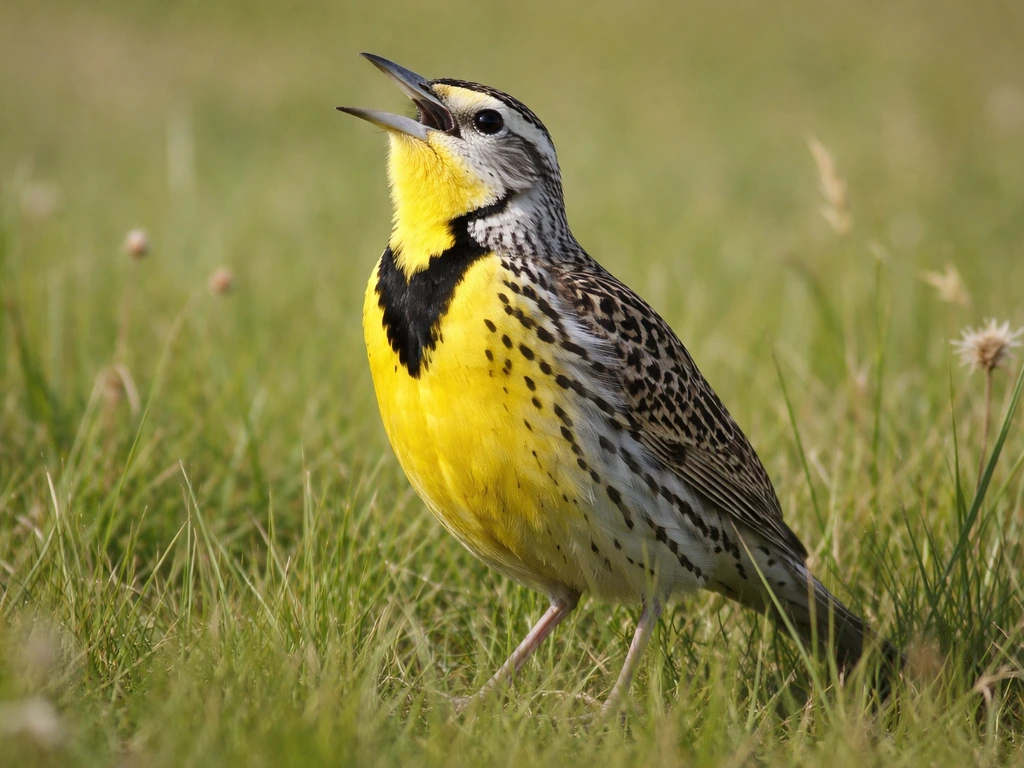
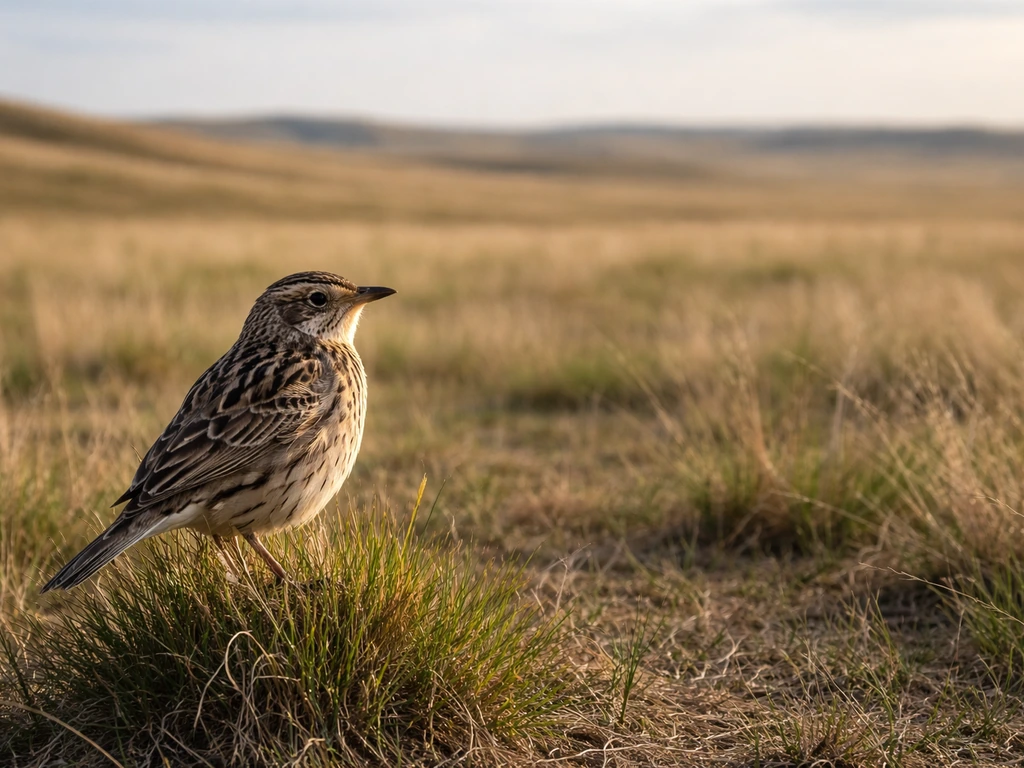
The western meadowlark (Sturnella neglecta) is a medium-sized songbird with one instantly recognizable field mark: a bold black "V" across a bright yellow breast. The back and wings are streaked brown, which helps it blend into dry grass, but the yellow front makes it easy to spot when it perches up on a fence post or a low shrub to sing. It's a stocky bird with a short tail and a long, pointed bill.
The song is what really sticks with people. The western meadowlark produces a rich, flute-like series of gurgling whistles that carry a long distance across open country. Its shorter call note is a low, bell-like "pluk" or "chupp" sound, often heard when the bird is mildly disturbed or during territorial interactions. If you've driven through Wyoming with the windows down in spring or early summer, you've almost certainly heard one without knowing what it was.
It's worth distinguishing the western meadowlark from its close relative, the eastern meadowlark (Sturnella magna). The two species look nearly identical in the field. The key differences are voice and range: the eastern meadowlark has a simpler, clearer whistled song and sticks to eastern North America. The western meadowlark's song is more complex and gurgling, and its range runs from western Canada south through the Great Plains and into Mexico. Wyoming is firmly western meadowlark territory.
Why the western meadowlark fits Wyoming so well
Wyoming is defined by open space. The state has more than 30 million acres of grasslands, shrublands, and mixed-grass prairies, and that is exactly the habitat the western meadowlark is built for. According to monitoring data, the species is a conspicuous and abundant resident of grasslands, croplands, weedy fallow fields, roadsides, and mixed grassland/shrubland areas across central and western North America. In Wyoming, that description could apply to almost every county in the state.
The bird's visibility matters too. You don't need to go looking for a western meadowlark in Wyoming; it finds you. It perches prominently, sings loudly, and appears along roadsides, in agricultural areas, and across high plains elevations throughout the state. For Wyoming residents in the early 20th century, it was simply the bird you saw every day. That kind of everyday familiarity is exactly what makes a state bird feel right rather than arbitrary.
Symbolically, the meadowlark's open-country lifestyle mirrors Wyoming's identity as a wide, rural, undeveloped state. It's not a forest bird or a coastal bird. It's a plains bird, and Wyoming is plains country, high desert, and grassland from corner to corner. The match between species and landscape is about as clean as state-bird designations get.
How Wyoming officially adopted the meadowlark in 1927

Wyoming's Legislature formally designated the meadowlark as the state bird on February 5, 1927. That makes Wyoming not just an early adopter but the first state to give the western meadowlark official state-bird status. The designation is codified in Wyoming Statutes Title 8, Section 8-3-105, which reads: "An American icteroid bird (genus Sturnella), the bird commonly known as the meadowlark, is the state bird of Wyoming."
The origin story behind the 1927 designation has a classroom connection. Wyoming Public Media's "Museum Minute" segment recounts that the selection process had roots in school-based input, a common pattern in 1920s state-symbol designations when legislators often turned to public or student votes to build popular support for the choice. The Thermopolis Independent Record also links the adoption to local community involvement and documents Wyoming's role as the first among several states to make the meadowlark official.
The official state of Wyoming still lists "State Bird: Meadowlark" among its core facts and symbols, and the Wyoming Game and Fish Department confirms the species' scientific name as Sturnella neglecta. Nothing has changed since 1927; the designation has stood for nearly a century without any legislative challenge or revision.
Other states that chose the same bird
Wyoming was first, but it didn't end up alone. The western meadowlark is the state bird of six states in total, making it one of the most shared state-bird designations in the country. The other five are Kansas, Montana, Nebraska, North Dakota, and Oregon. Every one of those states has strong grassland or open-country habitat that the meadowlark calls home, which explains why so many state legislatures landed on the same answer independently.
| State | Year Adopted | Notes |
|---|---|---|
| Wyoming | 1927 | First state to designate the western meadowlark |
| Nebraska | 1929 | Codified in Nebraska Revised Statutes § 90-107 |
| Montana | 1931 | Adopted by legislature on March 14, 1931 |
| Kansas | 1937 | Preceded by a 1925 schoolchild vote by the Kansas Audubon Society |
| North Dakota | 1947 | Became official state bird that year |
| Oregon | 1927 (re-designated 2017) | Originally chosen in 1927 via schoolchildren poll; re-designated as official state songbird in 2017 via SCR 18 |
Oregon's situation is slightly different from the others. The western meadowlark was [chosen there in 1927 by schoolchildren in a poll run by the Oregon Audubon Society](https://www. oregonlegislature. gov/lpro/SMLByChapter/2017%20-%20Government.
pdf), the same year Wyoming made it official. Oregon adopted the western meadowlark after a schoolchildren poll, and its designation later evolved in 2017. In 2017, Oregon passed SCR 18, which reorganized the designation: the western meadowlark became the official state songbird, while the osprey was added as the official state raptor.
A 2022 Oregon wildlife monitoring report for the Biglow Canyon Wind Project also recorded western meadowlark (Sturnella neglecta) among observed birds, supporting the species' presence in Oregon field contexts [In 2017, Oregon passed SCR 18, which reorganized the designation: the western meadowlark became the official state songbird, while the osprey was added as the official state raptor. ](https://www. oregon. gov/energy/facilities-safety/facilities/Facilities%20library/2023-08-17-Biglow-Canyon-Wind-Project-2022-Wildlife-Monitoring-Results.
pdf). So Oregon still recognizes the meadowlark, just under a more specific label.
Kansas followed a similar path to Wyoming in spirit. The Kansas Audubon Society ran a statewide schoolchild vote in 1925 that favored the meadowlark, but the Kansas Legislature didn't make it official until 1937, a decade after Wyoming. If you're wondering why, in particular, the western meadowlark became Kansas's state bird, there are specific local reasons behind that 1937 decision why is the western meadowlark the state bird of kansas. If you're curious about the specific reasons each state landed on this bird, the stories for Kansas and Oregon are worth reading on their own, since each state has its own angle on why the meadowlark felt right locally.
Where to go from here
If you want to go deeper, the most useful next steps are to look at how the western meadowlark's presence and symbolism plays out differently across the six states that share it. Wyoming, Kansas, and Oregon each have distinct origin stories for their designations, and comparing them shows how the same bird can carry different regional meanings. You can also explore the broader picture of what Wyoming's full set of state symbols looks like, or dig into which other states share state birds with their neighbors, a pattern that turns up more often than you'd expect across the Great Plains and the West.
- Wyoming officially adopted the western meadowlark on February 5, 1927, making it the first state to do so.
- The bird fits Wyoming because it's a native, year-round presence in the state's defining grassland and open-country habitats.
- It's recognizable by its bright yellow breast with a black V-shaped chest mark and its rich, gurgling song.
- Five other states share the designation: Kansas, Montana, Nebraska, North Dakota, and Oregon.
- The designation is codified in Wyoming Statutes § 8-3-105 and has not changed since 1927.
FAQ
How can I tell I’m looking at the western meadowlark, not the eastern one?
Wyoming’s designation is specifically for the western meadowlark, whose scientific name is Sturnella neglecta. If you are comparing meadowlarks in the field, the similar-looking eastern meadowlark (Sturnella magna) has a different song and mainly occurs farther east, so Wyoming sightings within the state’s range are typically western.
What field clues should I use if I hear a meadowlark in Wyoming?
Look and listen for the bird’s most distinctive combination: a bold black “V” across the yellow breast, plus a more complex, gurgling whistle rather than a simpler, clearer whistled pattern. In Wyoming, location helps too, because the western species is the dominant meadowlark you will run into across grasslands and roadsides.
Do I need to visit a special habitat or park to see a western meadowlark in Wyoming?
The state-bird choice is tied to broad familiarity and habitat presence, not to a single “best” meadowlark location. Even though the bird favors open country, you can still find it in places like weedy fallow fields, croplands, and roadside areas, so you do not need protected parks to encounter one.
Is 1927 the year Wyoming picked the bird, or the year it became official?
February 5, 1927 is the formal legislative adoption date for Wyoming. Oregon’s school poll and later legal reorganization into a songbird (in 2017) show that “chosen” and “made official” can be different milestones depending on the state, but Wyoming’s record is anchored to that 1927 legislative designation.
Does the official state bird status mean meadowlarks are guaranteed in every season and every year?
No, the article’s description of “nothing has changed” refers to Wyoming’s state-bird status remaining intact since 1927. That said, individual birds and local populations can vary from year to year, so the designation does not guarantee you will see one on every single trip.
When is the best time of day and time of year to hear the western meadowlark in Wyoming?
Because Wyoming has a lot of open land, the bird’s visibility is typically highest in spring and early summer when breeding activity increases singing. Midwinter can be quieter, so if you are trying to locate one by sound, prioritize warmer months and early mornings or late afternoons when birds are active.
Where in Wyoming are meadowlarks least likely to be found, even if I’m in the right region?
The meadowlark’s symbol match is stronger for Wyoming’s landscape identity than for forests or coastal environments. If you are searching in heavily wooded areas or dense canopy, your chances drop, because this bird is adapted to perching and calling from exposed spots in grassland and shrubland.
Why do other states share the same bird, but have different official details or timelines?
Wyoming is one of several states that share the western meadowlark, but each state has its own origin story and sometimes its own official framing. If you compare symbols across states, note that Oregon’s designation was reorganized in 2017, while Wyoming’s remained a state bird without that later renaming step.
What’s a common mistake people make when researching state-bird meadowlark history?
If you want to avoid confusion when researching, match the terms “state bird” versus “state songbird” and “western meadowlark” versus the eastern species. A common mistake is to assume all meadowlark-related designations refer to the same legal status or the same species across states.