
The state bird of Uttarakhand is the Himalayan monal (Lophophorus impejanus). It is also called the Impeyan monal, and locally in Uttarakhand it is simply known as "monal. The state bird of Rajasthan is a different species, the Great Indian Bustard Impeyan monal. " This is the official designation confirmed by the Government of Uttarakhand, the Zoological Survey of India's Fauna of Uttarakhand volume, and consistent with every major state-symbol reference for the state.
State Bird of Uttarakhand: Which Bird It Is

Marcus Webb
10 Jun 2026
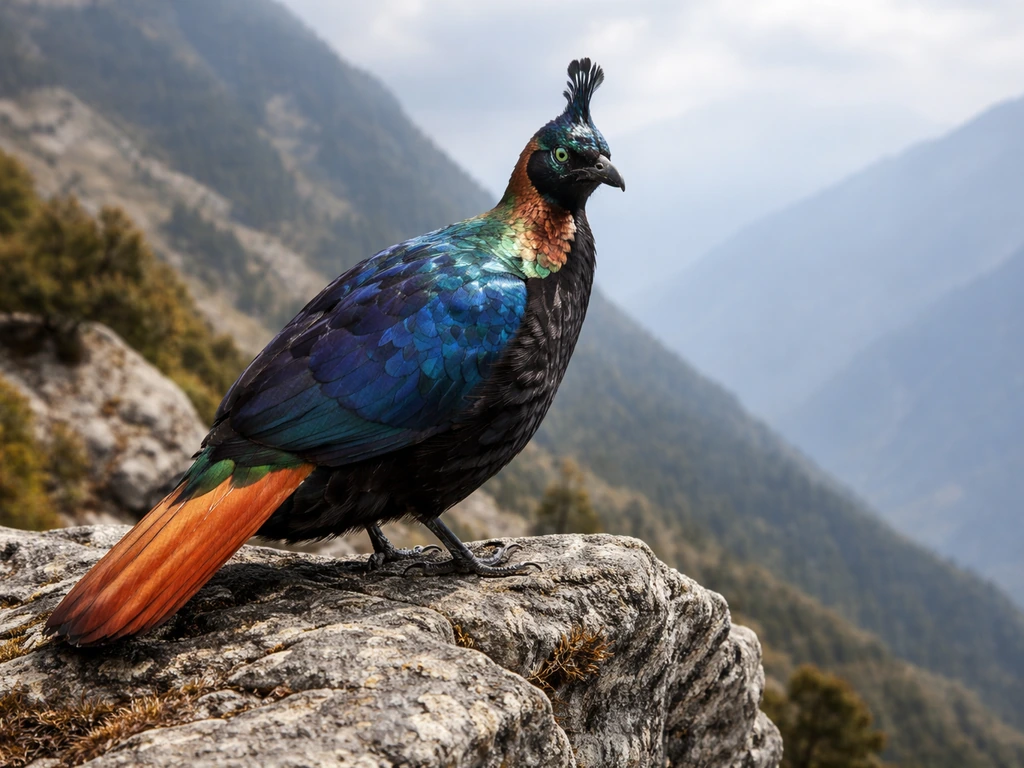
How to recognize the Himalayan monal
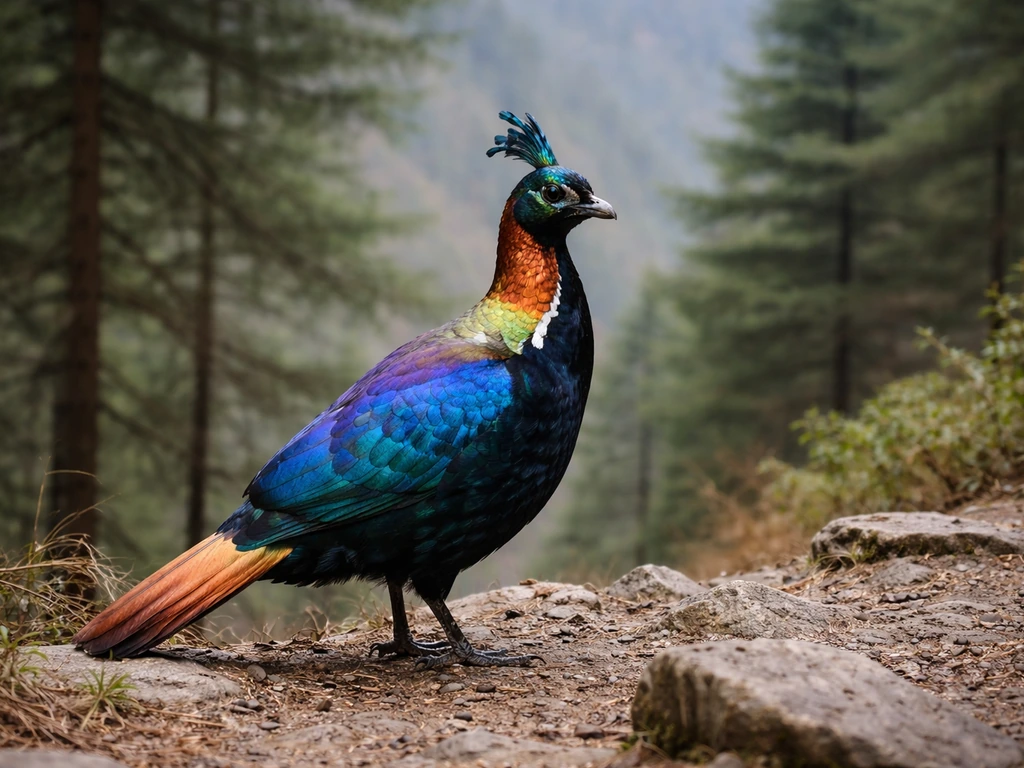
The male Himalayan monal is one of the most visually striking pheasants in the world, and once you've seen one, you won't confuse it with anything else. The adult male has a long, metallic green crest and a body covered in iridescent blue, copper, purple, and green plumage. The effect in sunlight is almost jewel-like. The female is considerably more subdued, with brownish-black feathers, but she has her own clear field marks: a prominent white stripe on the tail and a white patch on the throat.
In terms of habitat, the Himalayan monal lives in Himalayan forests and shrublands at elevations typically between 2,100 and 4,500 meters above sea level. It favors open coniferous and mixed forests, often with rhododendron and bamboo undergrowth. If you spot a large, brilliantly colored pheasant in the high-altitude forests of Uttarakhand, you are almost certainly looking at this species. The scientific name Lophophorus impejanus (Latham, 1790) is the binomial to match against any state-symbol text you find.
Why Uttarakhand chose the monal as its state bird
The Himalayan monal is about as representative of Uttarakhand's high-altitude ecology as a bird can be. The state is defined by its Himalayan geography, and the monal is one of the most iconic and immediately recognizable species of that landscape. Its presence is tightly tied to the alpine and subalpine forests that cover much of the state's upper reaches, making it a natural emblem of the region's biodiversity.
Beyond ecology, the monal carries genuine cultural weight across the broader Himalayan region. In neighboring Nepal, it is called "danphe" or "danfe" and is that country's national bird, which speaks to how deeply embedded the species is in Himalayan identity. In Uttarakhand, the monal's local name and its dazzling appearance make it a bird that local communities know and recognize. Conservation researchers also treat it as a priority species: the Garhwal Himalayas studies flag it as facing pressure from habitat change and exploitation, which gives its state-bird status added practical significance as a conservation signal. The state bird of Sikkim is the Himalayan Monal state-bird status.
When Uttarakhand officially adopted its state symbols
Uttarakhand was carved out of Uttar Pradesh and became a separate state on November 9, 2000. The state's official biological symbols, including the Himalayan monal as state bird, were adopted around the time of the state's establishment. This is where the question "which is punjab state bird" comes in, because Punjab has its own official state bird as well Himalayan monal as state bird.
A 2019 Times of India report references forest department conservation actions specifically tied to the "state bird of Uttarakhand, Himalayan Monal," which confirms the designation has been actively applied in official policy and conservation discourse well beyond its initial adoption. The Zoological Survey of India's government-hosted Fauna of Uttarakhand volume also explicitly identifies the species as "the State bird of Uttarakhand," giving the designation firm institutional footing.
Does any other Indian state share this bird?
Yes. Himachal Pradesh also designates the Himalayan monal (Lophophorus impejanus) as its state bird. Both states share a Himalayan geography and the same iconic species, which makes logical sense given that the bird's range spans those high-altitude forests without regard for administrative borders. This is worth knowing because it is one of the more common shared-bird situations among Indian states, comparable to how several American states share the same state bird. The scientific name remains the same in both cases, so there is no ambiguity about which monal species is meant. It is not the Chinese monal or any other Lophophorus species; it is specifically Lophophorus impejanus.
Indian state birds that share the Himalayan monal designation
| State | State Bird | Scientific Name |
|---|---|---|
| Uttarakhand | Himalayan monal | Lophophorus impejanus |
| Himachal Pradesh | Himalayan monal | Lophophorus impejanus |
How to confirm the designation yourself
If you want to verify this independently, the most authoritative route is the Fauna of Uttarakhand (State Fauna Series, Volume 18), published by the Zoological Survey of India and hosted on faunaofindia.nic.in. It is a government-produced reference that explicitly names Lophophorus impejanus as the state bird. For a quick cross-check on the species itself, the BNHS Envis checklist for Uttarakhand birds ties "Himalayan Monal / Impeyan Monal" to the same binomial, confirming the spelling and taxonomy. Avibase's entry for Lophophorus impejanus provides the typical elevation range (2,100 to 4,500 m) and habitat context, which you can use to verify any field observation you're trying to pin down.
Other Indian states have their own equally interesting official birds. To learn the same for Odisha, you can look up the official state bird designation for Odisha specifically. Sikkim's state bird is the blood pheasant, also a high-altitude Himalayan species, while Arunachal Pradesh claims the great hornbill. The great hornbill is the state bird of Arunachal Pradesh Arunachal Pradesh claims the great hornbill.
The what is the state bird of sikkim is the blood pheasant Sikkim's state bird. If you're exploring Indian state bird designations more broadly, the pattern of Himalayan states choosing mountain pheasants and raptor-rich states choosing birds of prey is a useful frame for understanding how these symbols get picked. For the neighboring state of Assam, you can similarly look up its official state bird to see which species represents its wildlife identity Assam's official state bird. To answer what is the state bird of Assam, check the official state-symbol listing for the bird that Assam recognizes.
Uttarakhand's choice of the monal fits squarely into that logic. The state bird of Jharkhand is the Indian cuckoo Indian cuckoo (state bird of Jharkhand). If you're wondering what the state bird of Jharkhand is, the answer is the Indian cuckoo.
FAQ
If I see a pheasant in Uttarakhand, how can I tell it is the Himalayan monal and not a different bird?
Focus on the adult male’s metallic green crest and multi-colored, jewel-like body sheen in sunlight. The female is more brown-black but still shows a clear white stripe on the tail and a white throat patch, which are strong field marks for the Himalayan monal.
Is Uttarakhand’s state bird definitely the Himalayan monal, and not a similarly named monal species?
Yes, the official state-bird designation is Lophophorus impejanus, also called Impeyan monal. It is not the Chinese monal or any other Lophophorus species, so taxonomy and the scientific name are the safest way to confirm.
Do other Himalayan states use the same state bird as Uttarakhand?
Himachal Pradesh also designates the Himalayan monal (Lophophorus impejanus) as its state bird. Because the bird’s range crosses high-altitude habitats across administrative borders, shared-symbol cases like this happen in mountain regions.
What elevation range should I expect if I’m trying to spot the Himalayan monal in Uttarakhand?
Typical observations are at roughly 2,100 to 4,500 meters. If you are much lower than that or in lowland habitat, the chances drop sharply, even if the bird looks superficially pheasant-like.
Where in the landscape is the Himalayan monal most likely to be found?
Look for high-altitude forests and shrublands, especially open coniferous or mixed forests with rhododendron and bamboo undergrowth. Spotting it in dense, low-elevation tropical-looking areas is uncommon for this species.
Does the state bird designation depend on Uttarakhand’s district boundaries or specific regions within the state?
No, it is a state-level official symbol, so it does not change by district. However, the bird’s local presence does vary with suitable alpine and subalpine habitat within Uttarakhand.
How can I verify the state bird claim quickly without relying on second-hand summaries?
Use the Zoological Survey of India reference that explicitly identifies the state bird, and check that it names Lophophorus impejanus as the Himalayan monal. For field-level confirmation, a bird checklist that ties the same common name to the same scientific name can also help.
Why does the same bird get called different names across the Himalayas?
Common names vary by language and region. In Nepal it is known as danphe/danfe, while in Uttarakhand it is commonly referred to as monal or Impeyan monal, but these refer to the same species when the scientific name matches.