Idaho's official state bird is the Mountain Bluebird (Sialia currucoides). It was designated by the Idaho legislature on February 28, 1931, and is still enshrined in Idaho Code Section 67-4501, which reads: 'The Mountain Bluebird (Sialia currucoides) is hereby designated and declared to be the state bird of the state of Idaho.' That's the definitive answer, straight from state law.
What Is the State Bird of Idaho? Identification and Facts

Marcus Webb
25 Apr 2026
How Idaho chose the Mountain Bluebird
The Idaho legislature officially adopted the Mountain Bluebird as the state bird in 1931. The Idaho Secretary of State's State Emblems page confirms the adoption date and frames it as a straightforward legislative choice, common for the era when many states were formalizing their official symbols. The 1931 session law, preserved by the Idaho State Historical Society, shows the act was approved on February 28 of that year.
There wasn't a lengthy debate or a narrow vote recorded in the historical record. Like many state bird designations of that period, the selection recognized a bird that was already strongly associated with the landscape and widely known to Idaho residents. The Mountain Bluebird was a natural fit: it's native, it's striking, and it's genuinely common across Idaho's high-country terrain. The Idaho Department of Education has even produced educational materials specifically noting that Idaho's state bird is the Mountain Bluebird, helping clear up any confusion with similarly named species.
How to identify a Mountain Bluebird
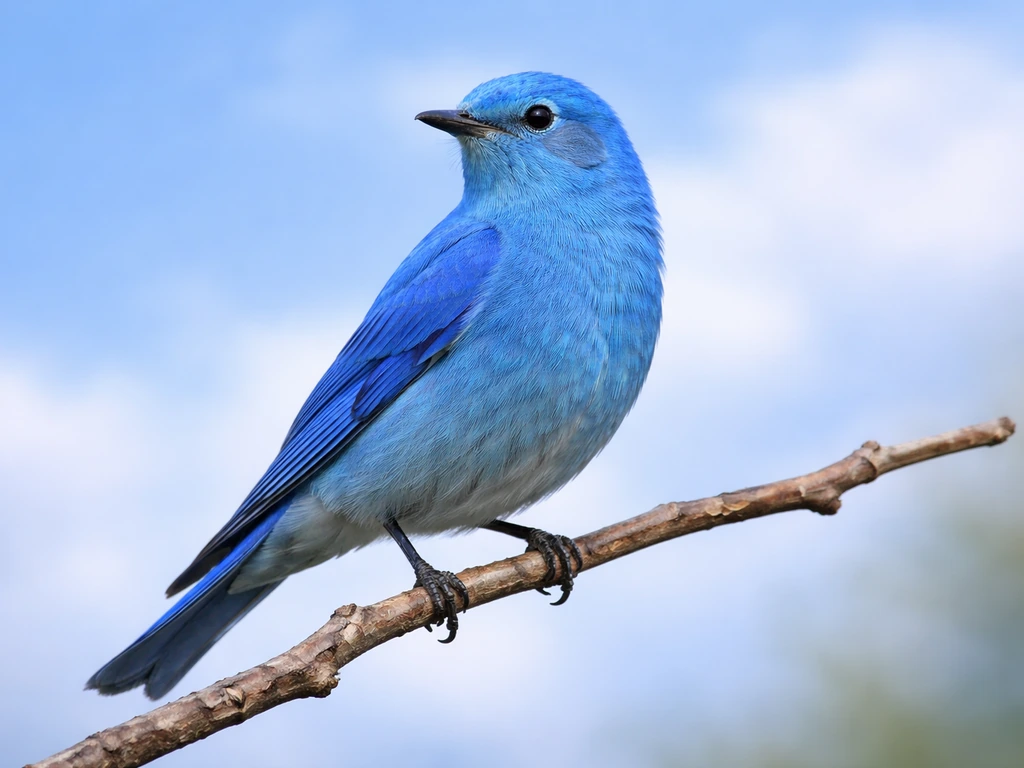
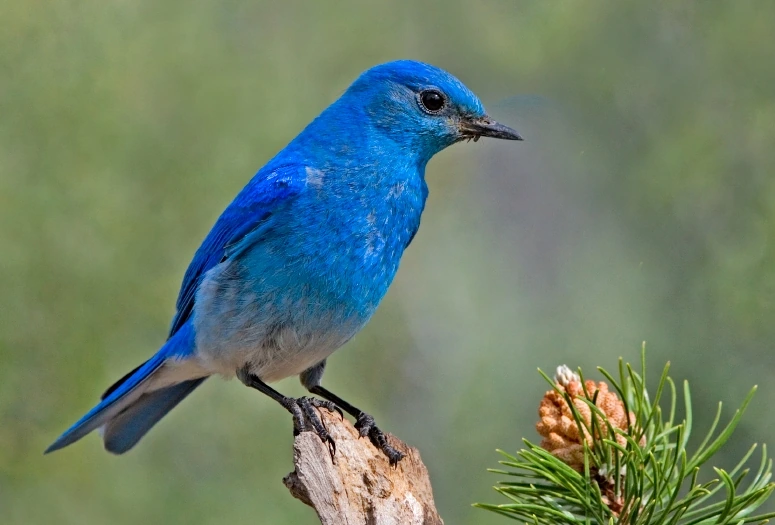
The male Mountain Bluebird is one of the easiest birds to identify in the American West once you know what you're looking for. He is entirely sky-blue, top to bottom, with no rusty breast or white wingbars to complicate things. That all-blue look is the key distinction from other blue birds you might see in the region. The female is much subtler, mostly gray-brown with a faint blue wash on the wings and tail, which is typical of bluebird species.
In terms of size, Mountain Bluebirds are medium-small songbirds, noticeably slender and long-winged compared to the Eastern Bluebird. They have an upright perching posture and often hover briefly before diving to catch insects on the ground, a behavior that helps narrow identification in the field. Their call is a thin, soft 'few,' and the song is a warbled, high 'chur chur.' If you're out in open high-elevation country in Idaho and you see a flash of pure sky-blue, you're almost certainly looking at a male Mountain Bluebird.
Quick ID checklist
- Male: entirely sky-blue plumage, no rusty or orange on the breast
- Female: gray-brown body with blue wash on wings and tail
- Slender build with longer wings than other bluebird species
- Distinctive hovering behavior before dropping to catch insects
- Call: a thin, soft 'few'; song: warbled 'chur chur'
- Often perches on fences, posts, or low shrubs in open terrain
Where to find Mountain Bluebirds in Idaho
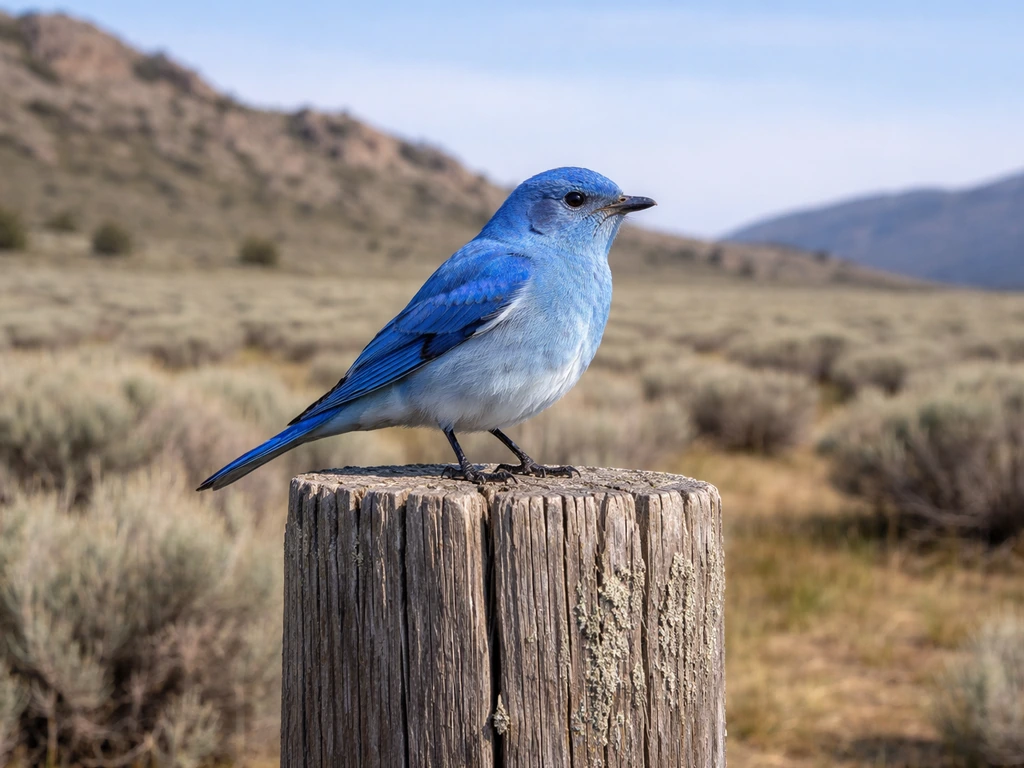
Mountain Bluebirds are most at home in open, high-elevation habitats, and Idaho has plenty of that. The U.S. National Park Service notes the Mountain Bluebird is the only bluebird species normally found above 5,000 feet in elevation, which tells you a lot about where to start looking. Sagebrush flats, mountain meadows, open ponderosa pine forests, and alpine areas are all reliable habitat types.
Craters of the Moon National Monument and Preserve is a well-documented location, where Mountain Bluebirds are common in the northern portions of the park from March through October. More broadly, you'll find them across the state during the breeding season, from the Snake River Plain upward into the mountains. In winter, many birds move to lower elevations or migrate south, so spring through early fall is the best window for spotting them in Idaho.
Historical and cultural background
The 1931 designation came during a wave of state symbolism across the country. Many states formalized their official birds, flowers, and trees during the 1920s and 1930s, often driven by civic organizations, schools, and women's clubs who campaigned for recognizable local symbols. Idaho's choice of the Mountain Bluebird reflected the bird's genuine presence across the state's varied landscape, from low sagebrush country to high mountain terrain.
One persistent misconception worth addressing: some people search for Idaho's 'bluebird' and aren't sure if it refers to a specific species or a generic name. The Idaho Department of Education has directly tackled this in educational materials, pointing out that there is no bird simply called a 'blue bird' and that Idaho's state bird is specifically the Mountain Bluebird, a distinct species with a scientific name and well-documented range. The species has remained Idaho's official symbol for nearly a century without any legislative challenge or change.
Idaho shares its state bird with one other state
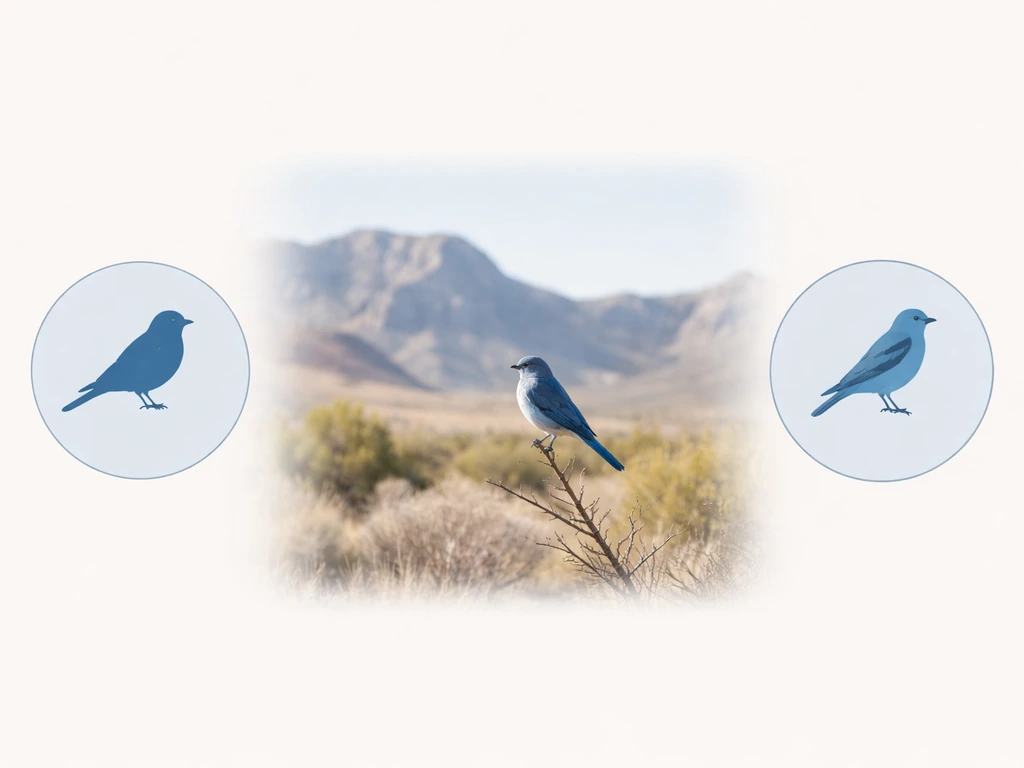
Idaho is not alone in claiming the Mountain Bluebird. Nevada also designated the Mountain Bluebird (Sialia currucoides) as its official state bird, making it one of a handful of species shared between two states. Nevada's designation came later, codified in the state's statutes with the same species name and scientific classification. The two states are geographic neighbors, which makes sense given that both encompass large stretches of the Great Basin and Intermountain West where Mountain Bluebirds thrive.
| State | Official State Bird | Year Designated |
|---|---|---|
| Idaho | Mountain Bluebird (Sialia currucoides) | 1931 |
| Nevada | Mountain Bluebird (Sialia currucoides) | 1967 |
If you're interested in how neighboring states handle their own designations, Utah's state bird is the California Gull, a choice tied to a famous historical event involving the gull protecting crops from locusts. Utah's state bird is the California Gull, so you can connect the crop-protecting story to the official symbol. Utah's state bird is the California Gull (Larus californicus). Iowa and Rhode Island each have their own distinct designations with equally interesting histories. This helps explain why people sometimes wonder, why is Iowa State mascot a bird? Rhode Island also has an official state bird, so if you're wondering what is the state bird of Rhode Island, look up the state's designated species. Iowa's official state bird is the Eastern Goldfinch, according to Iowa state symbolism. The Mountain Bluebird's range across the Intermountain West makes it a logical regional symbol, and the fact that Idaho and Nevada both landed on the same species speaks to how strongly the bird is identified with western landscapes.
How to confirm what you're seeing is the real thing
If you're in Idaho and want to confirm a Mountain Bluebird sighting, the combination of all-blue plumage (in males), open high-elevation habitat, hovering flight behavior, and that soft 'few' call should get you there quickly. The U.S. Fish and Wildlife Service maintains a species account for the Mountain Bluebird (Sialia currucoides) that covers national distribution and status, which is useful if you want a federal-level confirmation of where the species occurs. Cornell Lab of Ornithology's All About Birds platform also provides detailed identification notes, range maps, and audio of the call and song.
For the official legal record, Idaho Code Section 67-4501 and the Idaho Secretary of State's State Emblems page are the two authoritative sources. If you want the quick takeaway on why the Mountain Bluebird is Idaho’s state bird, those official sources are the place to start Idaho Secretary of State's State Emblems page. Both clearly and consistently identify the Mountain Bluebird as Idaho's one and only official state bird, with no ambiguity or competing designations.
FAQ
Is there any chance Idaho has changed its state bird since 1931?
No. The designation is still in force in the current Idaho Code Section 67-4501, which continues to name the Mountain Bluebird as the official state bird.
What if I see a different bluebird in Idaho, could it be the state bird anyway?
The state bird is specifically the Mountain Bluebird (Sialia currucoides). Other similar-looking bluebirds in the region can differ in plumage details and habitat, so focus on the identification traits discussed (especially the male’s uniform sky-blue look).
How can I tell a Mountain Bluebird from other blue birds that are not bluebirds?
Use a combination of features rather than just color, including the male’s all-blue plumage, the slender, long-winged shape, and the typical feeding behavior (brief hovering followed by ground dives for insects).
Are Mountain Bluebirds in Idaho year-round?
They are easiest to spot in spring through early fall. In winter, many move to lower elevations or migrate south, so if you search in midwinter, you may need to adjust expectations and location.
Where in Idaho is the best place to look for Mountain Bluebirds?
Target open, high-elevation habitats, since Mountain Bluebirds are typically found above 5,000 feet. Sagebrush flats, mountain meadows, open ponderosa pine forests, and alpine areas are reliable starting points.
Does “blue bird” mean any bird that is blue in Idaho?
No. “Bluebird” can be a generic phrase, but Idaho’s official symbol is not generic. The state bird is a specific species, the Mountain Bluebird (Sialia currucoides).
Do male and female Mountain Bluebirds look different enough to cause confusion?
Yes. Males are vividly sky-blue, while females are more gray-brown with only a faint blue wash. If you only recognize the male, you might miss breeding females, so check for the subtle wing and tail blue tones.
What time of day is best to spot Mountain Bluebirds?
In general, bird activity is often highest during daylight hours when they’re actively foraging. If you’re trying to confirm hovering and ground-feeding behavior, plan for midday to afternoon in open habitat rather than dawn-only searches.
Can Mountain Bluebirds be confirmed by sound alone?
You can use the call and song as strong clues. The call is a thin, soft “few,” and the song is described as a warbled, high “chur chur,” which can help when lighting makes plumage harder to judge.
If I want the most “official” verification, what should I check?
For the definitive answer, use Idaho Code Section 67-4501 and the Idaho Secretary of State’s State Emblems page. Those are the legal and administrative records that keep the designation unambiguous.