South Australia's official bird emblem is the Piping Shrike, which is the same bird as the white-backed magpie (Gymnorhina tibicen leuconota). The emblem was gazetted on 14 January 1904 as part of South Australia's State Badge proclamation, making it one of the longest-standing official bird emblems in Australia. If you've been searching under the umbrella of 'state birds,' this is South Australia's equivalent: a bold black-and-white magpie perched on a gum branch, often shown against a rising sun background.
What Is the Bird Emblem of South Australia?

Marcus Webb
30 May 2026
What 'bird emblem' actually means here
A quick note on terminology, because it trips people up. South Australia doesn't use the phrase 'state bird' the way US states do. Instead, the bird appears as the central motif of SA's State Badge, and official government documents refer to it as the 'bird emblem' or simply the emblem of the piping shrike. The designation sits within a broader framework of state insignia managed by the South Australian Department of the Premier and Cabinet. So when someone asks for SA's bird emblem, the State Badge and the piping shrike are the same answer.
Quick species profile: recognising the Piping Shrike
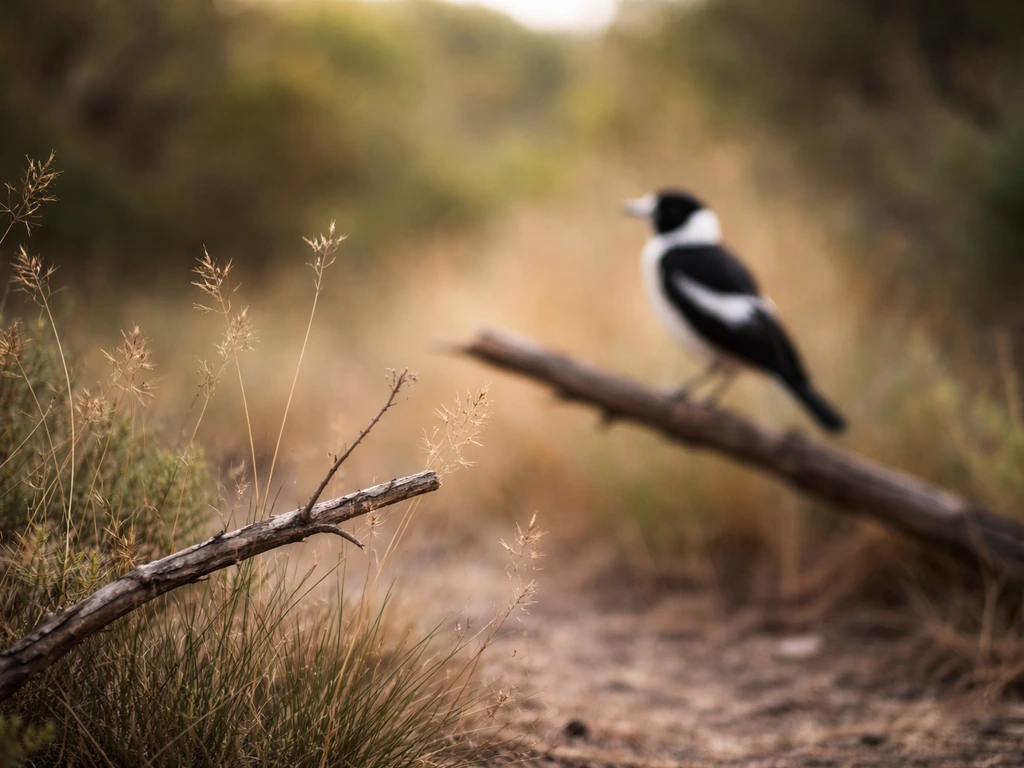
The 'piping shrike' is not a separate species. It's the local South Australian name for the white-backed magpie, a subspecies of the Australian magpie (Gymnorhina tibicen leuconota). The name 'piping' comes from the bird's distinctive, melodious carolling call, which historically South Australians described as a piping sound. Here's what to look for in the field:
- Size: Around 37 to 43 cm in length, roughly the size of a crow but more slender
- Plumage: Bold black-and-white pattern. The defining feature of the white-backed subspecies is the entirely white back, contrasting with black wings and a black head
- Bill: Strong, straight, hooked pale grey-blue bill typical of the magpie family
- Call: A rich, flute-like carolling, often described as one of Australia's most recognisable bird songs
- Habitat: Open woodlands, grasslands, farmland, parks, and suburban areas across South Australia and broadly across southern and eastern Australia
- Behaviour: Ground forager, often seen walking across lawns and open ground probing for invertebrates
The Australian Faunal Directory confirms Gymnorhina tibicen occurs across all Australian states. The white-backed form (leuconota) is the subspecies most strongly associated with South Australia and the one depicted on the state emblem. It's a genuinely widespread bird, so you're very likely to encounter it in person if you're in SA.
A common point of confusion: Piping Shrike vs Magpie-Lark
It's worth flagging this because even the SA Parliament has debated it. In a 2017 House of Assembly discussion, members noted widespread public confusion between the piping shrike (white-backed magpie) and the magpie-lark (Grallina cyanoleuca, also called a 'peewee'). The two birds look superficially similar with black-and-white colouring, but they're unrelated. The emblem is definitively the white-backed magpie. The magpie-lark has no official role in SA's emblem system.
How the Piping Shrike became SA's emblem
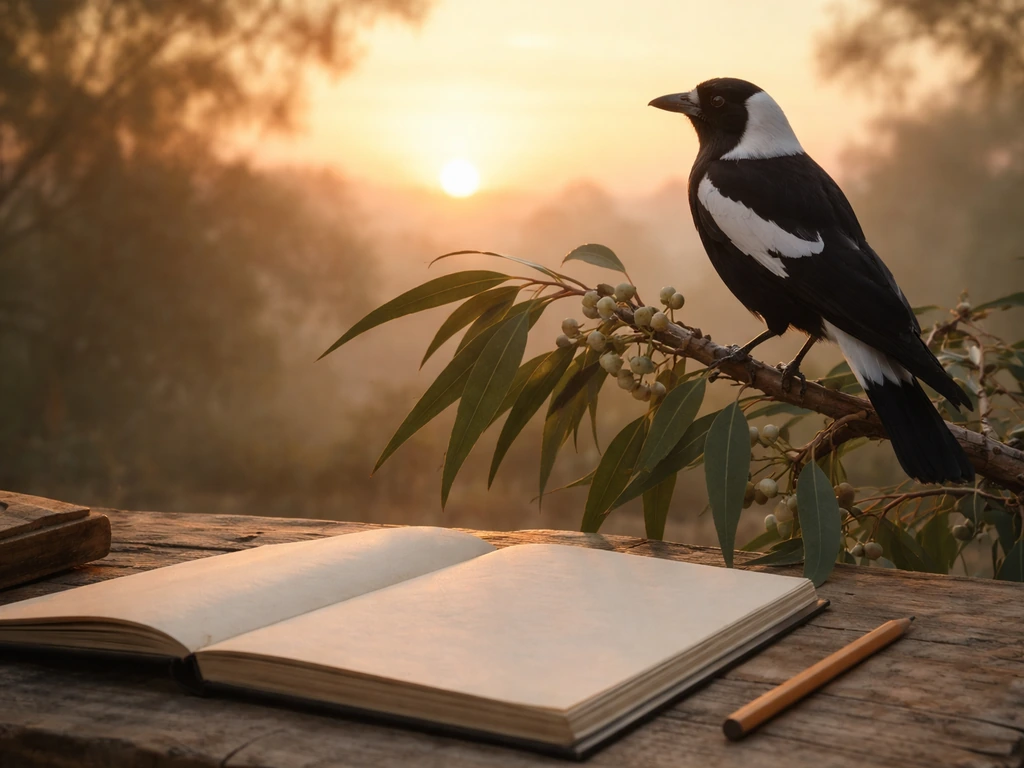
The emblem design was originally created by Robert Craig in 1901, showing the white-backed magpie on a gum branch with a rising sun in the background. Artist Harry Gill modified the design in 1910, and it's this refined version that became the enduring state emblem image. The proclamation was gazetted on 14 January 1904, formally establishing it as SA's State Badge.
The choice makes cultural and environmental sense for the era. The white-backed magpie was a deeply familiar bird across South Australia's settled landscape, its carolling call tied to the Australian morning in a way that felt genuinely local. Choosing it reflected both civic pride and the practical reality that this was a bird every South Australian knew. The piping shrike has since appeared on SA's state flag, government communications, and official branding, including the government 'roundel' that pairs the bird image with the words 'South Australia.'
How to verify the designation today
Three authoritative sources will confirm this for you right now: Queensland’s “Emblems of Queensland Act 2005” indicates that the brolga is the State’s bird emblem.
- SA Department of the Premier and Cabinet (dpc.sa.gov.au): Their 'Using the state insignia and emblems' page explicitly names the State Badge as featuring 'a piping shrike (also known as a White Backed Magpie)' and references the 14 January 1904 gazettal
- SA Memory (State Library of South Australia): Their dedicated Piping Shrike page states 'the state emblem of South Australia is an image of the Piping Shrike or White Backed Magpie' and includes the gazettal date plus designer attributions (Craig 1901, Gill 1910)
- Australian Government Department of the Prime Minister and Cabinet: The official Australian symbols booklet describes SA's state badge, confirming it depicts the white-backed magpie/Australian piping shrike on a gum branch with a rising sun background
For archival verification, the South Australian Government Gazette of 30 August 2001 also contains wording referencing 'the emblem of the piping shrike' in the context of relevant legislative schedules. That's about as official as it gets.
How SA's emblem compares with other state and provincial bird emblems
South Australia's piping shrike designation stands out in a few ways when you put it alongside other official bird emblems in Australia and beyond. Tasmania’s Department of Natural Resources and Environment uses the swift parrot as an example on its conservation pages, which is a useful caution that not all commonly linked birds are legislative emblems blank" rel="noopener noreferrer">Tasmania’s conservation pages use the swift parrot as an example. For British Columbia in Canada, the provincial bird is the Pacific golden-plover what is the provincial bird of british columbia.
| Jurisdiction | Bird Emblem | Year Designated | Legal Basis |
|---|---|---|---|
| South Australia | Piping Shrike (White-backed Magpie) | 1904 (gazetted) | State Badge proclamation |
| Queensland | Brolga (Antigone rubicunda) | 1986 | Emblems of Queensland Act 2005 |
| Ontario, Canada | Common Loon | 1994 | Provincial designation |
| Nova Scotia, Canada | Osprey | 1994 | Provincial designation |
| Saskatchewan, Canada | Sharp-tailed Grouse | 1945 | Provincial designation |
South Australia's 1904 gazettal makes it one of the earliest formally documented bird emblems in any jurisdiction. Queensland's bird emblem, the brolga, wasn't announced until January 1986, more than 80 years later. Canadian provincial bird emblems like those of Ontario, Nova Scotia, and Saskatchewan followed a similar mid-to-late 20th century pattern. For Saskatchewan, the provincial bird is also used as an official symbol, so it helps to know the name before comparing jurisdictions. You might also be looking for the provincial bird of Prince Edward Island, which is a different emblem in a different jurisdiction. Nova Scotia's provincial bird is the osprey. If you're looking for a Canadian example, the provincial bird of Ontario is the eastern bluebird. What makes SA's designation unusual is that it's embedded directly in the state badge rather than existing as a standalone 'state bird' category, which is why the term 'bird emblem' is used rather than 'state bird.'
No US state bird is the Australian magpie, obviously, but the magpie's role in SA closely parallels how bold, familiar, vocally distinctive birds tend to get chosen as emblems across jurisdictions. The Northern Mockingbird, for instance, was chosen by five US states partly for similar reasons: it's loud, recognisable, and deeply connected to the local landscape.
The Piping Shrike within SA's broader symbol system
South Australia has a full set of state symbols across multiple categories. The piping shrike sits within the insignia and emblems tier, specifically as the State Badge, rather than as a standalone wildlife emblem like a 'state animal' or 'state bird' category. Other SA symbols include the Sturt's Desert Pea as the floral emblem, the hadrosaur (Leaellynasaura) in some informal contexts, and the state's coat of arms which incorporates the badge. The Australian Government's symbols booklet places the piping shrike within this broader set, describing it alongside SA's colours, flora, and gemstone emblems.
In practical terms, the piping shrike is SA's most visible official symbol. It appears on the state flag, on government letterheads, in the official branding roundel, and across public-facing government materials. If you see a bold black-and-white magpie on an official South Australian document, that's the piping shrike emblem doing exactly the job it was designed to do back in 1904.
FAQ
If South Australia does not call it a “state bird,” how do I confirm I’m looking at the official bird emblem?
Yes. On official South Australian government materials, the “bird emblem” shows the piping shrike as the central motif of the State Badge, so it is best identified by that badge artwork rather than by looking for a standalone “state bird” program name.
What bird do people most commonly confuse with the piping shrike emblem?
The piping shrike is the white-backed magpie subspecies (leuconota) depicted on the State Badge. If you are looking at a black-and-white magpie-like bird in SA, the magpie-lark (peewee) is a common mistaken match, but it has no official role in the emblem system.
Do the colors and background elements change in different versions of the emblem, and how can I tell if it is still correct?
There can be artwork variation. For example, some reproductions use simplified linework or a different shade of black-and-white, but the key is the depiction as a white-backed magpie on a gum branch, traditionally shown with a rising-sun element behind it.
If the bird lives across Australia, does that mean South Australia’s emblem could be a different magpie species?
No. Because “piping shrike” is a local name for the white-backed magpie subspecies, you should expect the emblem bird to be that subspecies (leuconota), even though magpies and related forms occur widely across Australia.
Is the “bird emblem” the same thing as the State Badge itself, or just part of it?
If you need to distinguish it for educational or design accuracy, match both the name and the image context: the emblem is tied to the State Badge proclamation, and “bird emblem” wording in government contexts refers to the piping shrike motif within that badge.
Why do other places call it a “state bird,” but South Australia uses different terms?
If you’re comparing jurisdictions, use the wording carefully: some places have a standalone “state bird” category, while SA embeds the emblem bird within the State Badge. That difference explains why you will not find a typical “SA state bird” label in the same way.