British Columbia's official bird is the Steller's Jay (Cyanocitta stelleri). South Australia has its own bird emblem, which is different from Canada’s provincial bird symbols British Columbia. The bird emblem of Queensland is the koala as its official animal emblem official bird. It was officially adopted as the province's bird emblem on December 17, 1987, and is recognized under BC's Provincial Symbols and Honours Act. If you've seen a bold, crested blue-and-black jay rummaging around a coastal campsite or coniferous forest in BC, there's a good chance you've already met the province's official symbol.
What Is the Provincial Bird of British Columbia?

Marcus Webb
31 May 2026
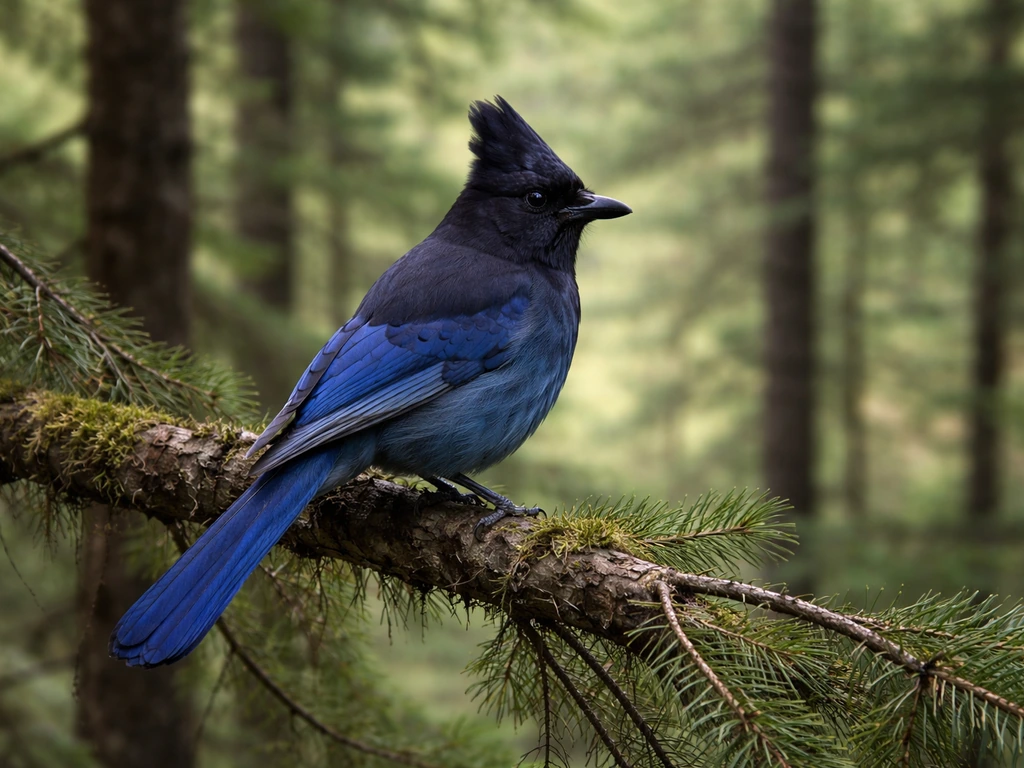
The official provincial bird of British Columbia
The correct term used in British Columbia's legislation is actually "bird emblem" rather than "provincial bird," but both phrases refer to the same thing: the Steller's Jay. The Provincial Symbols and Honours Act (RSBC 1996, c. 380) includes a specific section designating a "Bird emblem" for the province. Both the BC government's official B.C. Symbols page and the Legislative Assembly of BC's Provincial and Parliamentary Symbols page list it the same way: Bird, Steller's Jay (Cyanocitta stelleri), adopted December 17, 1987.
What the Steller's Jay actually looks like
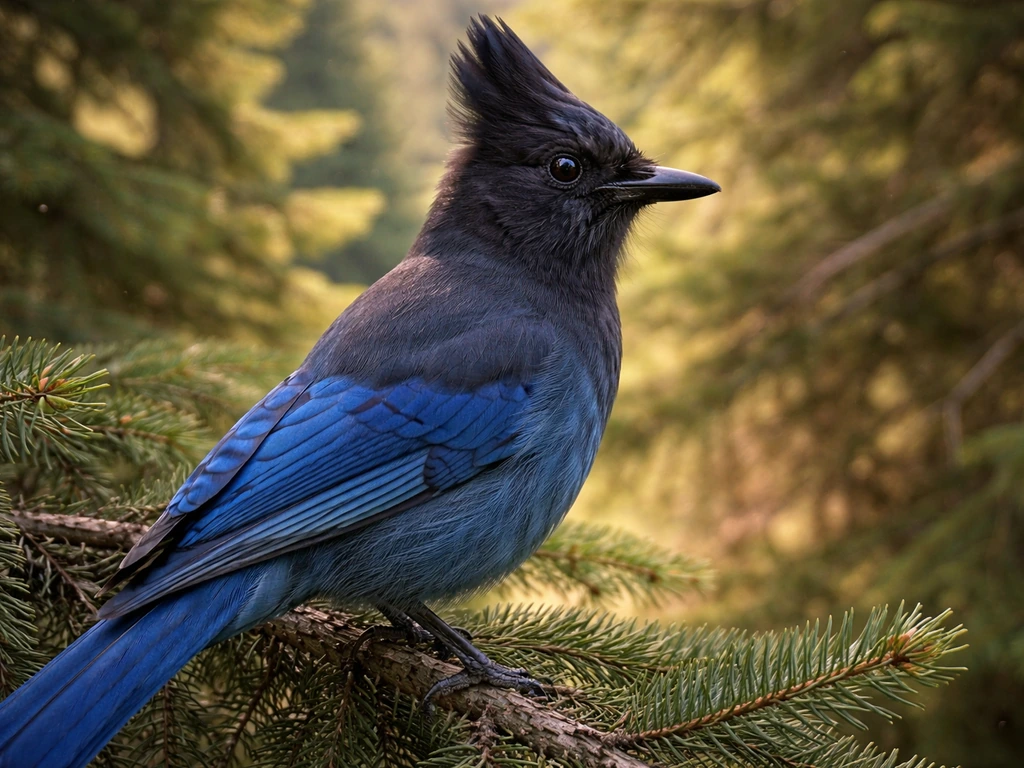
The Steller's Jay is hard to mistake once you know what to look for. It's a medium-sized, stocky bird with a prominent dark crest, deep blue body, and a blackish head, back, and upper chest. Look closely and you'll notice thin streaks of blue above and around the eyes, which help distinguish it from other crested jays. In terms of size, it runs about 29 cm (11.5 inches) long, weighs around 105 g (3.7 oz), and has a wingspan of roughly 47.5 cm (19 inches). It's noticeably larger and darker than the Blue Jay you might see in eastern Canada, and the bold crest is the quickest field mark to lock onto.
In British Columbia, the Steller's Jay is a widespread, year-round resident of coniferous forests along the coast, and through the southern and central parts of the province. Environment and Climate Change Canada's Wildlife Species profile describes Steller's Jay as a widespread resident in coniferous forest of coastal, southern, and central parts of British Columbia. It's not a shy bird. Campers and hikers in BC know it well because it's loud, curious, and quick to investigate anything that might be food. Environment and Climate Change Canada's federal wildlife species profile confirms both the bird's identity and its strong association with BC's forest habitat.
Why the Steller's Jay was chosen
The Steller's Jay wasn't chosen by a government committee behind closed doors. It was selected through a province-wide public vote organized by BC's Ministry of Environment and Parks. Around 85,000 ballots were returned by residents, and the Steller's Jay came out on top with 21,261 votes. That's a genuinely democratic origin for a provincial symbol, and it reflects how well-known and well-loved this bird already was across the province before it made it official.
The choice makes practical sense, too. The Steller's Jay is endemic to western North America, it's a permanent resident (not a seasonal visitor), and it's closely tied to the coniferous forests that define so much of BC's landscape. It's recognizable, widespread, and distinctly western, which made it a natural fit as a symbol for the province.
How it became official: the historical context

The designation happened on December 17, 1987. After the public vote tallied the Steller's Jay as the clear winner, the provincial government formalized the choice and it entered BC's official symbols record. BC Gov News records the moment simply: "1987 - Steller's jay adopted as B.C.'s official bird." The bird's status is now codified in the Provincial Symbols and Honours Act, which is the same legislation that governs BC's floral emblem, tartan, and other official provincial symbols. It's been the province's official bird for nearly four decades without challenge or revision.
How to confirm the designation today
If you want to verify this yourself, there are three reliable official sources to go to directly:
- BC government's official B.C. Symbols page (gov.bc.ca) — lists "Bird - Steller's Jay" with the adoption date of December 17, 1987
- Legislative Assembly of BC's Provincial and Parliamentary Symbols page — independently reproduces the official bird designation with the scientific name and adoption date
- Provincial Symbols and Honours Act (RSBC 1996, c. 380) on BC Laws — the actual legislation that codifies the "Bird emblem" designation
For species-level confirmation, Environment and Climate Change Canada's federal wildlife profile for the Steller's Jay (species code STJA) explicitly states the bird was declared the provincial bird of British Columbia in 1987 and describes its BC range. These sources are all government-authored and the most authoritative you'll find.
How BC's bird compares to other provinces and jurisdictions
The Steller's Jay is unique to BC among Canadian provincial birds. No other Canadian province has designated the Steller's Jay as its official bird. Other provinces have gone with entirely different species. Ontario, Nova Scotia, Prince Edward Island, and Saskatchewan each have their own designated provincial birds, and PEI, for instance, went with the Blue Jay, a related but distinct species from the same family. If you are looking for Saskatchewan's provincial bird, it is the Sharp-tailed Grouse what is saskatchewan's provincial bird. You can also look up what is the provincial bird of Prince Edward Island to compare it with BC's Steller's Jay. Unlike British Columbia, Nova Scotia has its own provincial bird Nova Scotia's provincial bird. If you’re also curious about Ontario, its provincial bird is different from British Columbia’s Steller’s Jay. The Steller's Jay is the only jay in the group that's native to western North America, which underscores just how geographically distinct BC's bird symbol is from those of eastern provinces.
On the U.S. side, the Steller's Jay ranges through much of the western United States but has not been named the official state bird by any U.S. state. Washington State, for example, chose the Willow Goldfinch as its state bird, despite the Steller's Jay being common there too. So while the bird crosses political borders biologically, BC stands alone in giving it official recognition as a government symbol.
| Jurisdiction | Official Bird | Same as BC? |
|---|---|---|
| British Columbia (Canada) | Steller's Jay | Yes (this is BC) |
| Ontario (Canada) | Common Loon | No |
| Nova Scotia (Canada) | Osprey | No |
| Prince Edward Island (Canada) | Blue Jay | No (related family) |
| Saskatchewan (Canada) | Sharp-tailed Grouse | No |
| Washington State (USA) | Willow Goldfinch | No |
The Steller's Jay is a genuinely regional symbol. Its range is tied to the coniferous forests of the Pacific Coast and western mountain ranges, which is exactly why it feels like such an authentic pick for British Columbia. When you spot that bold crest and hear that raucous call in a BC forest, you're looking at the province's official bird in its natural element.
FAQ
Is “provincial bird” the official wording in British Columbia law?
In BC legislation the formal term is “bird emblem.” The common phrase “provincial bird” is used in everyday conversation, but when you check legal or government symbol records, the entry is under “Bird emblem” for the Steller’s Jay.
Are there any other birds that could be confused with the Steller’s Jay in British Columbia?
Yes, people often mix it up with other crested jays. A quick field check is the Steller’s Jay’s dark, blackish head and upper chest plus the thin blue streaks above and around the eyes, and it also tends to look larger and darker than the Blue Jay common in eastern Canada.
Do Steller’s Jays stay in British Columbia year-round or only in summer?
They are permanent residents in BC, meaning you should be able to spot them in both winter and summer. If you are only seeing jays during a short season, that usually indicates a different local species or a temporary movement of birds.
Where in British Columbia is the best chance to see the bird emblem?
The province-wide pattern is coniferous forests, especially along the coast and across southern and central BC. If you are in dense spruce, fir, or mixed conifer habitat, the likelihood is higher than in mostly open grassland or deciduous-only areas.
Does the Steller’s Jay actually get used as a “symbol” on provincial materials?
Typically, the bird emblem is reflected in official symbol lists and government references rather than in everyday signage. If you want to confirm how it is represented, look for the “B.C. Symbols” or legislative symbol listings rather than informal tourism descriptions.
What if I saw a Steller’s Jay outside its typical range, is it still the provincial bird?
Yes. Occasional sightings outside the usual BC range do not change its status, the designation is legal and fixed. Birds can wander, but the official bird emblem remains the Steller’s Jay adopted in 1987.
Was BC’s bird emblem chosen by a committee, or was it voted on publicly?
It was selected through a province-wide public vote organized by BC’s Ministry of Environment and Parks. Approximately 85,000 ballots were returned, and the Steller’s Jay won with 21,261 votes.
How can I quickly verify the designation from an official government source?
Use the government symbol listings that specifically show the “Bird emblem” entry for British Columbia. For species-level confirmation, the Environment and Climate Change Canada profile also ties the Steller’s Jay to BC’s 1987 designation, which is useful if you want both the symbol and the species record in one place.
Is BC the only place in Canada that uses the Steller’s Jay as an official bird symbol?
Yes. No other Canadian province has named the Steller’s Jay as its official bird. Each province uses its own designated species, so comparing symbol lists is the easiest way to avoid assumptions based on bird familiarity.
Next Article
What Is the Bird Emblem of South Australia?
South Australia bird emblem is the piping shrike, with ID traits, habitat, history, and tips to verify the official desi