
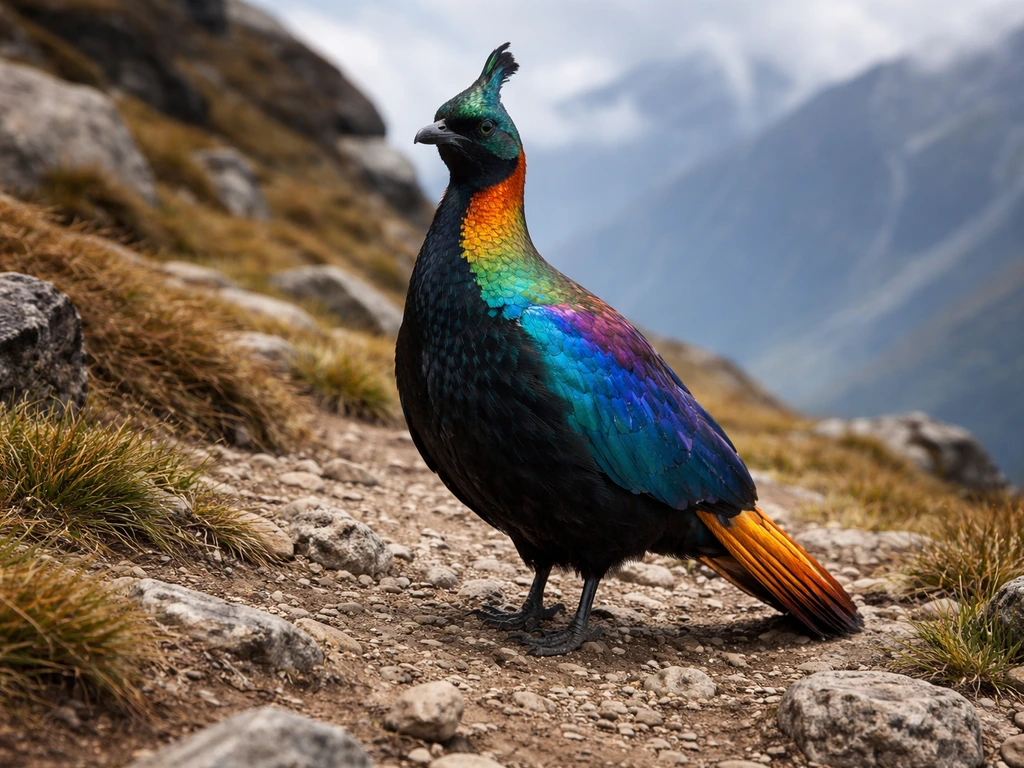
The Himalayan monal (Lophophorus impejanus) is the national bird of Nepal. The Government of Nepal officially declared it as the national bird, where it is also commonly known as the Danphe or impeyen pheasant. It is not a U.S. state bird, so if you landed here through a state-bird lookup, you are in slightly different territory than this site's usual focus.
Himalayan monal is the national bird of which country?

Marcus Webb
3 Jun 2026
"State bird" vs. "national bird": clearing up the confusion

This site focuses on official U.S. state birds, so a search for "Himalayan monal is the state bird of" understandably lands here. But the Himalayan monal does not appear on any U.S. state bird list. The phrasing trips people up for two reasons. First, the bird is the state bird of Uttarakhand, a state in India, which is a genuinely official "state bird" designation but not an American one. Second, because U.S. Fish and Wildlife Service databases list the species by its common name for wildlife management purposes, it can surface in U.S. bird-related searches without actually being a U.S. symbol.
The clearest way to think about it: Nepal's national bird sits in the same category as the U.S. bald eagle, a country-level symbol. Uttarakhand's state bird sits in the same category as, say, Virginia's cardinal, a subnational symbol. Neither is a U.S. state bird. If you are looking up the official bird for one of the 50 U.S. states, the Himalayan monal won't be your answer.
What exactly is the Himalayan monal
The Himalayan monal is a large, striking pheasant in the genus Lophophorus. Its full scientific name is Lophophorus impejanus, and it goes by several common names: Himalayan monal, Himalayan monal pheasant, impeyan monal, and Danphe (the Nepali name). NCBI Taxonomy lists additional common names for Lophophorus impejanus, including “blank" rel="noopener noreferrer">Impeyan monal” and “Himalayan monal pheasant.”. It sits in the family Phasianidae alongside other pheasants, peacocks, and turkeys. The species is listed on CITES Appendix I, meaning international trade is strictly controlled, and it carries a Least Concern status on the IUCN Red List, which reflects a stable enough population despite ongoing habitat pressures. IUCN’s assessment document package for Lophophorus impejanus includes the assessment context under IUCN’s system and references mapping or distribution materials for the species.
The male is one of the most visually spectacular birds in the Himalayan region. It has iridescent plumage that shifts through metallic greens, purples, blues, and coppers depending on the light, paired with a distinctive crest of spatula-tipped feathers. The female, by contrast, is streaked brown and much more camouflaged. That extreme visual contrast between the sexes is typical of pheasants in this genus.
Where to find the Himalayan monal

The species lives across a broad stretch of the Himalayas and surrounding mountain ranges. Its native range runs from Afghanistan and Pakistan in the west, through northern India (including Uttarakhand and Himachal Pradesh), Nepal, southern Tibet, and Bhutan in the east. It is a bird of high-altitude Himalayan forests and shrublands, generally found between roughly 2,100 and 4,500 meters (about 6,900 to 14,800 feet) in elevation, though it moves to lower elevations during harsh winters.
Within Nepal specifically, the Danphe is found across much of the high-mountain zone and is well known to trekkers in areas like the Annapurna and Everest regions. Nepal's conservation planning has explicitly focused on protecting this species as part of its broader pheasant conservation framework, connecting its national-symbol status directly to active wildlife management.
Why Nepal chose the Himalayan monal as its national bird
The reasons Nepal elevated the Danphe to national symbol are familiar to anyone who studies how countries and states pick their representative birds. The Himalayan monal is visually iconic, immediately recognizable, and deeply embedded in the cultural identity of mountain communities across Nepal. Its range closely mirrors Nepal's own geographic identity as a Himalayan nation. The male's brilliant iridescent plumage is also genuinely memorable, the kind of bird that makes an impression and works well as a national emblem.
There is also a conservation dimension. By designating a wild species as a national bird, a government signals a commitment to protecting it and its habitat. Nepal's Pheasant Conservation Action Plan explicitly frames the Himalayan monal's national-bird status as part of the justification for conservation investment. That logic is common across many national and state bird designations worldwide: the symbol creates a public connection to the species that can be leveraged for habitat protection.
This pattern appears in state-bird choices too. Other birds designated as state or national symbols share similar qualities: distinctive appearance, cultural relevance, and a geographic range that reflects something meaningful about the place choosing them. If you are curious about similar dynamics in other national and regional bird designations, the great hornbill's state-bird status and the sarus crane's designation as a state bird follow comparable reasoning and are worth comparing. The great hornbill is the state bird of Nagaland. The sarus crane is the state bird of Haryana, India sarus crane's designation as a state bird.
How this fits on a U.S. state-bird reference site
If you came here looking for a U.S. state bird, the Himalayan monal is not the answer you need. Here is a quick reference summary of what the monal's designations actually are, so you can see exactly where the "state bird" terminology applies and where it does not.
| Designation | Jurisdiction | Type of Symbol |
|---|---|---|
| National bird of Nepal | Nepal (country) | National symbol |
| State bird of Uttarakhand | Uttarakhand, India | Indian state symbol |
| U.S. state bird | Any of the 50 U.S. states | Not applicable |
For U.S. state bird lookups, every one of the 50 states has its own official designation, and none of them is the Himalayan monal. If you are trying to look up the official bird of a specific U.S. state, the most direct path is to search by state name. You might also find it useful to know that some non-North-American birds do come up in U.S. wildlife databases purely as species records, which is likely what triggered a U.S.-adjacent result for this search. The yellow-footed green pigeon is another example of a bird that gets flagged in similar lookup confusion, since it is a state bird in India rather than the U. The yellow footed green pigeon is the state bird of Andhra Pradesh, in India yellow-footed green pigeon. S.
The bottom line: if your question was "what is the national bird of Nepal," you have your answer. If your question was "what is the state bird of a U. The [scarlet honeycreeper is native to the island of Jamaica. S. state]," search this site by state name and you will get the right official bird, along with why it was chosen and what it looks like.
FAQ
Why does the Himalayan monal show up in some U.S.-state-bird searches if it is not a U.S. state bird?
It is the national bird of Nepal (not a U.S. state bird). The common name you may see is Danphe or impeyen pheasant, which can show up in wildlife databases even when the question is about U.S. symbols.
Is the Himalayan monal the state bird of any U.S. state, or is it only associated with Uttarakhand?
If you mean Uttarakhand, India, the Himalayan monal is often referred to there as the state bird. That is different from U.S. state designations, so the country or state you are asking about matters.
What other names should I search for if I am trying to confirm the Himalayan monal designation?
The animal is widely called the Himalayan monal, but it also appears under related common names such as impeyan monal and Danphe. If you are searching for an official listing, try these alternate names to avoid mismatches.
Does its presence in wildlife databases mean it is officially a U.S. state bird?
No, the species is not legally “tied” to being a U.S. symbol because it can be present in wildlife records. U.S. wildlife databases catalog species for management and monitoring, but those records are not the same as state bird designations.
If I see it described as a high-altitude forest bird, does that automatically mean it is Nepal’s national bird?
For the Nepal designation, rely on Nepal’s national-bird status rather than elevation or habitat clues. The species commonly lives in high-altitude forests and shrublands, but that habitat fact alone does not determine a bird’s symbolic status.
What is the fastest way to avoid mix-ups when I am looking up the official bird of a U.S. state?
If your goal is the official bird for a U.S. state, you should search by the U.S. state name, not by the species name. This prevents confusion with national birds and with similarly named “state birds” in other countries.
How can I confirm I am looking at the correct species, not a similarly named bird?
You can use the scientific name Lophophorus impejanus to distinguish it from similarly named birds in search results. This helps when websites list different common names or have spelling variations.
Where in Nepal is the Danphe most likely to be encountered by trekkers?
The Danphe is found across Nepal’s high-mountain zone, so it is often encountered in popular trekking regions like the Annapurna and Everest areas. If you are planning birdwatching, that regional presence is more practical than focusing on “national symbol” status.