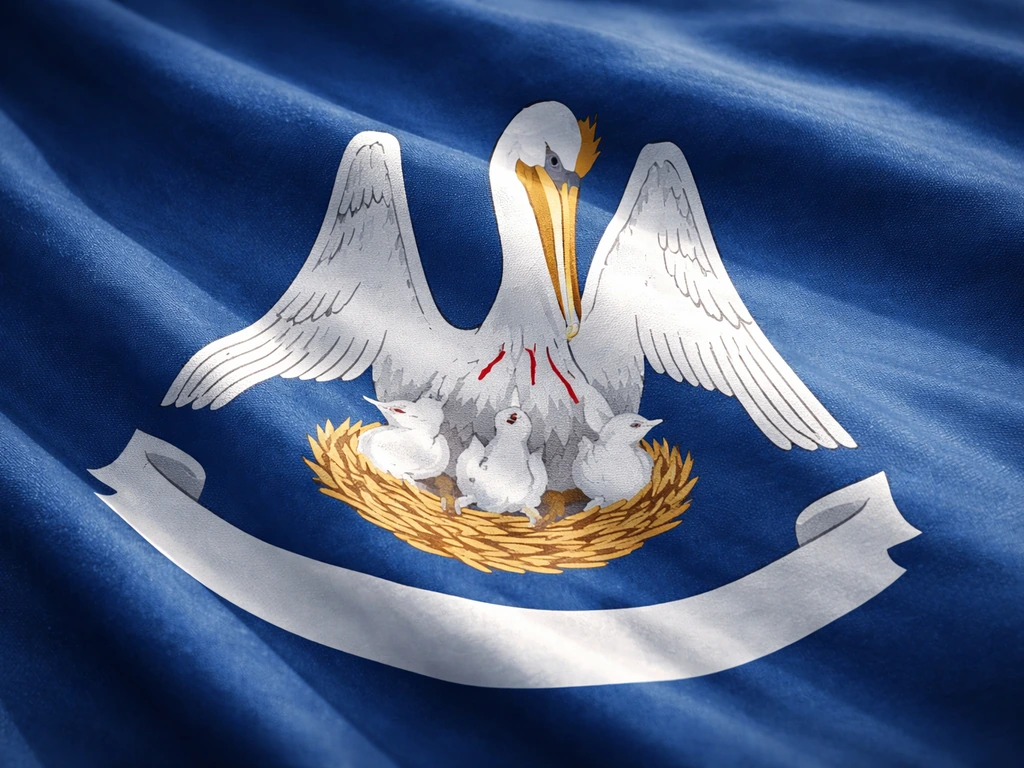
The bird on the Louisiana flag is a Brown Pelican (Pelecanus occidentalis), shown in a classic heraldic pose called "pelican in her piety", a mother pelican tearing at her own breast to feed three chicks in a nest below her. And yes, that is the same species as Louisiana's official state bird. The flag, the state seal, and the state bird designation all point to the same animal. If you're still asking what is the state bird of louisiana, this is the same Brown Pelican shown across the flag and seal.
What Bird Is on the Louisiana Flag? State Bird Match

Marcus Webb
14 May 2026
Is the flag bird the same as Louisiana's official state bird?
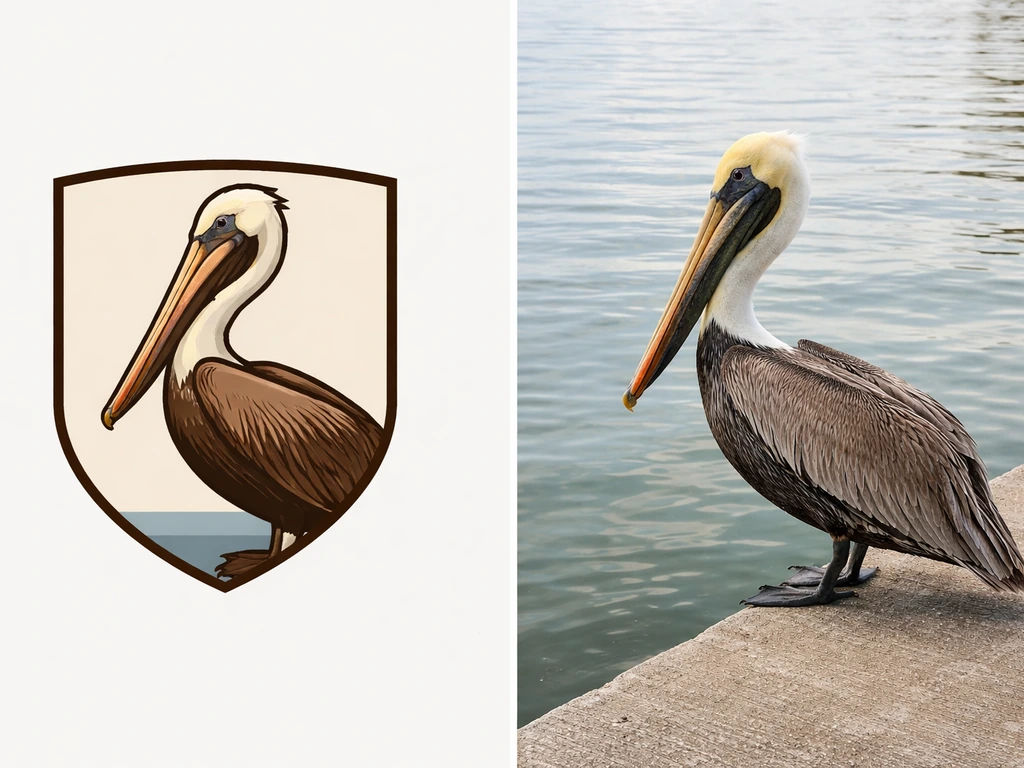
They are exactly the same species. Louisiana officially designated the Brown Pelican as its state bird under Louisiana Revised Statute 49:159, which states that after July 27, 1966, the Brown Pelican "as it presently appears on the seal" is the official state bird. The law explicitly ties the state bird to the pelican imagery already embedded in the flag and seal, so there is no separation between the two symbols. The bird you see on the flag is, by law, the same bird named as the state bird.
This is worth noting because some states use different species on their flags than their designated state birds. Louisiana is not one of those. The Brown Pelican is the single unifying symbol across the flag, the seal, and the official bird designation. If you've landed here wondering whether the flag shows something other than the state bird, the answer is no, it's the same bird throughout.
What you're actually seeing on the flag
The Louisiana flag is a solid blue field with the state coat of arms centered on it. The coat of arms shows a mother pelican in a nest, her head turned to the viewer's right, with three chicks below her. She is depicted "vulning" herself, meaning she is piercing her own breast with her beak. Three drops of blood appear on her breast, which is a legally specified detail under Louisiana law. Below the nest is a white ribbon bearing the state motto: "Union, Justice and Confidence."
The three drops of blood are not artistic license. Louisiana law explicitly requires their display in official pelican imagery used on the seal and flag. A 2010 redesign standardized this imagery, and the Louisiana Secretary of State's office acts as the official custodian of the approved artwork. Wikipedia describes a November 22, 2010 redesign that standardized the official pelican imagery, including the requirement for three drops of blood. If you're looking at a version of the flag without those three blood drops, it predates the standardized design or is an unofficial reproduction.
How to identify a Brown Pelican in real life
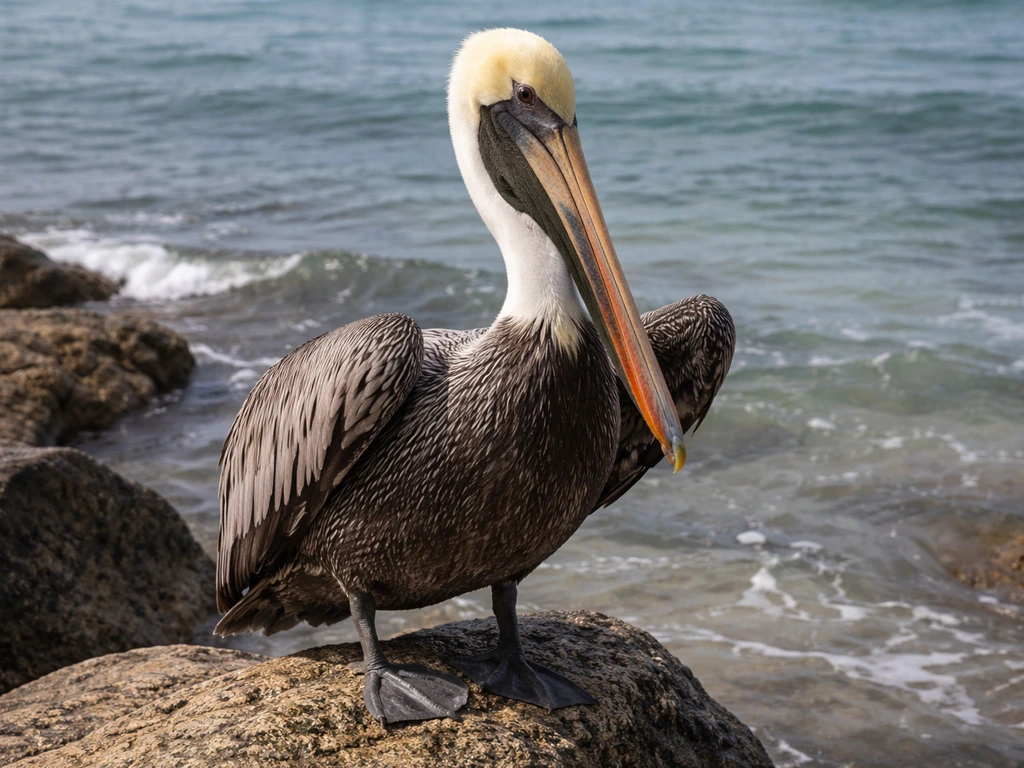
The Brown Pelican is one of the easier birds to identify if you know what to look for. It's a large water bird, dark gray-brown on the body, with a distinctive white head and neck in adults. The most obvious feature is the long, flat bill and the loose, expandable pouch (called a gular pouch) hanging beneath it. You won't mistake this for most other birds.
- Size: Large, stocky seabird — wingspan can reach around 7 feet
- Body color: Dark grayish-brown overall, with a white to yellowish head and neck
- Bill: Long, grayish, flat, with a large distendable throat pouch
- Flight: Often flies low over water in formation, alternating flaps and glides
- Feeding behavior: One of the few pelicans that plunge-dives from height into the water to catch fish
- Habitat: Coastal bays, tidal estuaries, beaches, and nearshore ocean waters
In Louisiana specifically, you'll find Brown Pelicans along the Gulf Coast, barrier islands, and coastal marshes. Queen Bess Island off the coast has been a particularly significant nesting site tied to the species' recovery in the state.
How to verify this officially
If you need to confirm this for a school project, legal reference, or just personal certainty, here are the most reliable places to check:
- Louisiana Revised Statute 49: 159 — the official state bird designation, available through the Louisiana State Legislature's website
- Louisiana Revised Statute 49: 160 — the official flag description, which specifies the pelican tearing her breast to feed her young on a blue field
- Louisiana Secretary of State's "State Flag and Seal" page — the official custodian of flag imagery and the authoritative description of the pelican crest
- Louisiana.gov's State Symbols page — a plain-language summary that confirms the Brown Pelican is the state bird and links to the Secretary of State for high-resolution flag images
- Louisiana Department of Wildlife and Fisheries (LDWF) Brown Pelican fact sheet — for species identification and conservation context
The Secretary of State's office is the most authoritative source for the flag's visual design specifically. If you need a high-resolution, legally accurate image of the flag for any official purpose, that is where the official artwork lives.
Brown Pelican facts worth knowing
Beyond the flag and the state bird designation, the Brown Pelican has a genuinely interesting story in Louisiana. The species was once nearly wiped out in the state, largely due to the pesticide DDT, which caused reproductive failure. By the late 1960s, Brown Pelicans had essentially disappeared from coastal Louisiana as a breeding population. Between 1968 and 1976, chicks were relocated from Florida to Queen Bess Island off the Louisiana coast in a restoration effort coordinated by the Louisiana Department of Wildlife and Fisheries. The effort worked. The Brown Pelican eventually recovered well enough to be removed from the federal Endangered Species List in 2009.
This conservation comeback makes the Brown Pelican's role as a state symbol feel earned rather than arbitrary. It's a species deeply tied to the Louisiana coast, resilient enough to bounce back, and distinctive enough that it couldn't be confused with the wildlife of almost any other state.
Why Louisiana chose the pelican as its symbol
The pelican-in-her-piety image predates Louisiana's statehood. It traces back to European heraldry and early colonial Louisiana, where French settlers adopted the pelican as a symbol of the territory. The "pelican in her piety" pose, a mother sacrificing her own blood to nourish her young, was a medieval Christian symbol of self-sacrifice and charity. Louisiana's early colonial identity leaned heavily on Catholic tradition, and the image fit naturally into the visual language of governance and identity at the time.
By the time Louisiana became a state in 1812, the pelican was already embedded in the official seal. The formal designation as state bird in 1966 essentially made official what had been the de facto state symbol for over 150 years. The Brown Pelican was also genuinely abundant along Louisiana's Gulf Coast at the time of those early designations, making it both a practical and symbolic choice.
Flag bird vs. state bird: is there any difference here?
In Louisiana's case, there is no difference. The comparison that sometimes matters in other states, where a flag might show a bald eagle or other generic bird separate from the official state bird, does not apply here. Louisiana's flag, seal, and state bird statute all reference the same species: Pelecanus occidentalis, the Brown Pelican. The law even cross-references the seal imagery directly when defining the state bird, so they are legally bound together, not just coincidentally similar.
| Symbol | Bird Species | Legal Source |
|---|---|---|
| Louisiana State Flag | Brown Pelican (Pelecanus occidentalis) | La. R.S. 49:160 |
| Louisiana State Seal | Brown Pelican (Pelecanus occidentalis) | La. R.S. 49:160 / Secretary of State |
| Louisiana State Bird | Brown Pelican (Pelecanus occidentalis) | La. R.S. 49:159 |
If you're also curious about neighboring states, Mississippi's state bird is the Northern Mockingbird, while Missouri's is the Eastern Bluebird, both very different from the coastal, fish-eating Brown Pelican that defines Louisiana's identity. In Missouri, the Eastern Bluebird is the state bird Missouri's is the Eastern Bluebird. If you are wondering why Missouri chose the Eastern Bluebird as its state bird, the story starts with its strong connection to the state’s open fields and insect-rich habitats Missouri's is the Eastern Bluebird. To answer the question directly, Mississippi’s state bird is the Northern Mockingbird Mississippi's state bird. Missouri’s state bird is the Eastern Bluebird Missouri's state bird. The Brown Pelican is not shared as an official state bird by any other U.S. state, making it uniquely Louisiana's symbol. You might also notice the same Brown Pelican appears on the Louisiana state quarter, another consistent use of the state's most iconic bird symbol.
FAQ
Are there any versions of the Louisiana flag that show a different bird than the official state bird?
Yes, unofficial reproductions can omit required details. If the “pelican in her piety” depiction does not include the three blood drops called for in Louisiana’s standardized artwork, it may be older or inaccurate. Officially approved flag artwork should match the state seal imagery that the law links to the state bird.
How can I tell quickly that it is a Brown Pelican and not a different pelican species?
Look for the classic adult Brown Pelican look, especially the long flat bill and the expandable throat pouch (gular pouch) hanging beneath the beak. The flag also emphasizes the adult white head and neck contrast against the darker body, a pattern typical of Brown Pelicans.
Does the flag’s pelican imagery match the state bird statute wording exactly?
The statute effectively ties the state bird to how the bird “presently appears on the seal,” which means the official standard is the seal artwork, not a generic pelican illustration. That is why the flag and seal are treated as legally connected depictions.
Why does the pelican appear to be harming itself on the flag?
That pose is the heraldic “pelican in her piety,” a traditional symbol of self-sacrifice and charity. Louisiana’s official artwork uses the medieval-style meaning, and the imagery includes specific visual elements, like the three blood drops, as part of the approved design.
What should I check if I need a high-resolution flag image for a school or legal purpose?
Use the Louisiana Secretary of State’s office as your source for legally accurate, standardized artwork. Avoid random images from the internet that might be stylized, cropped, or missing mandated elements, especially the three blood drops on the pelican.
Is the Brown Pelican used only on the flag, or does it appear elsewhere in Louisiana symbolism?
It is consistently used across multiple state symbols, including the state seal and the state bird designation. You may also see the same pelican concept in other official or licensed depictions, such as state quarter artwork, but the flag and seal are the key legal anchors.
Is the Brown Pelican the only U.S. state bird that is clearly identifiable from the flag artwork?
Not necessarily. Some states choose a state bird that is not the same species depicted on the flag. Louisiana is an exception because its statute explicitly cross-links the state bird to the seal depiction of the pelican shown in the flag’s coat of arms.
Where in Louisiana would someone realistically see Brown Pelicans in the wild?
Common sightings occur along the Gulf Coast, barrier islands, and coastal marshes. If you are planning a trip for wildlife viewing, focus on coastal habitats rather than inland areas, since the species is strongly tied to the state’s shoreline ecosystem.
Next Article
Why Is the Brown Pelican Louisiana State Bird? Facts and ID
Why Louisiana chose the brown pelican as state bird, with history, ID tips, and where to spot it in coastal habitats.
