Here is the straight answer: no New Hampshire has the Blue Jay as its official state bird. Not one. If you landed here expecting to find a state name, that is completely understandable, because the Blue Jay is one of the most recognizable and beloved birds in North America. But after checking every official state designation on the books, the Blue Jay does not appear on the list. It is not a shared designation between multiple states, and it is not a single state's pick either. It simply has not been chosen by any state legislature.
What State Has the Blue Jay as the State Bird?

Marcus Webb
23 Mar 2026
Is the Blue Jay a state bird anywhere? Let's clear this up
No, the Blue Jay (Cyanocitta cristata) is not the official state bird of any U.S. state. Multiple reputable sources, including cross-referenced lists of all 50 official state bird designations, confirm this consistently. It is not a case of the Blue Jay being shared between two states or hidden under an alternate official name. The bird simply has never been adopted by any state legislature as a state symbol.
This surprises a lot of people, and honestly, it is a reasonable mistake to make. The Blue Jay is common, striking, and well-known across most of the eastern United States. It is exactly the kind of bird you might expect a state to claim. But official state bird picks often come down to local tradition, lobbying by school children's groups, or legislative history, and the Blue Jay just never got over that finish line anywhere.
Vermont is a good example of how close it came. When Vermont legislators debated which bird to adopt as the state bird, the Blue Jay was seriously considered alongside the crow. In the end, Vermont went with the Hermit Thrush, which it officially designated as its state bird. That story shows the Blue Jay was on people's radar, but it still lost out.
How to recognize a Blue Jay
Even though the Blue Jay is not a state bird, it is worth knowing how to identify one, especially if you are trying to figure out what bird you just saw and are running searches to match it. The Blue Jay is hard to mistake once you know what to look for.
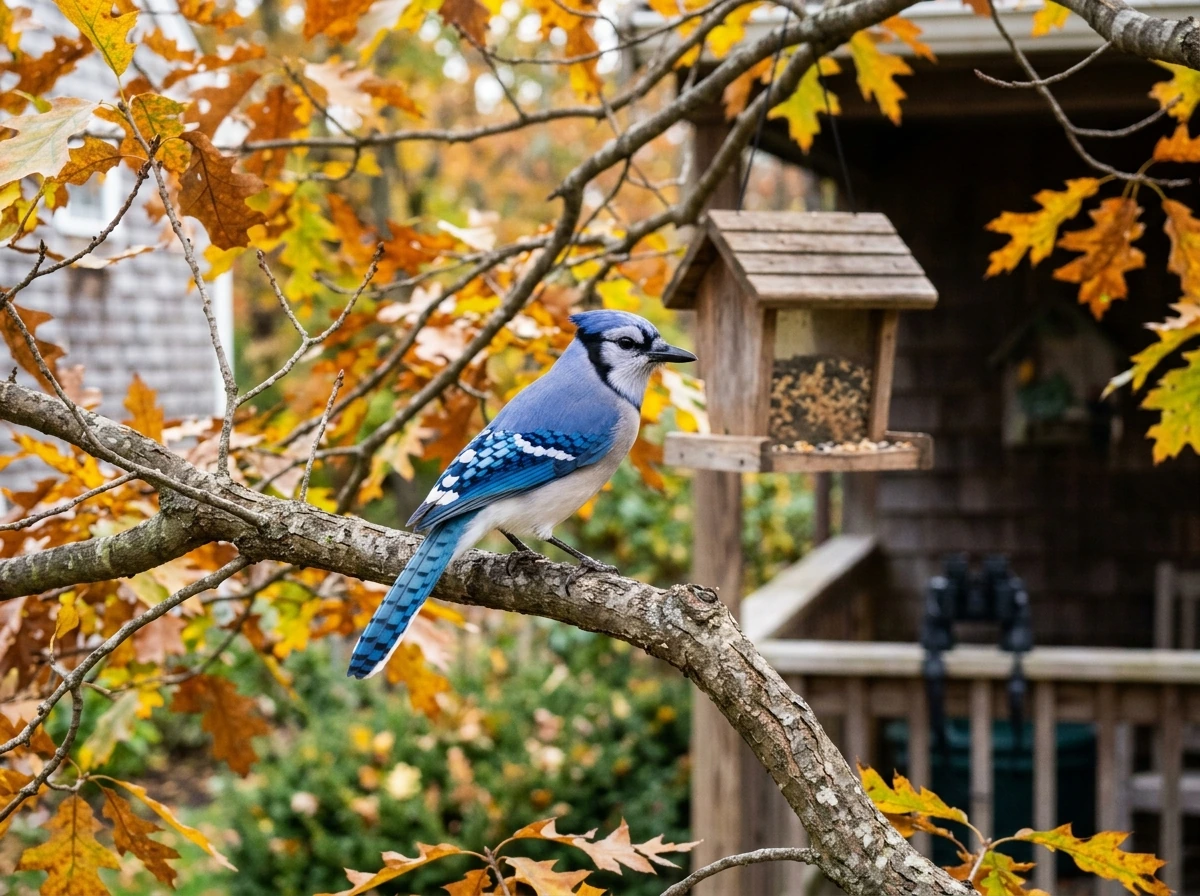
- Bright blue upperparts (back, wings, and tail) with white underparts and a pale gray belly
- A prominent, upright crest on the head that raises and lowers depending on mood
- A bold black necklace-like band that runs around the throat and across the chest
- White wing bars and white patches in the tail feathers, visible in flight
- A loud, harsh "jay-jay" call that carries a long distance
- Medium-sized, roughly 9 to 12 inches in length, larger than a robin
Cornell Lab of Ornithology describes the Blue Jay as 'blue above and white below' with a bold black necklace, while eBird adds that the crest appears particularly fluffy and full. The Audubon Field Guide’s identification notes for Blue Jays include field marks like the crest and the black “necklace” on the throat, along with white wing bars and tail corners. If you spot one at a feeder, you will likely notice its bold, sometimes aggressive behavior toward other birds. The Audubon Society calls it 'one of the loudest and most colorful birds of eastern backyards and woodlots,' which is a fair description. They are forest-edge birds that adapted extremely well to suburban life.
Why no state picked the Blue Jay
There is no single official explanation for why the Blue Jay has never been chosen, but a few patterns stand out when you look at how state bird designations work. Many state birds were selected in the early 20th century, often through campaigns organized by women's clubs, Audubon chapters, or school systems. Birds that won those early votes tended to be either regionally unique, deeply symbolic, or already beloved in folk culture. The Northern Cardinal, for example, ended up as the state bird of seven states partly because of how beloved it was in the mid-Atlantic and Midwest at the time of those votes.
The Blue Jay, despite being common and attractive, may have lost out partly because of its reputation. Mass Audubon describes Blue Jays as 'clever and aggressive,' and they are known for raiding other birds' nests. Mass Audubon’s Aggressive Birds context places the Blue Jay among frequent assailants that target other birds near people Mass Audubon describes Blue Jays as 'clever and aggressive'. That behavioral profile does not always make for a popular political choice when a state is trying to pick a symbol that residents will feel proud of. The Blue Jay is appreciated, but it has a complicated reputation among birders and casual observers alike.
The history behind how state birds get designated
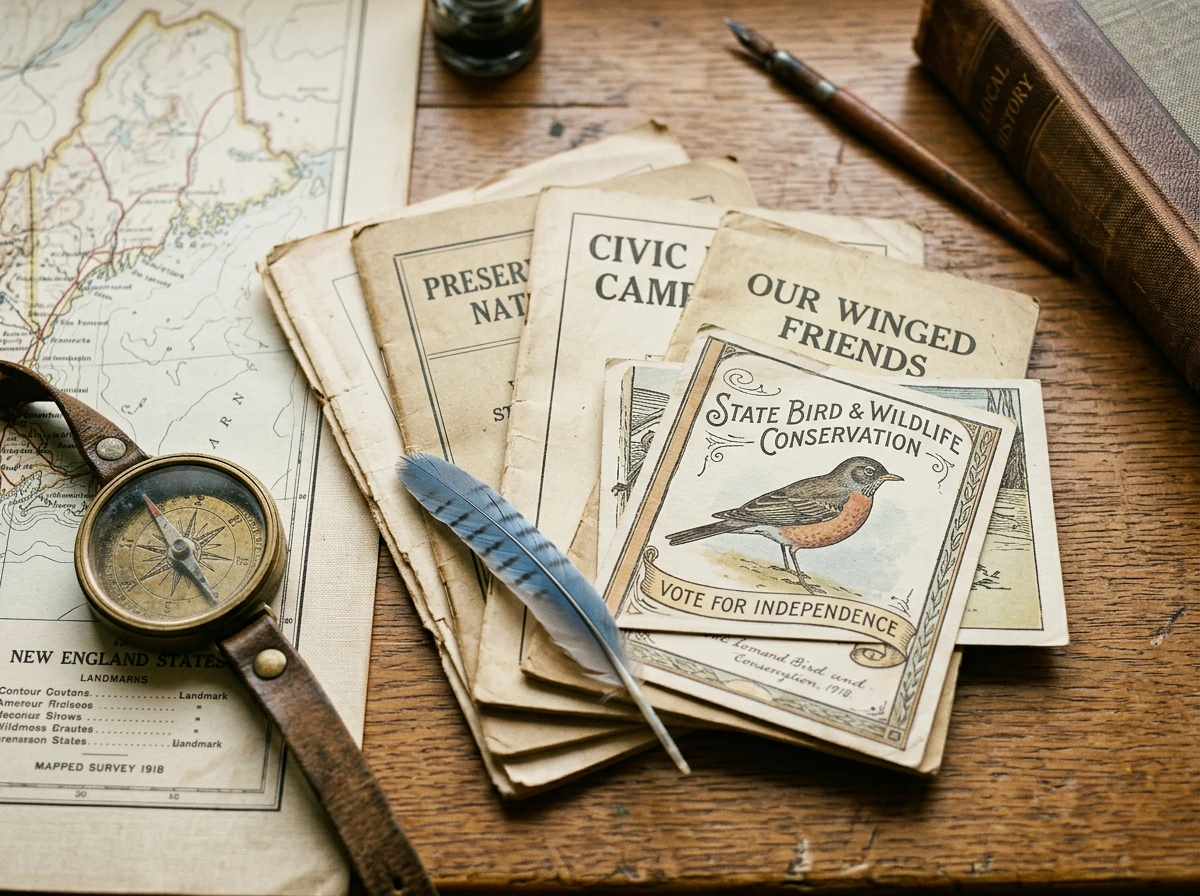
Most state bird designations happened between the 1920s and 1940s, with a wave of activity driven by national conservation movements and civic pride campaigns. Organizations like the Audubon Society encouraged states to recognize native species as official symbols. Some states held public votes, others relied on legislative decisions, and a few changed their picks over time as tastes or advocacy changed.
Vermont's debate is a useful window into how these decisions actually played out. Legislators genuinely argued over the Blue Jay and the crow before landing on the Hermit Thrush. That kind of deliberation was common. The process was not always tidy or scientific. It was a civic and cultural moment, shaped by who showed up and what arguments landed. The Blue Jay's moment just never came.
Because no state ever officially designated the Blue Jay, there is no state government page, resolution number, or adoption year to point to for a Blue Jay state bird. That is worth knowing if you are doing research: any source claiming a specific state has the Blue Jay as its official bird should be treated with skepticism and cross-checked against authoritative lists.
Which states have similar or comparable state birds
If you are interested in the Blue Jay partly because you are exploring state birds of the eastern United States, there are several nearby state bird pages worth looking at. New York's state bird, the Eastern Bluebird, shares the Blue Jay's striking blue coloring and is another bird that surprises people with how vibrant it looks in person. Pennsylvania's state bird, the Ruffed Grouse, is a completely different kind of bird, but Pennsylvania is Blue Jay territory and a great state for comparing regional bird life.
New Jersey's state bird, the Eastern Goldfinch (also known as the American Goldfinch), is another bright, feeder-familiar species that tends to attract the same kind of attention the Blue Jay does. Delaware's state bird, the Delaware Blue Hen, is not a wild species at all but a domestic chicken breed, which is a reminder of how varied these designations can be.
For a broader comparison, here is a quick look at how the Blue Jay stacks up against some actual state birds in the eastern U.S., just to give you a sense of where it fits in the picture:
| Bird | Official State Bird Of | Color Profile | Feeder Visitor? |
|---|---|---|---|
| Blue Jay | No U.S. state | Blue and white with black necklace | Yes, frequent |
| Northern Cardinal | 7 states (incl. Virginia, Ohio, Indiana) | Bright red (male) | Yes, very common |
| Eastern Bluebird | New York, Missouri | Blue back, rusty breast | Occasionally |
| American Goldfinch | New Jersey, Iowa, Washington | Bright yellow (male) | Yes, very common |
| Hermit Thrush | Vermont | Brown with spotted breast | Rarely |
Where to go from here
Since the Blue Jay is not a state bird, the most useful next step depends on what you are really after. If you want to explore the official state birds of northeastern states where Blue Jays are common, check out the dedicated pages for New York's state bird, Pennsylvania's state bird, New Jersey's state bird, and Delaware's state bird, or see what is the state bird of new mexico. Each of those pages covers the full picture: what the bird looks like, why that state chose it, and the historical background behind the designation.
If you are specifically trying to verify a state bird claim you read somewhere, the most reliable approach is to cross-reference a complete list of all 50 official state bird designations. Authoritative sources like Britannica maintain consolidated lists that you can scan quickly. Any claim about the Blue Jay being a state bird will not hold up against that kind of check.
And if you are a birder who just loves the Blue Jay and wants more natural history on the species itself, Cornell Lab's All About Birds and eBird both have thorough species pages covering range maps, behavior, and identification details. The Blue Jay may not have a state to call its own, but it has plenty of fans, and it more than earns its reputation as one of the most striking birds you will find at a winter feeder anywhere in the eastern half of the country.
FAQ
So, is the Blue Jay official in any U.S. state at all, even if it is shared with another bird?
None. There is no U.S. state that has adopted the Blue Jay as its official state bird, including shared or joint designations.
How can I tell whether a website saying “Blue Jay is our state bird” is reliable or just a nickname?
If you saw a claim online, check whether it is describing “state bird” as a general nickname or school mascot rather than the legal state symbol. True state birds are established by legislation or an official state adoption, and the lack of a public adoption year or resolution is a major red flag.
Why do some sources say the Blue Jay is a state bird when it is not official?
Yes, but it varies by source and is usually not official. Some organizations and history blogs may list commonly discussed “candidate” birds, or they may mix up state birds with regional birds, state trees, or state mammals.
Could any state list the Blue Jay under another name, like “jay” or a scientific-name variation?
No state currently uses the Blue Jay under a different official name. If a state had adopted it, you would generally see it listed under the standard English name and scientific name (Cyanocitta cristata) or a clearly defined equivalent.
What is the fastest way to verify a state bird claim for any bird, including the Blue Jay?
Use authoritative consolidated lists of the 50 official state birds, then confirm with the state government bill or resolution if you need primary documentation. If a Blue Jay entry does not appear in the consolidated list, it is extremely unlikely the designation is real.
Can a bird be very common in a state and still not be the official state bird?
The Blue Jay can still be your state’s “most seen” bird and appear in local birding culture without being the state’s official symbol. It is common at feeders and in suburban areas, which may drive the confusion.
Did any state ever seriously consider the Blue Jay before choosing a different state bird?
Vermont is a key example people reference because it demonstrates deliberation. The Blue Jay was seriously considered during the decision process, but Vermont ultimately adopted the Hermit Thrush.
What is the closest official state bird option to the Blue Jay’s striking blue color in the region?
If you want a similar-looking, related bird with an official state designation nearby, the Eastern Bluebird is the state bird of New York. It shares that striking blue look, even though it is a different species than the Blue Jay.
Next Article
Which Is Karnataka State Bird? Identification and Facts
Discover Karnataka’s official state bird, key ID traits, where to spot it, and why it was chosen.