New Hampshire is the state whose official bird is the Purple Finch. The designation was made in 1957 through New Hampshire Revised Statutes § 3:10, which reads simply: "The purple finch is hereby designated as the official state bird of New Hampshire."
What State Bird Is the Purple Finch? Answer, ID, and Habitat

Marcus Webb
4 Jun 2026
Why New Hampshire chose the Purple Finch
The 1957 selection wasn't a random pick by legislators. It came with organized civic backing from three groups: the Audubon Society of New Hampshire, the New Hampshire Federation of Garden Clubs, and the State Federation of Women's Clubs. That kind of coalition push was actually the standard playbook for state bird designations in mid-20th century America. Local nature and civic organizations would build public support for a species they felt reflected the state's character, then present the case to the legislature. The Purple Finch fit New Hampshire well: it's a forest-dwelling bird native to the northeastern woodlands that define much of the state's landscape, not an imported or artificially promoted symbol.
This pattern of club-driven bird designation shows up across the country. If you're curious about another example, you can also look up what the state bird is for West Virginia state bird designations. Iowa's Eastern Goldfinch designation in 1933, for example, was pushed through by a committee presenting a formal petition to the Iowa Legislature. The New Hampshire process was similar in spirit, just a few decades later.
What a Purple Finch actually looks like
Knowing the state is one thing; being able to spot the bird is the practical next step. The Purple Finch is a small finch, roughly the same size as a House Finch or House Sparrow, with a conical seed-eating bill that has a straight culmen (the ridge running along the top). Males and females look completely different from each other, which trips up a lot of observers.
Male Purple Finch
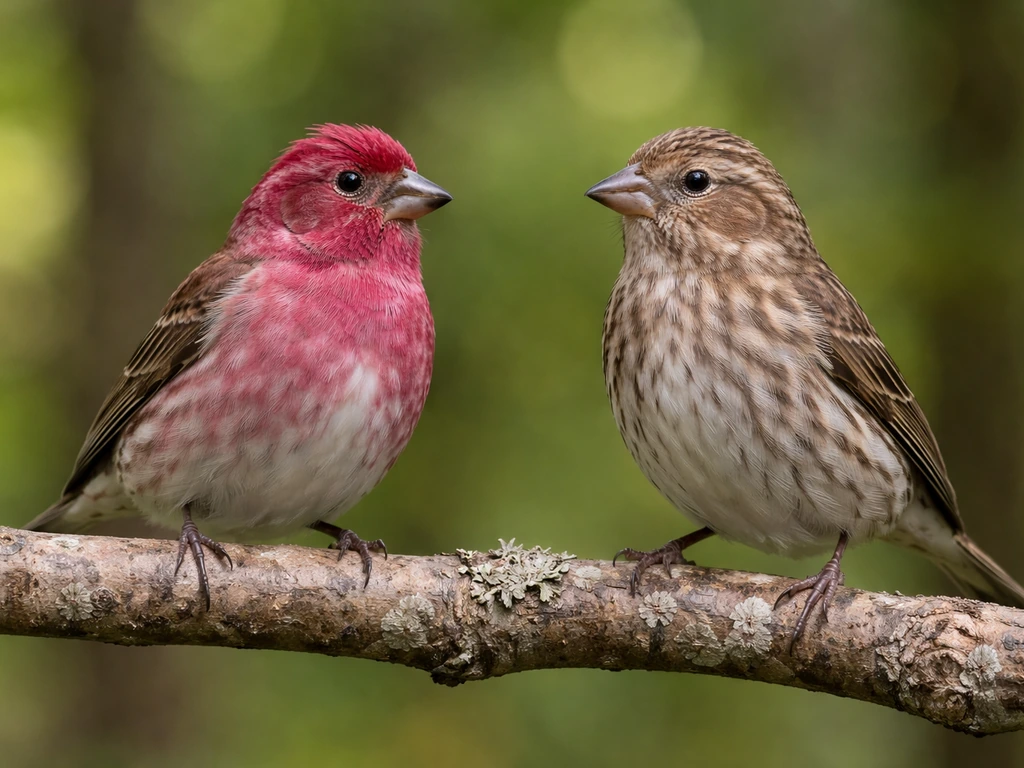
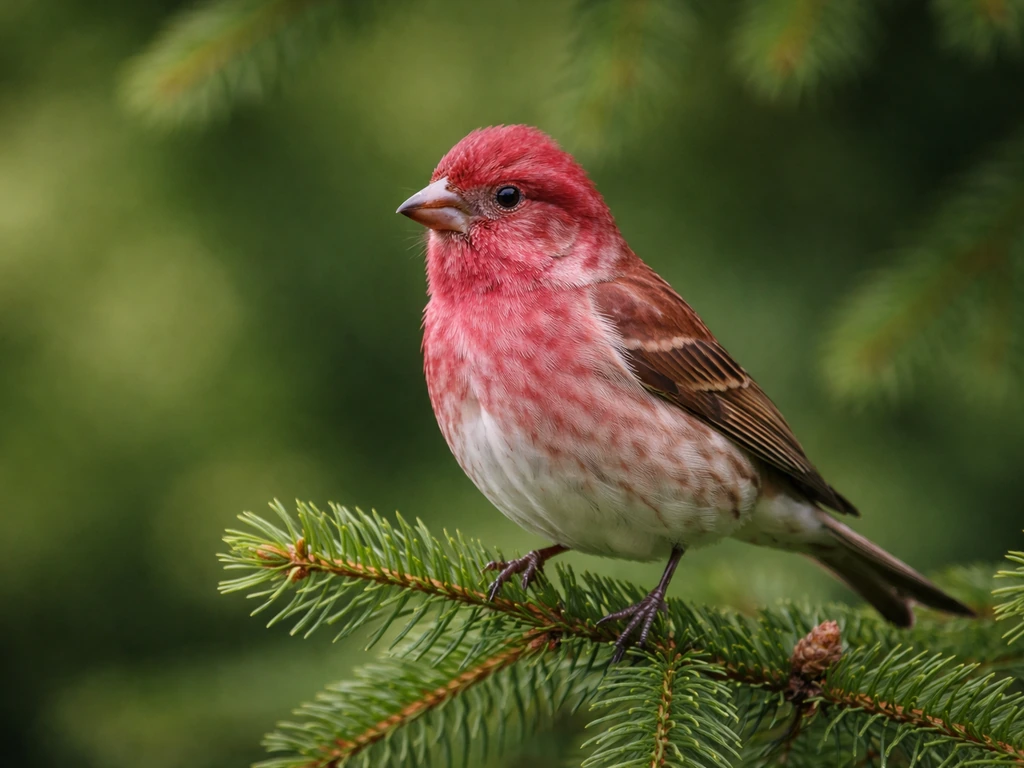
Adult males are washed in a rose-red or raspberry color that's brightest on the head and rump, with brownish tones on the back and a cloudy white belly. Pennsylvania Game Commission describes the color as "maroon-red" or raspberry, which is a useful mental anchor. The red isn't a neat, contained patch like paint; it bleeds across the head, chest, and upper back in a way that looks almost soaked in.
Female and immature Purple Finch
Females and immature males have no red at all. They're brown above with crisp, heavy dark-brown streaking on the breast and flanks, and they're whiter below. Mass.gov describes them as having "sparrow-like plumage," which is accurate and useful: if you see a streaky brown finch and wonder if it could be a female Purple Finch, think of a sharply marked sparrow silhouette with a thick finch bill.
Habitat
Purple Finches are forest birds at heart. They breed in coniferous and mixed forests, particularly in Canada and the northeastern U.S. During migration and winter, they spread out into a wider range of wooded and semi-open habitats including suburbs, swamps, and overgrown fields. They readily come to feeders, especially in winter, which is often when most people get their best looks at them. In winter, Pennsylvania’s Game Commission adds that purple finches may join foraging flocks with American goldfinches and pine siskins, and that in the east they are often found near human dwellings and readily visit feeding stations blank" rel="noopener noreferrer">They readily come to feeders, especially in winter, which is often when most people get their best looks at them..
Don't mistake it for these look-alikes
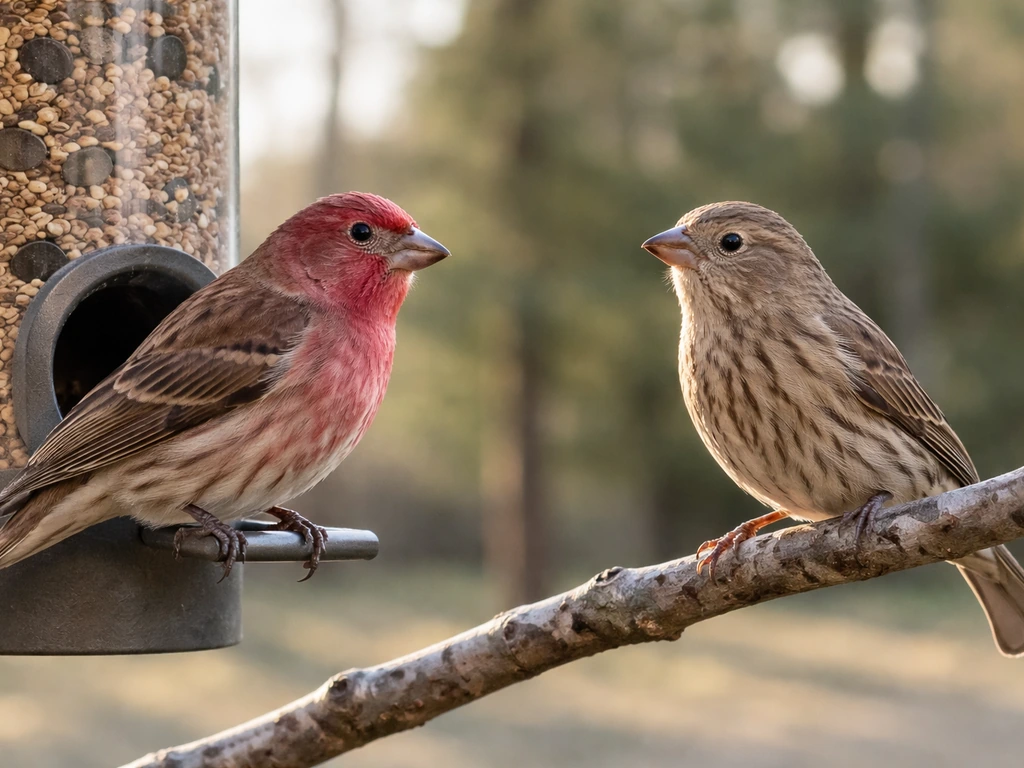
The Purple Finch is genuinely easy to confuse with two other species, and knowing the differences will save you a lot of uncertainty at the feeder.
| Species | Male Color | Bill Shape | Typical Habitat | Key Difference |
|---|---|---|---|---|
| Purple Finch | Raspberry/rose-red soaked across head and rump | Large conical, straight culmen | Forests, wooded areas, feeders in winter | Deeper red coverage on back; notched tail; female has bold white eyebrow |
| House Finch | Brighter red concentrated on forehead, breast, and rump; brown streaking on flanks | Smaller conical bill, curved culmen | Urban, suburban, open areas | More limited red; streaky flanks on male; female lacks strong eyebrow stripe |
| Cassin's Finch | Pinkish-red with bright red cap | Longer, more pointed bill | Mountain forests of the West | Less red on back than Purple Finch; mainly western range |
The House Finch is the most common confusion species because it overlaps heavily with Purple Finch at winter feeders and is far more common in towns and suburbs. According to Mass. gov, the Purple Finch is "often mistaken for the house finch," which makes sense given how similar they look at a quick glance.
The key is to check the flanks on males (House Finch has heavy brown streaking there; Purple Finch does not) and to look for the female's bold white eyebrow stripe, which is much more pronounced on Purple Finch than on House Finch. Cassin's Finch is mainly a western bird, so if you're in New Hampshire or anywhere in the East, you can largely rule it out.
The American Goldfinch is actually the Washington state bird, and knowing why it was chosen can help you spot it with context as well why is the american goldfinch washington state bird.
How New Hampshire's choice compares to other state bird decisions
New Hampshire is the only U. When you compare other state bird decisions like why is the oriole the state bird of maryland, you see similar mix of local identity and legislative approval behind the scenes. S. state with the Purple Finch as its official bird.
Maryland's state bird is the Baltimore Oriole, designated as the official state bird in 1947 what is maryland's state bird. But the finch family is well represented in state-bird selections more broadly. New Jersey and Washington State both chose the American Goldfinch, and Iowa designated the Eastern Goldfinch (the same bird) back in 1933. New Jersey adopted the American Goldfinch as its state bird for similar reasons tied to local advocacy and recognition of the species.
Some states, like West Virginia, also have an official state bird, which you can look up by state bird listings West Virginia's official state bird. If you are curious about another state bird decision, Washington State’s official bird is different from New Hampshire’s Purple Finch. Those designations share the same civic-petition origin story as New Hampshire's Purple Finch selection.
Neighboring states have gone different directions. Virginia's state bird is the Northern Cardinal, Maryland went with the Baltimore Oriole (which has its own set of reasons tied closely to the state's history and colors), and Massachusetts selected the Black-capped Chickadee. Vermont, another New England neighbor, chose the Hermit Thrush. None of them picked a finch, which makes New Hampshire's Purple Finch choice stand out a bit in the region.
Where and when to find Purple Finches
If you want to actually see one after reading this, timing and location matter. Here's a practical breakdown by season:
- Summer (breeding season): Look in coniferous and mixed forests across Canada and the northern U.S., including New Hampshire, Vermont, and Maine. They're up in the canopy a lot, so listen for their rich, warbling song.
- Fall and winter: This is your best window in most of the U.S. Purple Finches migrate south from Canadian breeding grounds and winter across a wide swath of the central and southeastern U.S. They're irruptive, meaning numbers vary significantly year to year, and some years they're abundant at feeders while other years they're scarce.
- At feeders: They readily visit feeding stations in winter. Pennsylvania Game Commission notes they often join mixed foraging flocks with American Goldfinches and Pine Siskins, so if you see those species, scan the group for the raspberry-red of a male Purple Finch or the bold-browed female.
- Pacific Coast: Some populations along the West Coast don't migrate at all and can be found year-round in wooded areas there.
- New England year-round: Some northeastern birds are year-round residents, so if you're in New Hampshire itself, you have a reasonable shot at seeing the state bird across multiple seasons.
For targeted trip planning, eBird's Status and Trends range maps are the most reliable tool available right now. They show estimated occurrence by season so you can pick a location where the species is actually likely to be present during your visit, rather than just guessing based on general range maps.
FAQ
Are there any other states that also have the Purple Finch as an official state bird?
No. The Purple Finch is the official state bird of New Hampshire, and other states that selected finches chose different species, such as the American Goldfinch or Eastern Goldfinch.
What is the best time of year to see Purple Finches in New Hampshire?
Winter is often the easiest season because more birds visit feeders in colder months, especially during periods of heavy snowfall or when natural seed sources are limited.
Do Purple Finches migrate through New Hampshire, or are they mostly year-round residents?
They can be present year-round in parts of their range, but sightings typically increase during winter and migration when birds spread into a wider set of wooded and semi-open areas.
What type of bird feeder or food works best if I want to attract Purple Finches?
Seed-rich setups tend to perform best, particularly offerings like sunflower seeds. If you already get finches, keep the feeder stocked consistently in winter, since the best activity often comes during cold spells.
How can I avoid confusing a female Purple Finch with a female House Finch at my feeder?
Focus on the patterning and facial features. Female Purple Finches typically show a clearer, sparrow-like streaking effect and a more noticeable white eyebrow stripe than House Finches, which can look plainer by comparison.
How do male Purple Finches differ from male House Finches besides the red color?
The red look is the first clue, but the distribution matters too. Purple Finch red tends to look more blended and “soaked” across the head and upper body rather than as a tighter, more uniform patch, and males can show less obvious flank streaking than House Finch.
Can Purple Finches be reliably identified by color alone if lighting is poor?
Not always. Shade, distance, and camera flash can wash out or intensify reds. If possible, confirm with structural cues like the thick finch bill and the overall streaking pattern on females and immature birds.
If I don’t have a feeder, where should I look in winter to increase my chances?
Try edges of wooded areas where birds can forage with cover nearby. Suburbs, swamps, and overgrown fields can hold them in winter even if you are not in deep forest.
Why might my local sightings be lower even though Purple Finches are “in range”?
“In range” does not guarantee birds will be in your exact spot that day. Weather, temporary food availability, and where other feeding flocks are spending time can all change feeder and yard activity, especially during short warm or cold swings.
What’s the quickest ID checklist I can use during a single visit to a feeder?
Check sex first (males are red, females and immature birds are brown and streaked). Then compare the female’s eyebrow stripe and the male’s flank pattern, and confirm you are not seeing House Finch characteristics like stronger flank streaking on males.
Do Purple Finches ever show up in parks or town neighborhoods, or are they only in remote forests?
They are forest breeders, but they do come into towns during winter and migration, especially where there are trees and seed sources, so you can sometimes see them in parks and residential edges.