The Baltimore Oriole (Icterus galbula) is Maryland's official state bird, blank" rel="noopener noreferrer">designated by the General Assembly in 1947 under Chapter 54, Acts of 1947. It was chosen largely because of its striking black-and-orange plumage, which mirrors the heraldic colors on the Calvert family coat of arms, the same colonial imagery at the heart of Maryland's identity. The name 'Baltimore Oriole' itself comes from those colors, which early observers connected to the livery of Cecil Calvert, the second Lord Baltimore, who founded the Maryland colony in the 17th century.
Why Is the Baltimore Oriole the Maryland State Bird?

Marcus Webb
24 May 2026
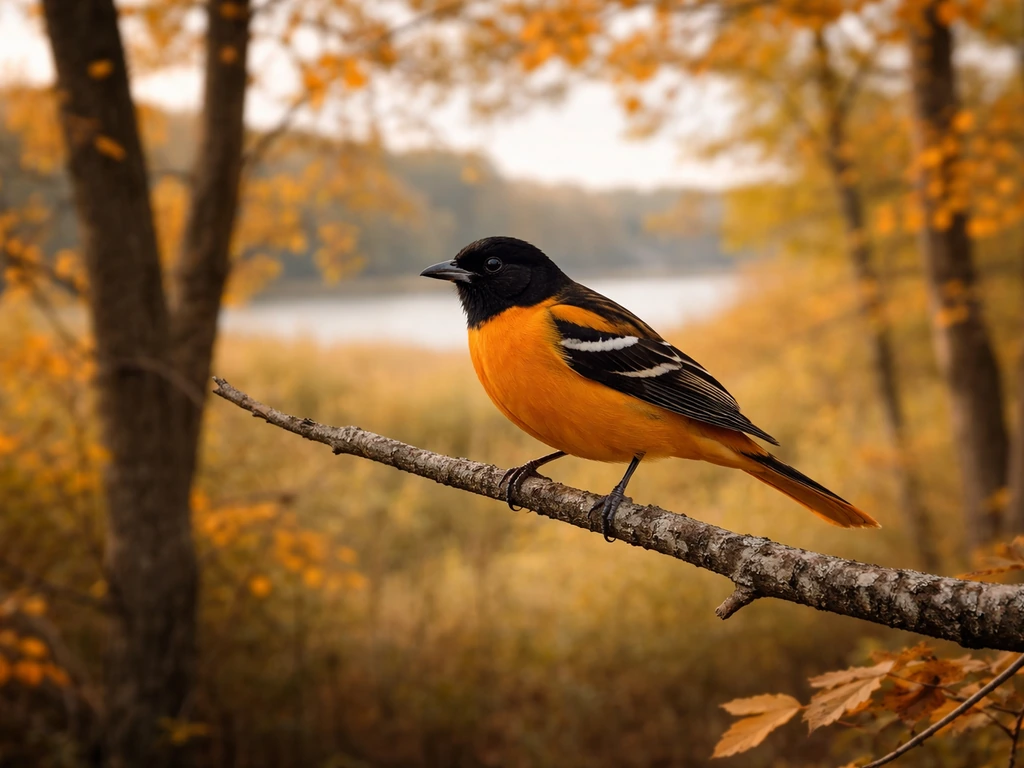
Maryland's Official State Bird: Confirmed
Maryland's state bird is unambiguously the Baltimore Oriole, Icterus galbula. This is the specific species, not orioles in general, and not the Orchard Oriole or any other member of the family. The Maryland Manual Online, published by the Maryland State Archives, lists it plainly: 'The Baltimore Oriole is Maryland's State Bird.' The statutory record ties it to Chapter 54, Acts of 1947, so the designation has been locked in for nearly 80 years.
The legislative act's opening 'WHEREAS' clause frames the choice clearly, describing the Baltimore Oriole as 'a bird of great beauty,' which tells you the General Assembly wasn't approaching this as a purely scientific or ecological decision. Beauty and symbolism were front and center from the start.
Why the Baltimore Oriole Was Chosen: The Real Story
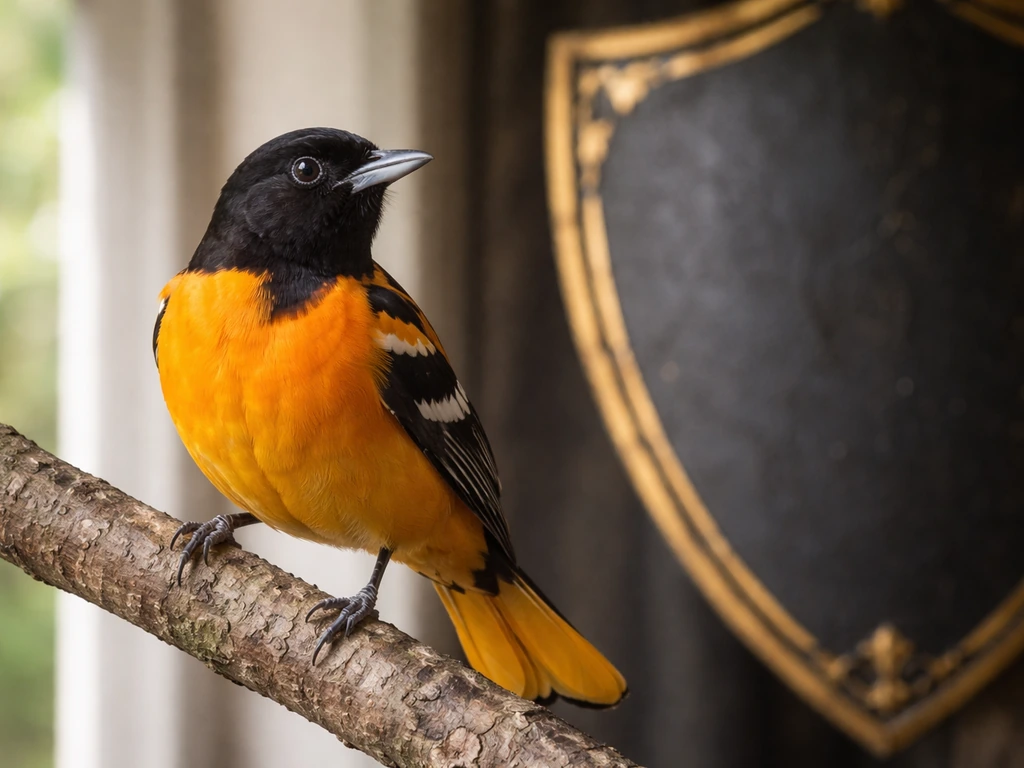
The deepest reason is heraldic. Cecil Calvert, the second Lord Baltimore, used black and gold (orange) as the colors of his coat of arms, and those exact colors appear on the male Baltimore Oriole's plumage. Early European settlers in Maryland noticed the bird's colors matched the Calvert shield and started calling them 'Baltimore birds,' a name that eventually formalized into Baltimore Oriole. By the time the General Assembly voted in 1947, the connection between bird and state identity was already centuries old.
The Maryland Manual makes this explicit, noting that the Baltimore Oriole's coloration is 'not unlike colors in the Calvert shield.' Audubon reinforces it, describing the species as 'flaming orange and black' and linking those colors directly to the coat of arms of the 17th-century Lord Baltimore. Few state birds have a name-origin story this tightly woven into the state's founding history, which makes the selection feel earned rather than arbitrary.
Beyond heraldry, the 1947 selection reflected broad recognition: the bird was already well known to Maryland residents, commonly seen in backyards and parks during summer, and closely associated with Baltimore in both name and visual identity. The MLB's Baltimore Orioles baseball team, which adopted the bird as its mascot, only deepened that public familiarity over the decades following the official designation.
Scientific and Cultural Significance in Maryland
Scientifically, the Baltimore Oriole is a Neotropical migrant. It breeds across North America during the warmer months and winters in Central and South America. For Maryland specifically, that means the bird arrives in late spring and remains through summer, with eBird data showing peak abundance from roughly late May through late July. This breeding-season presence puts the oriole squarely in view when Marylanders are spending time outdoors, making it one of the more frequently noticed songbirds in the state despite not being a year-round resident.
Culturally, the bird's reach into Maryland life goes well beyond birding. The MLB franchise named after it has made the oriole's orange-and-black color scheme part of daily Baltimore life for generations. The Washington Post noted that even after the Ravens won the Super Bowl, a serious push to replace the oriole as state bird went nowhere, underscoring just how embedded the bird is in Maryland's civic identity. Maryland DNR notes the oriole rarely winters in the state but can be attracted to backyard feeders during summer, which means casual residents encounter it regularly without needing to venture into the field.
What Makes It a Good State Symbol
A state bird needs to be recognizable, visually distinctive, and meaningfully tied to the place it represents. The Baltimore Oriole clears all three bars easily.
- Unmistakable coloring: The male's flaming orange-and-black plumage is one of the most striking color combinations in North American birds. Audubon calls it 'one of the most brilliantly colored songbirds in the east,' and most people agree once they've seen one.
- Name tied directly to the state's founding: Very few birds are named after the city and colonial family that define the state's history. The 'Baltimore' in Baltimore Oriole isn't a coincidence, it's a centuries-old legacy.
- Seasonal presence during peak outdoor activity: Because orioles breed in Maryland during late spring and summer, residents see them when it matters most, during the months people are in their gardens and parks.
- Heraldic color match: The male's black and orange plumage reflects the Calvert family colors exactly, giving the bird a symbolic weight that most state bird choices simply don't have.
- Strong public familiarity: Between backyard feeders, the MLB team, and the bird's distinctive song, most Marylanders already know what an oriole looks like before they ever go looking for one.
How to Spot a Baltimore Oriole in the Wild
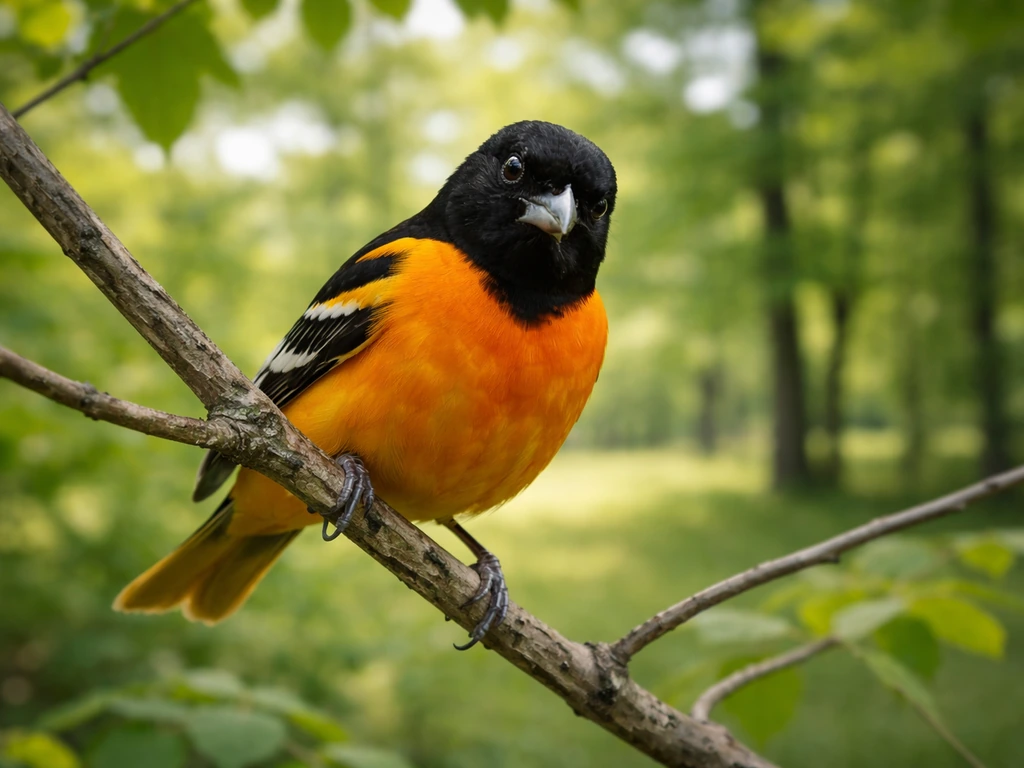
If you're in Maryland between late May and late July, you have the best shot at seeing one. Baltimore Orioles favor open woodland edges, tall shade trees near homes, and parks with mature canopy. Here's what to look and listen for.
Start with the song
You'll usually hear a Baltimore Oriole before you see it. The male sings a loud, flutelike whistle from high in the treetops, a rich, melodic call that carries well across neighborhoods and parks. Cornell Lab describes it as a 'rich, whistling song' that echoes from treetops near homes. Once you know it, it's hard to miss on a May morning in Maryland.
Key visual field marks
- Size and shape: Smaller and more slender than an American Robin, with a long tail and a pointed, slightly curved bill.
- Male plumage: Deep orange on the breast, belly, and shoulder patch, with a solid black head, back, and wings. White wing bars visible in flight.
- Female plumage: Much more variable, ranging from yellowish to brownish-orange on the head and back with two white wing bars. Don't expect the female to look like a dimmed version of the male; she can look noticeably different.
- Nest: Orioles build distinctive hanging, basket-like nests woven from plant fibers, often suspended from the tip of a high branch over open ground. Spotting a nest is a reliable sign of a breeding pair nearby.
Attract them to your yard
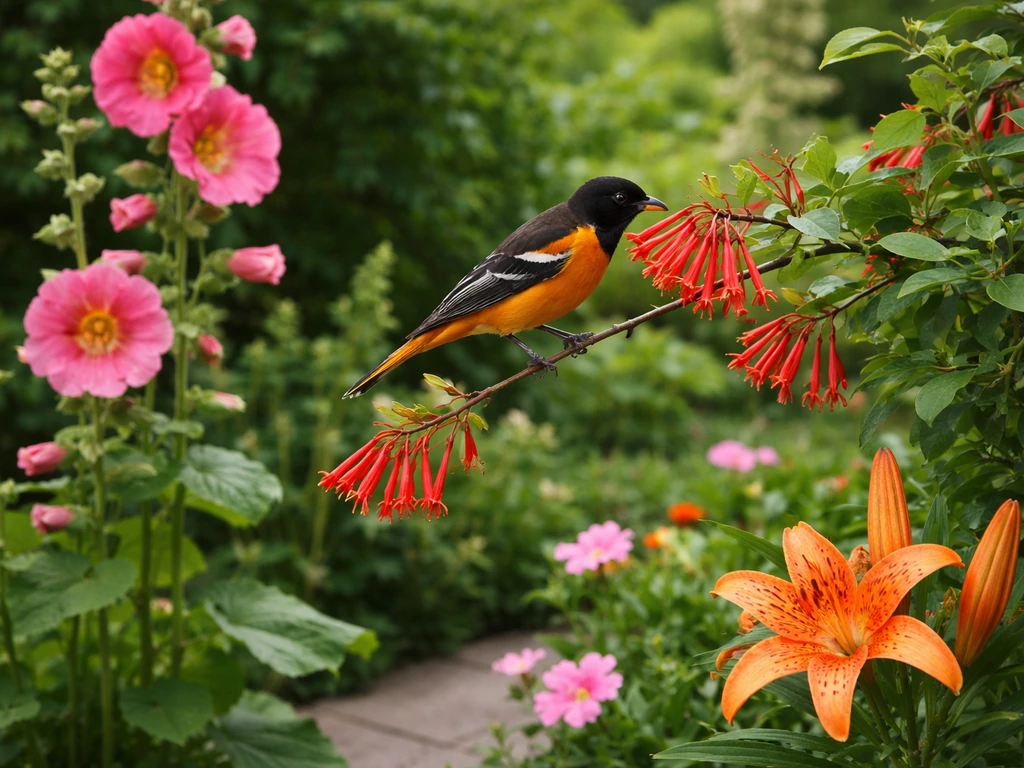
Maryland DNR notes that Baltimore Orioles are drawn to nectar-producing flowers like scarlet trumpet honeysuckle, hollyhock, rose of Sharon, wood lily, and tiger lily. They'll also visit feeders stocked with orange halves, grape jelly, or nectar. If you want to reliably see one without heading out to a park, planting native flowering species and putting out a simple feeder in late April before they arrive is the most practical approach.
Does Any Other State Share the Baltimore Oriole?
No. Maryland is the only state with the Baltimore Oriole as its official state bird. Unlike some species that get claimed by multiple states, Icterus galbula belongs exclusively to Maryland in the state-symbol world. That exclusivity actually reinforces how fitting the choice is: the bird's very name is tied to a single place.
For comparison, species like the American Goldfinch are claimed by multiple states. The American Goldfinch is the kind of bird that has also been adopted as a state symbol in other places, which is why it comes up in questions like why it is or isn't tied to Washington state. You might also hear people ask similar questions about other state birds, like the Purple Finch American Goldfinch. New Jersey and Washington both designate the American Goldfinch as their state bird, which creates a shared-symbol dynamic that Maryland simply doesn't have to deal with. If you're curious about the bird that Washington selected, what is Washington's state bird? The Baltimore Oriole is Maryland's and Maryland's alone.
If you're exploring neighboring states in this region, Virginia and West Virginia each have their own distinct state bird designations, as does Vermont. If you're wondering what Vermont chose, its official state bird is different from Maryland's Baltimore Oriole. West Virginia, for example, has a different official state bird than Maryland, so its designation is worth checking separately official state bird for west virginia. If you’re wondering what the Virginia state bird is, that designation is different from Maryland’s Baltimore Oriole what is the virginia state bird. Each has its own rationale rooted in local ecology and history, similar in spirit to Maryland's choice even if the birds themselves differ. The broader pattern across eastern states shows a preference for colorful, familiar songbirds that residents genuinely encounter, and the Baltimore Oriole fits that profile as well as any bird on the list.
The Bottom Line
Maryland chose the Baltimore Oriole in 1947 because it was, and still is, the perfect convergence of beauty, history, and everyday visibility. Its colors literally echo the founding family's heraldic identity, its name is inseparable from the city of Baltimore, and it shows up reliably in Maryland backyards and parks every summer. No other bird could claim all three of those things simultaneously. If you want to see Maryland's state bird for yourself, put up an orange-half feeder in late April, listen for a flutelike whistle at the treetops come May, and look for a flash of deep orange against the canopy.
FAQ
Is Maryland’s state bird the Baltimore Oriole, or do some people confuse it with other orioles?
Maryland’s official state bird is specifically the Baltimore Oriole (Icterus galbula). Other orioles, like the Orchard Oriole, are different species and do not count for the state-symbol designation. If you are trying to confirm your sighting, match both the bird’s look (black and orange, males) and the season, since the state symbol is most obvious in Maryland during summer.
When is the best time of year to see the Baltimore Oriole in Maryland?
The most reliable window is late spring through summer, especially roughly late May through late July. Because it is a migrant, you are much less likely to see it in colder months, so planning around that breeding-season presence is the difference between a casual sighting and a blank trip.
What should I do if I put out a feeder but never see an oriole?
Check two common issues, feeder timing and feeder type. Orioles arrive in late April to late May, so hanging the right foods shortly before they show up helps. Also, offer orange halves, grape jelly, or nectar, and place the feeder where it is visible from nearby cover, because orioles often forage along edges and mature canopy rather than open, exposed lawns.
Do female Baltimore Orioles look the same as the males I see in photos?
Not exactly. Males are the most striking, with deep black and bright orange. Females are usually more muted, with less saturated orange, so you might incorrectly assume you saw a different species. If the bird still has the oriole body shape and characteristic behavior, take extra time to confirm before ruling it out.
Are Baltimore Orioles year-round residents of Maryland?
No. They are typically migrants, with most wintering farther south. Maryland winters are usually outside their normal presence, so if you see one in winter you should double-check the identification and consider whether it could be a rare lingering individual or another orange-and-black bird.
Why do people sometimes say the oriole is ‘the bird of Baltimore’ but that’s different from ‘state bird’?
Baltimore Oriole is a name connected to the city, but the state bird designation is statewide and set by Maryland’s General Assembly. The city connection, plus the Orioles baseball team mascot, increases public familiarity, but it does not change the legal fact that Maryland’s official symbol is the Baltimore Oriole across the entire state.
What’s the easiest way to confirm a Baltimore Oriole by sound if I can’t see it well?
Listen for a loud, flutelike whistle from treetops. Orioles often sing from higher branches, so you can get the ID from the call first, then scan for the orange flash afterward. If you are in a park or neighborhood edge habitat, spend a few minutes looking upward when you hear that whistling song.
Is Maryland the only place that uses the Baltimore Oriole as a state symbol?
Yes for the specific designation. Maryland is the only U.S. state that officially names the Baltimore Oriole as its state bird, so it is a unique symbol in the state-symbol world. By contrast, some other birds appear as state birds in multiple states, which is not the case here.
Next Article
What Is the State Bird for Vermont? Answer and Details
Vermont state bird is the Hermit Thrush, plus quick ID traits, habitat, and why it was chosen, alongside the state flowe